
Wildfire Smoke Is Killing 24,000 Americans a Year. And Climate Change Is Making It Worse
Published Feb. 5 2026, 7:32 a.m. ET

NASA’s Terra satellite acquired this natural-color image of smoke from California wildfires blowing westward over the cloud-topped Pacific Ocean on September 2, 2020.
Harmful dust blends seamlessly into the air we inhale. A gust of toxic air smacking you would be felt momentarily, but its impact can be dangerous or even deadly. In the U.S., chronic exposure to smoke-filled air has increased death rates to a startling high. According to a new study, published in the journal Science Advances, tens of thousands of annual deaths in the U.S. have been linked to air pollution from wildfire smoke. Researchers analyzed the statistics between 2006 and 2020 and found a stark increase in exposure to tiny wildfire particulates. On average, 24,100 people have died a year from chronic exposure across the lower 48 states. "Our message is: Wildfire smoke is very dangerous. It is an increasing threat to human health," Yaguang Wei, a study author and assistant professor in the department of environmental medicine at Icahn School of Medicine at Mount Sinai, said in a statement.
The study focused on deaths caused by exposure to fine particulate matter, or PM2.5, that emerges from wildfires. The tiny but deadly substances can attack a person's lungs and even the bloodstream. While coughing and itchy eyes are the short-term symptoms, the situation can worsen with chronic and prolonged exposure. Health can deteriorate from coughing to severe respiratory illnesses. In severe cases, it can even lead to cardiovascular and neurological diseases and premature death. "Wildfire smoke PM2.5 has emerged as significant environmental hazard in the U.S., and it's driven by increasing frequency and intensity of wildfires due to climate change," said Min Zhang, a postdoctoral student at the Icahn School and study author.
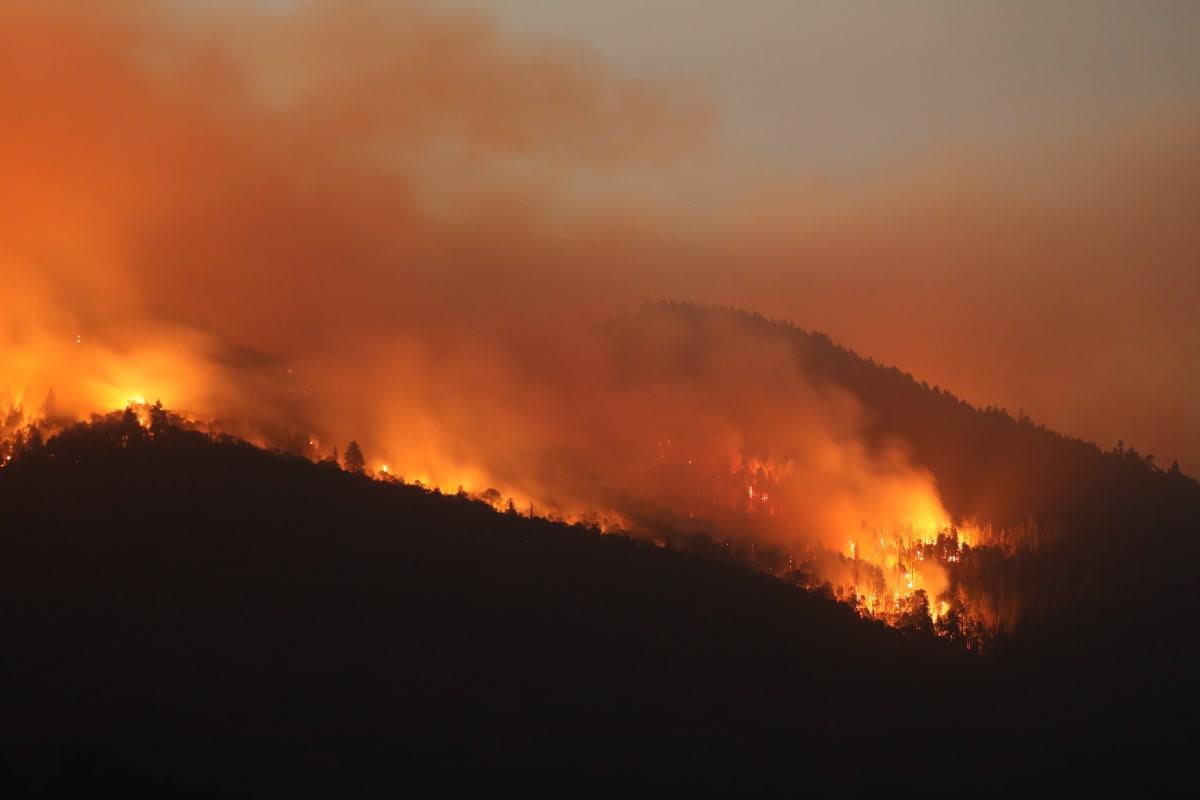
Burning trees from wildfires and smoke cover the landscape in California
The deadly impacts of PM2.5 exposure are concerning, especially when the country has become more prone to wildfires. Industrialization in fire-prone areas and growing mismanagement of forests have increased the possibility of wildfires. Michael Jerrett, professor of environmental health science at the University of California, who was not part of the study, said, "Nobody’s going to have ‘wildfire death’ on their death certificate unless the fire actually burned them or a tree fell on them or something like that." But its symptoms will show up gradually if the wildfire exposure continues for too long. "But many of the people that are dying from this exposure are ones that are already more vulnerable," Jerrett said. "These are real lives that are being lost. This is not some arbitrary abstract statistical concept," he added.
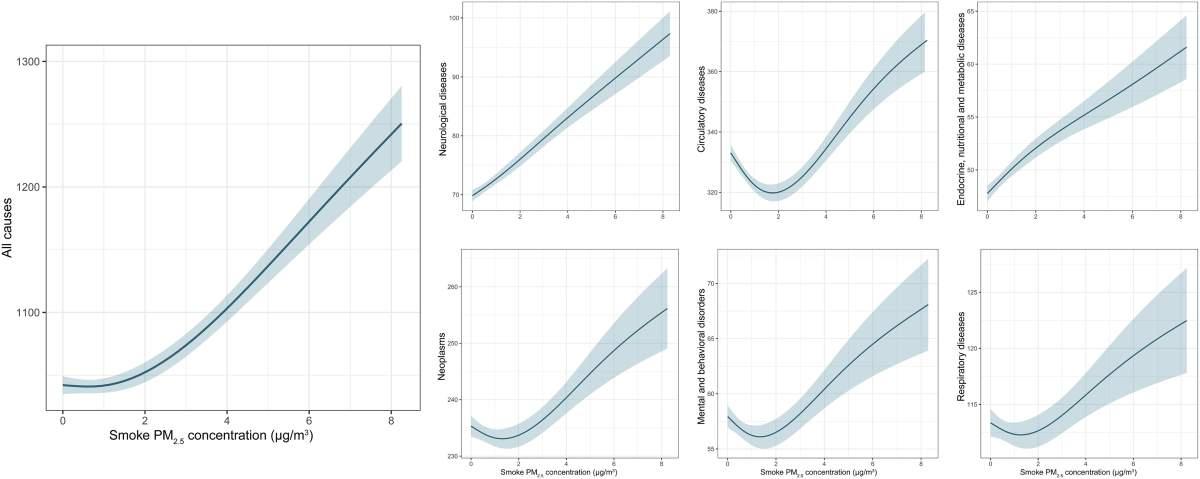
Exposure-response curves between annual wildfire smoke PM2.5 and mortality rate (per 100,000 persons).
To estimate the death rates caused by particulate pollution, the researchers combined two aspects: annual average exposure to PM2.5 from wildfire smoke and the number of deaths by county in the lower 48 states. For the mortality data across 3,068 counties, they didn't bifurcate and considered several causes of death, from circulatory and neurological to respiratory diseases. The data also included deaths caused by mental or behavioral disorders, tumors, endocrine, nutritional, and metabolic diseases, as well as accidental deaths. The latter can't be related to wildfire pollution, but the researchers included all causes to get bias-free and accurate data.
"We found no association for car accidents and falls, while for other diseases we found statistically significant effects," Wei revealed. The results highlighted what's often neglected: the link between death rates and PM2.5 pollution from wildfires. The research team found that with every 0.1 microgram per cubic meter increase of PM2.5 across the regions, around 5,594 more people died annually. "This highlights the importance of controlling wildfire-sourced PM2.5, which is currently not regulated by the EPA as it is usually regarded as natural disasters," Chen noted.