
This Pet Cow Just Used a Brush to Scratch Its Back — the First Known Tool Use in Cattle
Published Jan. 20 2026, 9:00 a.m. ET

Veronika, the cow, using a tool.
For a long time, cows were not believed to be intelligent enough to use tools. However, the very assumption is being questioned by a pet cow named Veronika from Austria. She is a Swiss Brown cow that is not raised for meat or milk. She has been kept as a companion animal by Witgar Wiegele, an organic farmer who deeply values and considers her part of his family. For the past 10 years, Veronica’s owner has watched her as she occasionally picks up sticks with her mouth and carefully moves them to scratch parts of her body she cannot reach on her own. Wiegele recorded a video of Veronika, and researchers from the University of Veterinary Medicine saw her in action.
“When I saw the footage, it was immediately clear that this was not accidental. This was a meaningful example of tool use in a species that is rarely considered from a cognitive perspective,” said Alice Auersperg, one of the researchers. The team called Veronika’s behavior the first documented example of tool use in a pet cow, according to a study published in Current Biology. “What this tells us is that cows have the potential to innovate tool use, and we have ignored this fact for thousands of years. There are around 1.5 billion heads of cattle in the world, and humans have lived with them for at least 10,000 years. It’s shocking that we’re only discovering this now,” the lead author of the study, Antonio J. Osuna-Mascaró, said.
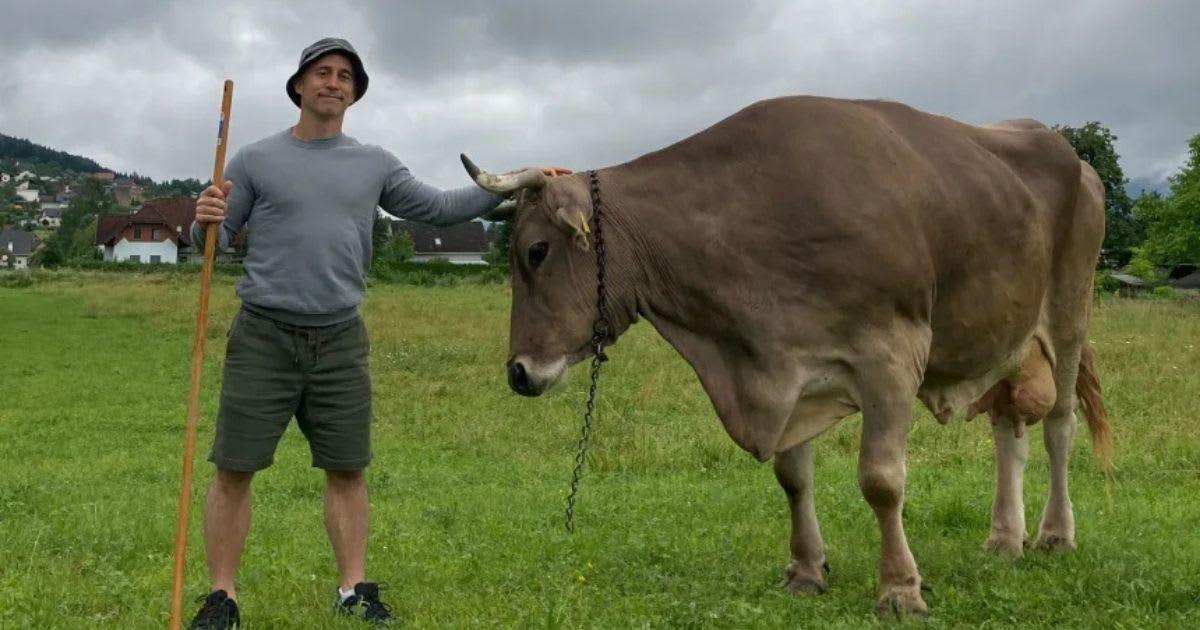
Antonio J. Osuna-Mascaró poses with Veronika
Researchers carried out a series of controlled tests to see how advanced Veronika’s tool use really was. The team placed a deck brush in front of her in various positions to see her response each time. They noted that every time Veronika used her long tongue to pick up the object. Especially, the end she chose to scratch a specific part of her body. Upon a close look, they noticed that she was not just using the brush to play with it. She was using it as a tool that served a clear purpose, something animals do to reach parts of their body due to physical limitations.
The scientists noticed that Veronika used the brush deliberately. She used the bristled end to scratch the tougher skin on her upper body, while she chose the smooth handle for more sensitive areas of her lower body. “This is extremely surprising because the only other solid example of multipurpose tool use that we know of belongs to the chimpanzees of the Congo Basin. These, sometimes, are observed using a single tool with two different ends, and use one end to open a hole in the termite mounds, and the other end to fish for the termites. The spatial relations in Veronika’s case are simpler. Nevertheless, it’s astonishing to find that a cow has the capability to do something like this,” said Osuna-Mascaró.
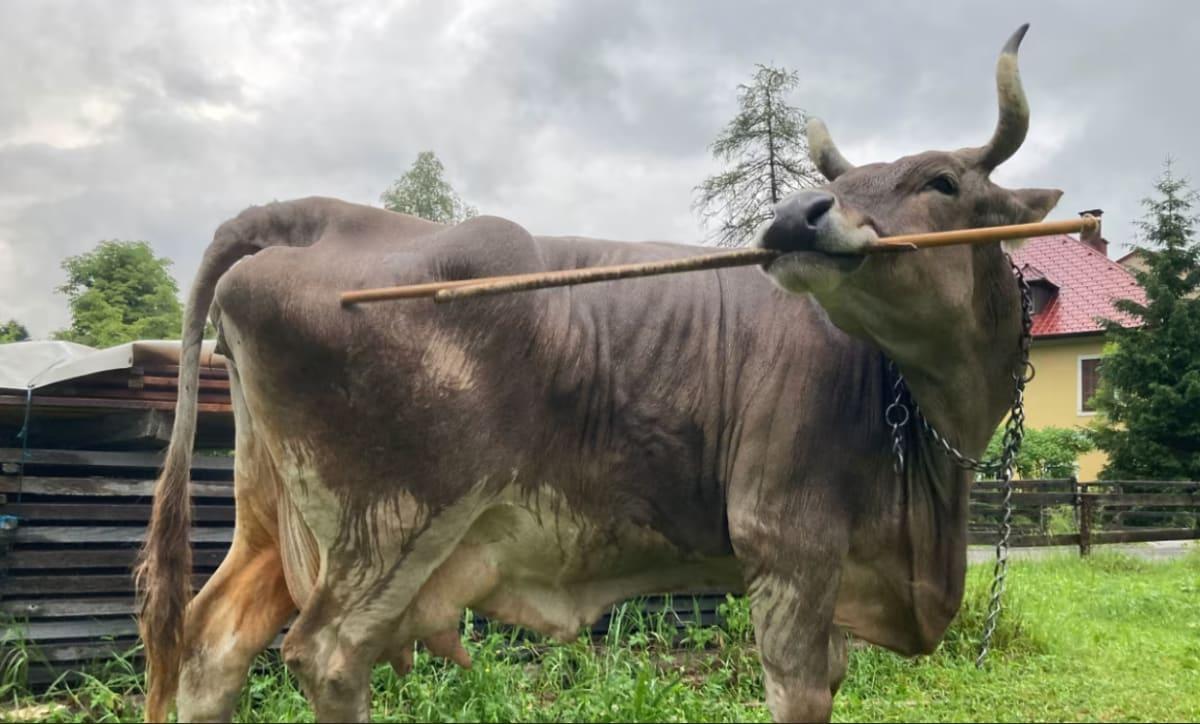
Veronika is using a tool
However, Veronika impressed the researchers even more because chimpanzees have the advantage of hands and opposable thumbs, and she was just using her mouth. Moreover, she was also adjusting her grip depending on which side of the brush she wanted to use, which part of her body she was scratching, and how much movement was needed to reach that spot. Marc Bekoff from the University of Colorado said, “Cows and other highly intelligent and emotional animals are far too often written off as being dumb and lacking emotions. Detailed research shows they are fully sentient beings with very active brains and rich and deep emotional lives.”