
NASA Scientists Discover Largest Protoplanetary Disk Ever Seen Around a Young Star
Published Dec. 24 2025, 7:36 a.m. ET

Dracula's Chivito, an extraordinary protoplanetary disk 1,000 light-years away from Earth
A star is born out of a giant cloud of gas and dust collapsing under its own gravity. As gravity pulls the gassy material inwards, some material is left swirling around the star. Over time, the momentum of the spinning material flattens it into the shape of a pizza-like disk, often called a protoplanetary disk. If all this makes it look like it’s just a giant cookie of gassy debris, then you’re incorrect. These celestial disks don’t just offer a cradle for the star to be born, but also become material reservoirs for the future planetary births. Colder temperatures around the disk cause them to transform into solid, rocky objects, first like pebbles, and eventually full-fledged planets.
In a study published in The Astrophysical Journal, NASA scientists documented the discovery of a protoplanetary disk, which is the largest ever observed circling a young star: IRAS 23077+6707, nicknamed "Dracula’s Chivito."

Star forming at the center of a disk, glittering with tinier stars
Many jumbo-sized protoplanetary disks have been observed before. Take the Gomez’s Hamburger spotted near Vicuña, Chile. But Dracula's Chivito just blew scientists’ minds with its sheer angular size, nearly 400 billion miles, around 40 times the diameter of our solar system to the outer edge of the Kuiper Belt of comets. It was detected by NASA’s Hubble Space Telescope and is located about 1,000 light-years from Earth. The nickname, Dracula’s Chivito, is based on the heritage of its researchers. One of them is from Transylvania, and the other from Uruguay, where a chivito (a sandwich) is the national dish.
It also has a curious asymmetry. “We were stunned to see how asymmetric this disk is,” said co-investigator Joshua Bennett Lovell, in a NASA press release. “Hubble has given us a front row seat to the chaotic processes that are shaping disks as they build new planets — processes that we don’t yet fully understand but can now study in a whole new way,” he added. Its turbulent, dynamic, and unstable nature makes it a potential candidate for birthing a giant new planet or a solar system in the future.
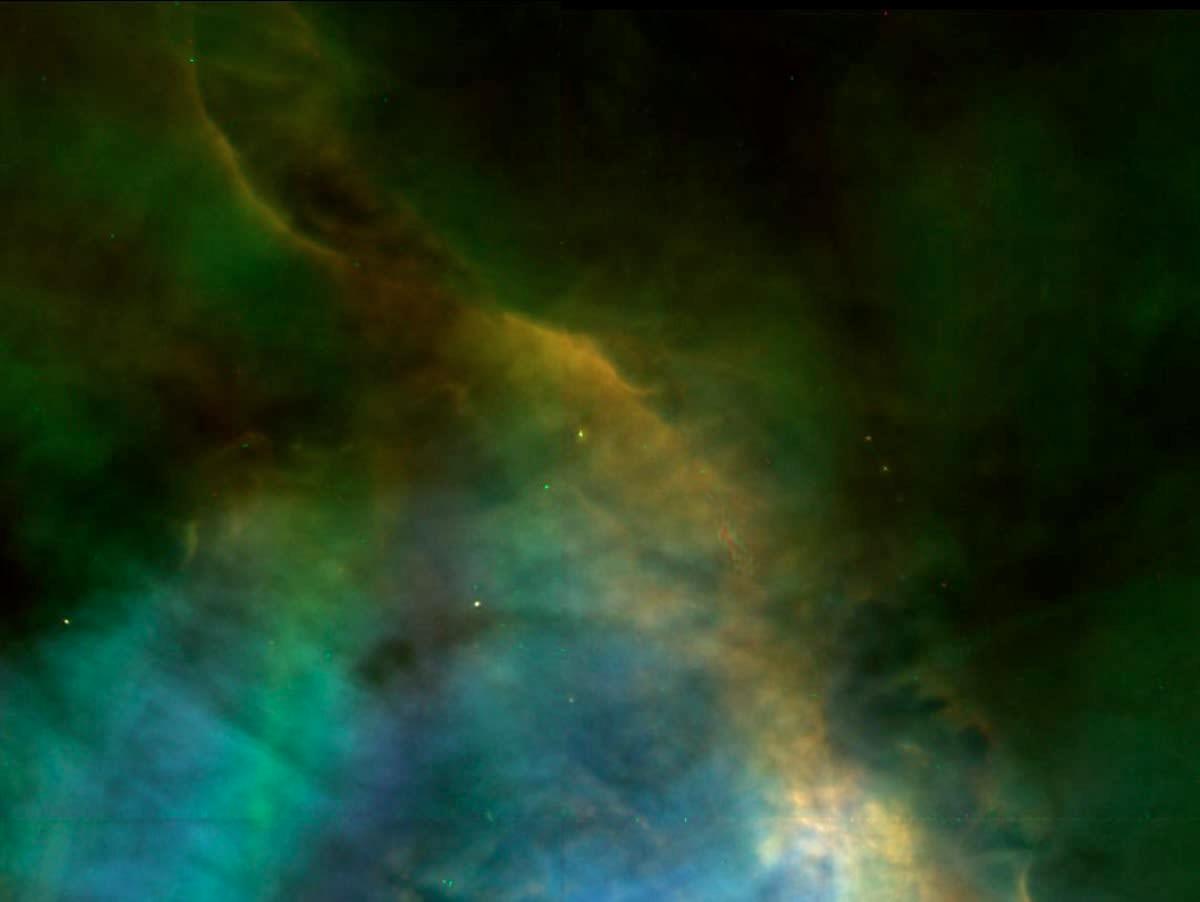
The dark disk, seen in silhouette against the background of the Orion Nebula, is possibly a protoplanetary disk from which planets will form.
With a disk mass estimated at 10 to 30 times that of Jupiter, IRAS 23077+6707 may depict a scaled-up version of our early solar system, according to NASA. Researchers think it has the potential to host a planetary system. Even though planet formation can vary in such extensive environments, the processes behind it might just be somewhat alike.
Lead author Kristina Monsch said, "The level of detail we’re seeing is rare in protoplanetary disk imaging, and these new Hubble images show that planet nurseries can be much more active and chaotic than we expected. We’re seeing this disk nearly edge-on and its wispy upper layers and asymmetric features are especially striking." She mentions that both the James Webb Space Telescope and the Hubble Space Telescope have spotted similar disks, but IRAS 23077+6707 allows scientists to study its substructures in visible light with a great amount of precision. "This makes the system a unique, new laboratory for studying planet formation and the environments where it happens," she added.