
Scientists Identify First Known Triple Galaxy System About 1.2 Billion Light-Years Away
Published Dec. 25 2025, 6:51 a.m. ET

A depiction of black holes merging.
A rare triple system was identified by astronomers about 1.2 billion light-years away from Earth. The system, known as J1218/1219+1035, is found to contain three interacting galaxies with active supermassive black holes at their centers. The research revealed that the black holes are constantly growing, accreting, actively feeding, and shining extremely bright. According to the study published in The Astrophysical Journal Letters, the scientists used the U.S. National Science Foundation Very Large Array (NSF VLA) and the U.S. National Science Foundation Very Long Baseline Array (NSF VLBA) to understand the cosmic system. The high-resolution observation helped them determine that all three galaxies have active galactic nuclei (AGN) within them. This is remarkable considering all three black holes are showing signs of high activity, which is quite unusual.
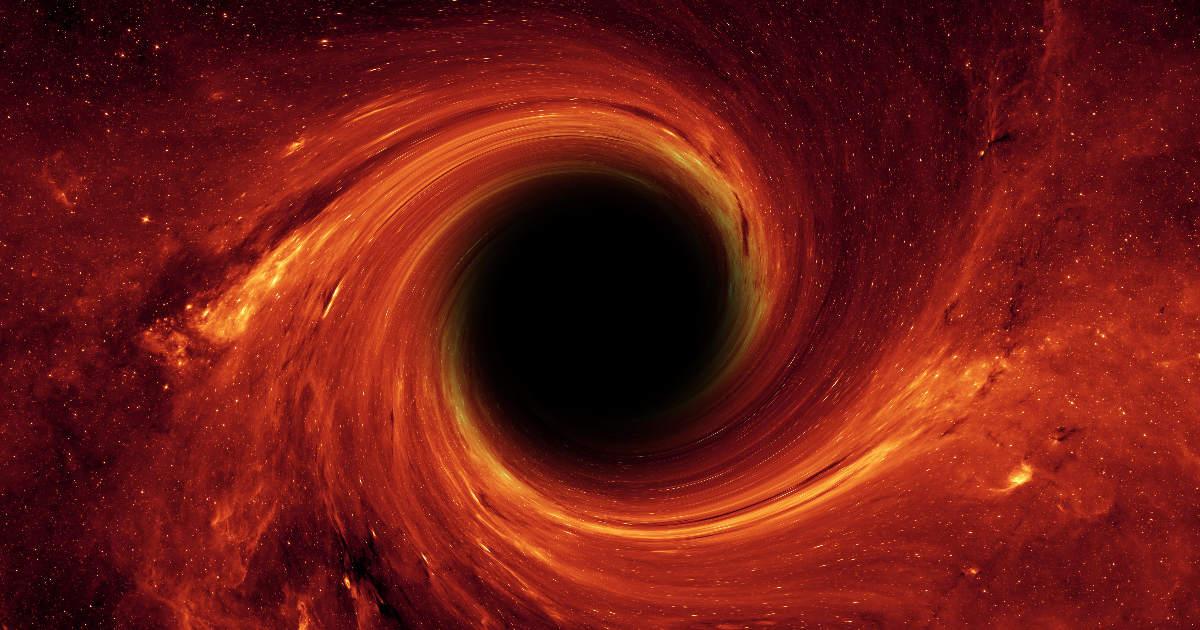
Black hole, nebula, and galaxy in deep outer space
This makes J1218/1219+1035 the first confirmed "triple radio AGN" and the third known AGN system in the nearby universe. “Triple AGN are even rarer than pairs. This is the first time we’ve been able to say that all three light up in the radio regime, which is why it’s special,” Emma Schwartzman, Ph.D., NRL Karles Fellow and astrophysicist, said in a statement. The system was confirmed as a triple system after three galaxies were spotted merging. Such systems play a major role in the prediction of hierarchical galaxy evolution, which suggests that galaxies grow in size by merging or colliding with other smaller galaxies. “This discovery gives us a rare window into a dynamic phase of galaxy evolution. More massive galaxies form via the mergers of other massive galaxies,” Schwartzman said.
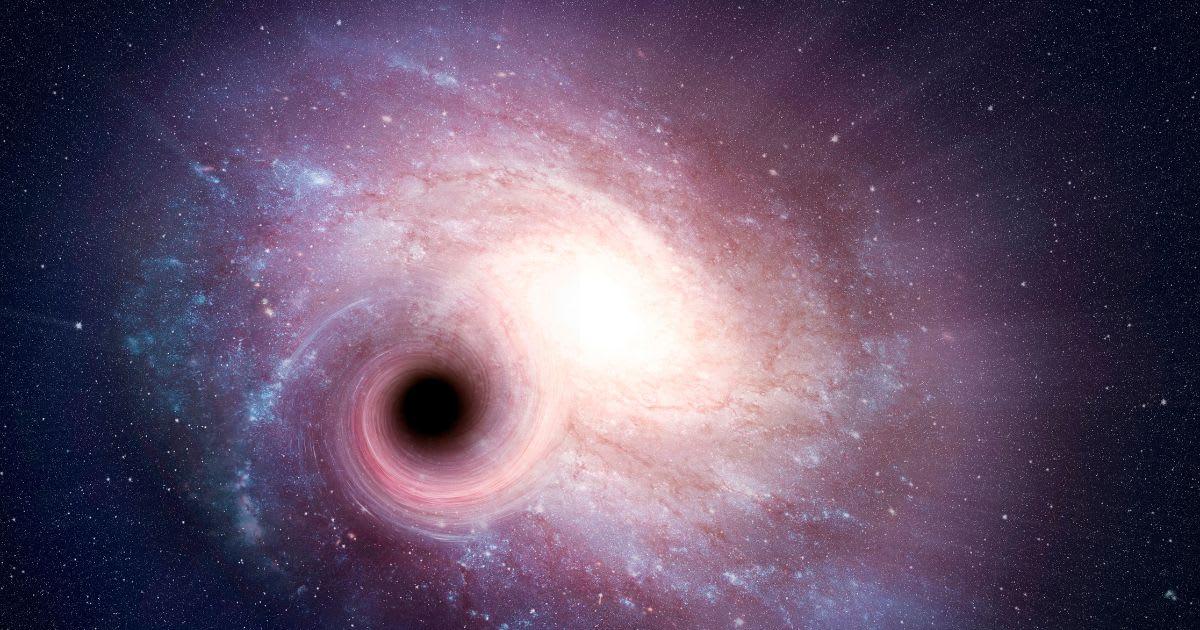
A black hole in the middle of a galaxy
The discovery of these simultaneous radio AGN within merging galaxies provides valuable insight into how supermassive black holes grow and evolve in space. The presence of black holes in the middle of these galaxies also highlights how encounters between two or more galaxies can drive gases into the center, prompting the growth of the black holes. That being said, the three galaxies are still merging and have not merged yet. Researchers hope that future observations will be able to detect a "bridge" of matter between the three galaxies, allowing them to differentiate. Earlier, NASA's Wide-field Infrared Survey Explorer (WISE) had detected only two AGN. It was the latest radio data that confirmed the presence of all three.
Starburst cluster dazzling with a glowing blue halo and glittering stars
Astronomers used morphology, brightness temperature measurements, and steep spectral indices as parameters to determine the nature of the cores present within the black holes. Schwartzman revealed that the third AGN was only discovered because of the high resolution achievable in the radio regime. “It reinforces the value of radio observations for uncovering black hole activity that would otherwise go undetected," Schwartzman emphasized. The researcher also insisted that no one method was enough to detect and confirm all three radio-bright nuclei as AGN. Multiple wavelengths need to be studied to detect pairs and triples. "Many studies are just optical or just radio, but we’re convinced we need all regimes at this point," she added. Schwartzman admitted there's much more to explore in the triple system, including the merger history of the system.