
Scientists Detect an Unusual Drift in Earth's 'Green Center.' Climate Change Could Be the Culprit
Published March 10 2026, 9:40 a.m. ET

Representation of Earth's vegetation blueprint that shifts through seasons.
The “greenness” of the Earth is constantly changing, shifting through the seasons. In a recent study published in Proceedings of the National Academy of Sciences, researchers from the German Center for Integrative Biodiversity Research, the Helmholtz Center for Environmental Research, and Leipzig University studied the global “green center” over recent decades and found surprising results. They observed a shift in the green center of our planet, which is measured by its vegetation health. “Imagine holding a perfectly round globe in your hands and attaching small weights to it, each representing the green leaves at every point on the Earth’s surface,” explained Prof. Miguel Mahecha, the lead author of the study, in a statement. “If you then carefully place this globe into calm water, the center of mass will always point downward,” she added.
When placed in steady water, gravity pulls the heaviest side downward. In this context, the areas with high vegetation weigh the heaviest. Using the model data and decades of satellite observations, the researchers concluded that the "green center" had indeed shifted over the years. According to the research, the greenness moves from north to south and back every year, depending on seasonal changes, traveling almost like a green wave. Scientists managed to locate the center of this wave, along with its direction and velocity. The results showed that the "green center" was positioned at the northernmost point in mid-July in the North Atlantic near Iceland, and by March it shifted to its southernmost position off the coast of Liberia.
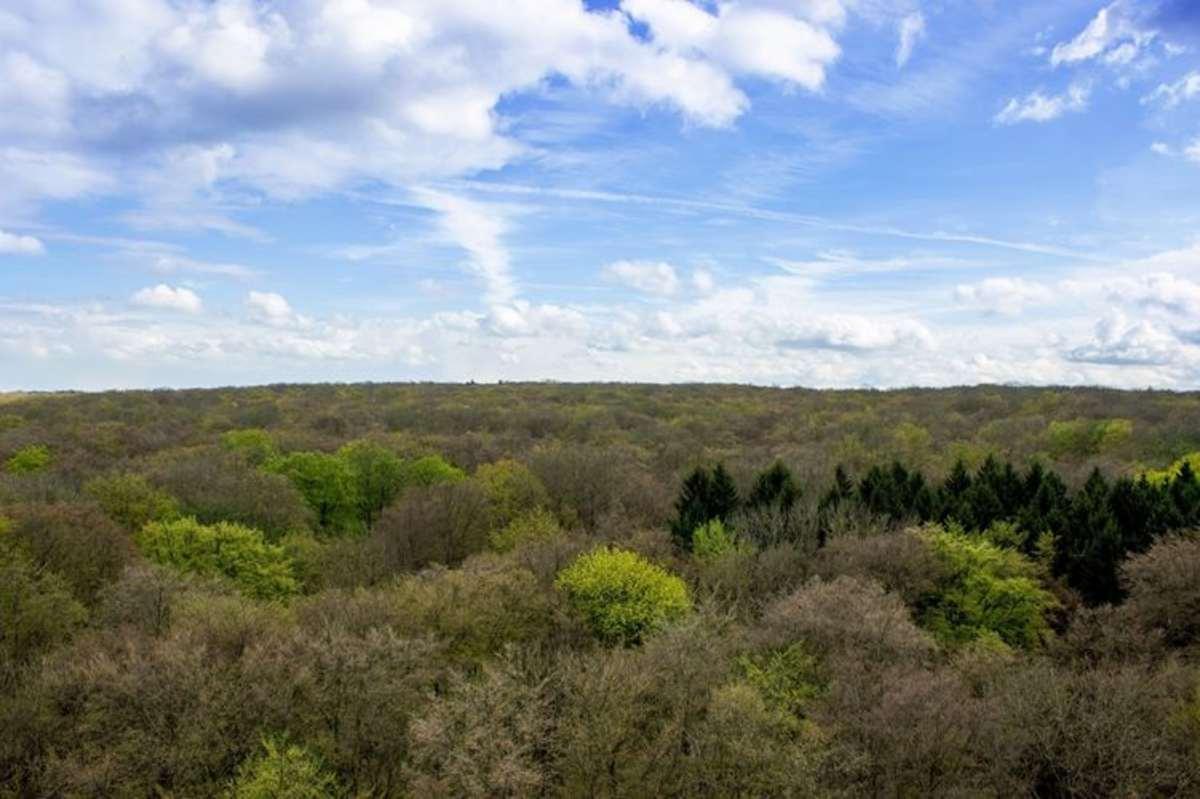
In April, the forests of Central Europe begin to turn green. At this time of year, the “green center" of global vegetation shifts northward. The photo shows the Hainich National Park in Thuringia.
The study highlighted something that often goes unnoticed by experts: global greening. Similar to climate change, biodiversity change, and global warming, global greening is also driven by human activities. While observing the green wave over a few decades, the team noticed a concerning pattern. The greenness consistently shifted northward with every seasonal cycle. Even though the Southern Hemisphere is struck with intense summer heat, scientists did not witness a bloom in vegetation in the region. “This was a huge surprise to us,” says Mahecha. She speculated, "Longer growing seasons and warmer winters in the Northern Hemisphere, which allow vegetation to remain slightly greener for longer, may be driving the Earth’s overall greening shift throughout the year."
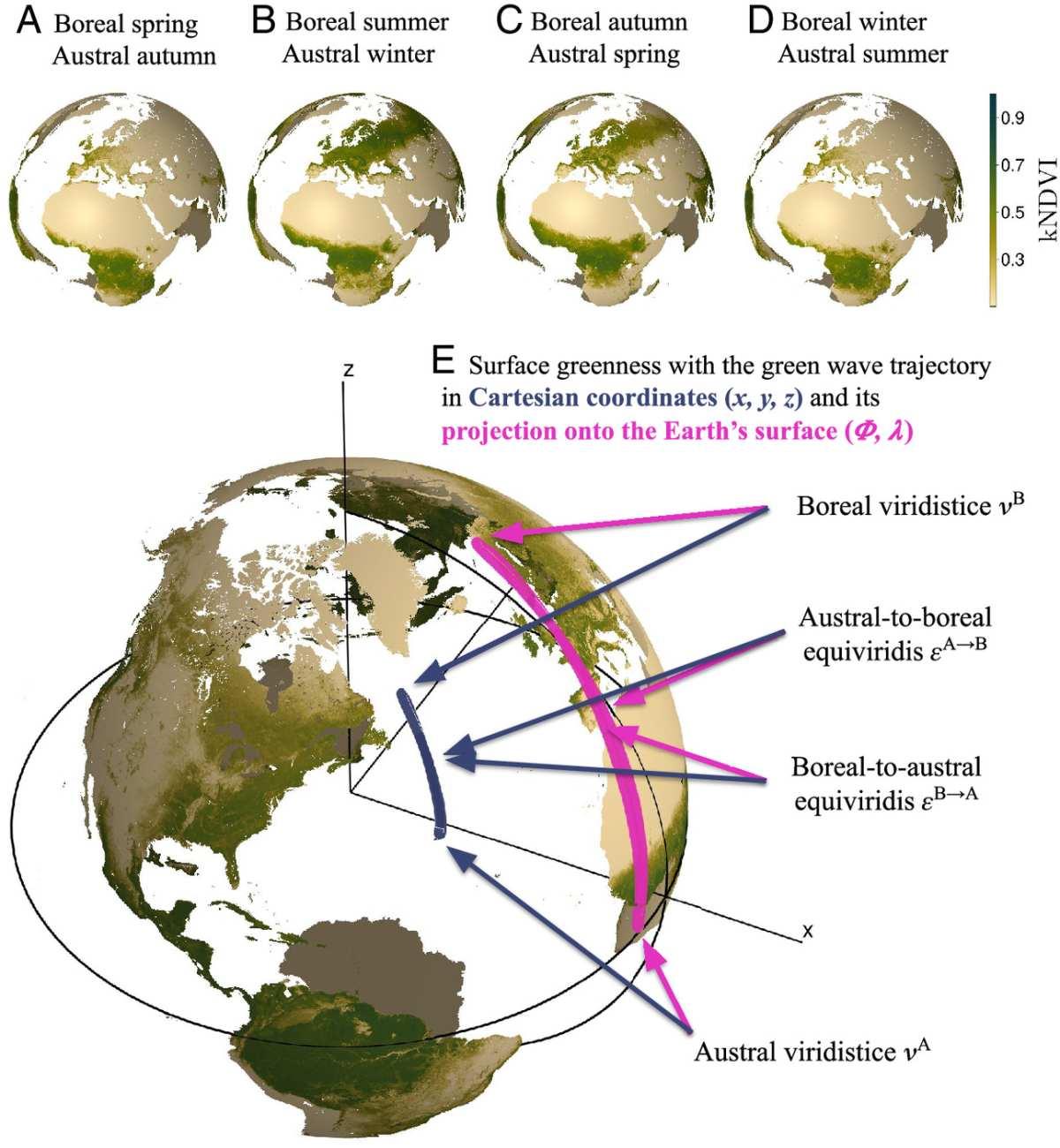
Mean seasonal cycle of a vegetation index observed from space and derived centroid trajectory. Upper panels show the “green wave” at stages corresponding to the 2023 boreal spring/autumn equinoxes and boreal summer/winter solstices on (A) March 20, (B) June 21, (C) September 23, and (D) December 21. In (E), we present the three-dimensional trajectory of the centroid of green surfaces in a Cartesian coordinate system.
"However, this is a hypothesis that we need to explore further," she added. This shift wasn't the only surprise the team observed. The green wave also slightly diverted eastward. Researchers hypothesize that the green hotspots in regions like India, China, and Russia may have catapulted the planet's greenness on its side. But again, there's still much scope for research to find proof to support these hypotheses. Why is tracing the global greening important? Measuring how fast and in which direction our planet's vegetation is shifting will allow experts to understand several other associated factors. The global greening impacts climate-biosphere interactions, land-use change, fire dynamics, droughts, and animal migration. The culmination of all these factors helps determine global change.
Tracking the green wave will also expose vulnerable areas and those that are flourishing. The holistic data will eventually help researchers develop the necessary measures to tackle issues that may arise in the future. With the green wave shifting northward, the Southern Hemisphere is prone to facing a lack of it. But since the new research has brought the issue to light, experts are aware of what's to come, at least for now. Moreover, the study highlighted how the vegetation of our planet is reacting to the warming world.