
Mass Tree Planting in China Turns One of the World’s Driest Deserts into a Green Carbon Sink
Published Feb. 12 2026, 9:43 a.m. ET

An aerial drone photo taken on Sept. 20, 2025, shows vegetation in the Taklimakan Desert.
Within the central Tarim Basin of northwestern China, it opened what looks like a gaping portal filled with nothing but shifting sands, their lone companions being little willows, poplars, or other hardy shrubs that became too hardened to desire water anymore. Locked within the arms of the Pamir and Kunlun Mountains, the Taklamakan Desert (a.k.a. Taklimakan or Takla Makan) had almost become a hopeless piece of all things dead, mute, and dry. In 1978, officials from the Chinese government decided to put their foot into these dejected, abandoned sands and try to breathe new life.
And today, see, the desert is far from being hopeless. It, in fact, is sprightly, all bright-eyed and bushy-tailed, with an unbelievable 66 billion trees. In a new study published in PNAS, scientists documented the dramatic transformation of this barren arid desertscape into a lush oasis. Today, scientists noted that it has turned into a brilliant biospheric carbon sponge that pulls enormous amounts of carbon from the atmosphere.
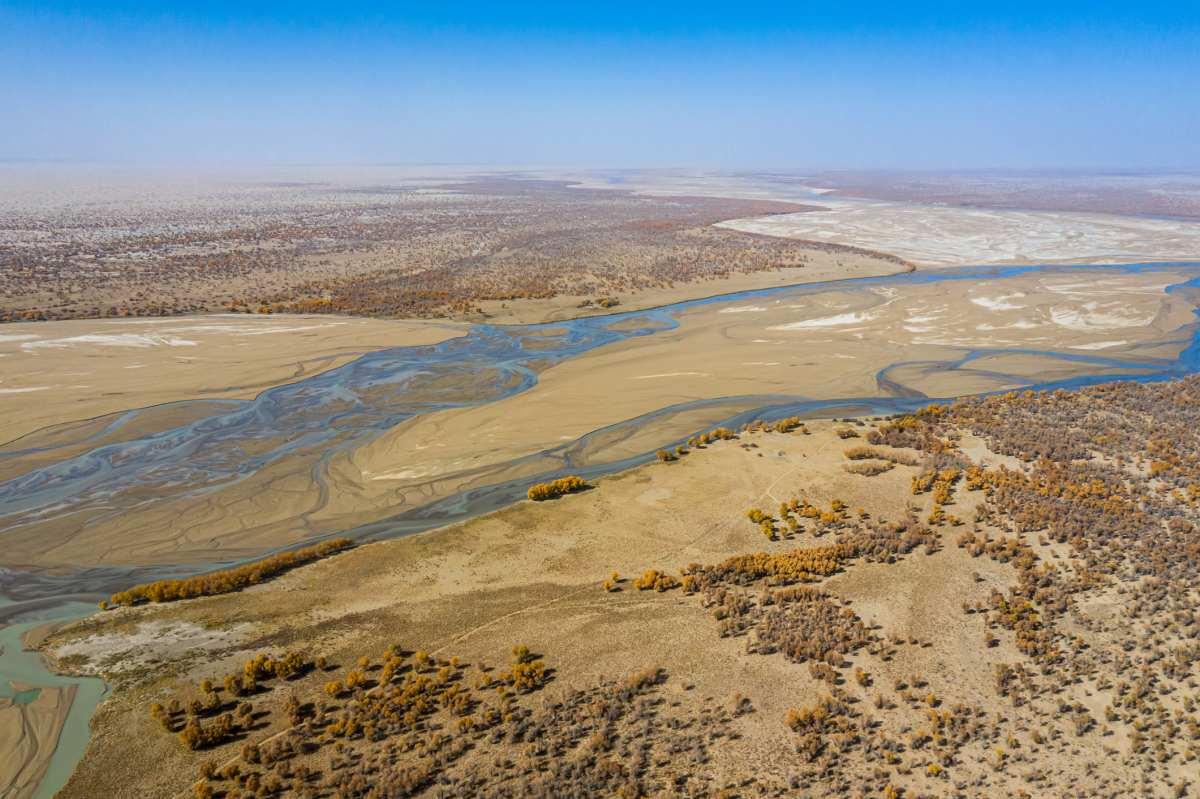
The Hotan River can pass through the Taklimakan Desert in the rainy season and flow into the Tarim River.
Roughly the size of the Great Barrier Reef, Taklamakan’s 130,000-square-mile area is encircled by mountains so tall that for the past several years, they blocked most of the moist air, keeping the desert desolate and tormented by extreme environments. Plants and flowers could not sprout here because the conditions were too harsh for them to survive. On most days, the hot, unrestrained sands would rise and whip up the surrounding towns with fierce sandstorms. However, one decision changed everything. A mass tree planting project transformed this “biological void” into something that now protects the planet from greenhouse emissions.
Called the Three-North Shelterbelt Program or the “Great Green Wall,” it was hailed as a world-class ecological engineering project intended to slow desertification. The plan was to plant billions of trees around the margins of both the Taklamakan and Gobi deserts by 2050. Only quite recently, however, scientists noticed the scale of growth the program contributed to ever since it was launched.
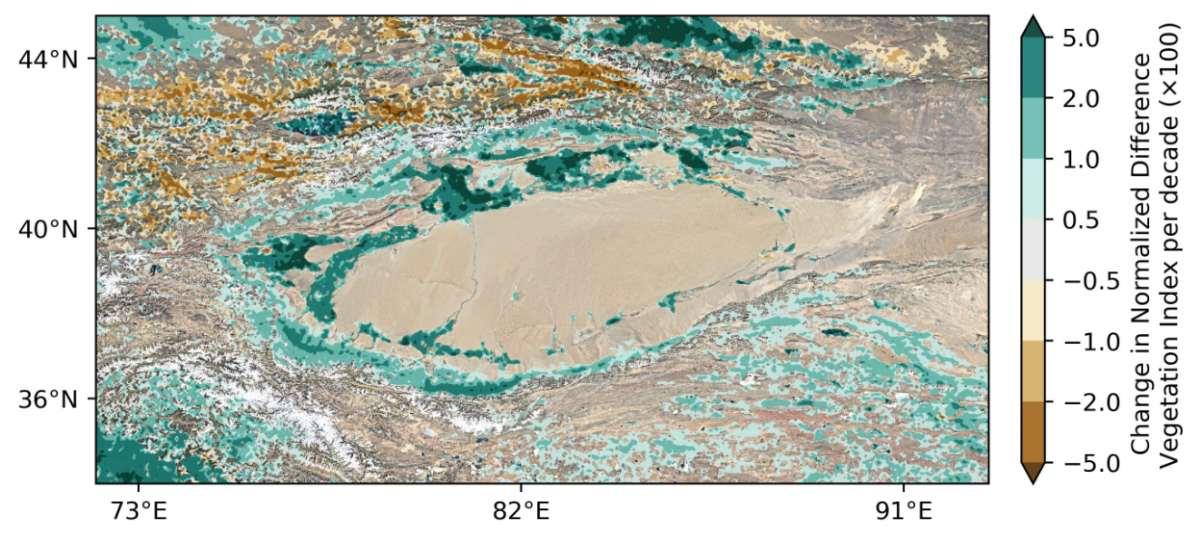
Green areas show the rate of increase in vegetation observed by NASA's MODIS instrument since 2000.
The team used NASA’s Orbiting Carbon Observatory and the MODIS satellite to track carbon dioxide concentrations and the intensity of greenness slowly draping the desert. Observations revealed a surprising drawdown in seasonal carbon dioxide. Plant cover increased dramatically, and the cover displayed signs of strong photosynthetic signals.
Overall, this afforestation initiative showed two major positive indicators. One, a dip in the atmospheric carbon dioxide, and the second, a rise in solar-induced fluorescence, the light emitted during photosynthesis. “This is not like a rainforest in the Amazon or Congo,” UCR atmospheric physicist and study co-author King-Fai Li remarked in a press release. Co-author Yuk Yung told Live Science that it demonstrates the “potential to transform a desert into a carbon sink and completely halt desertification.
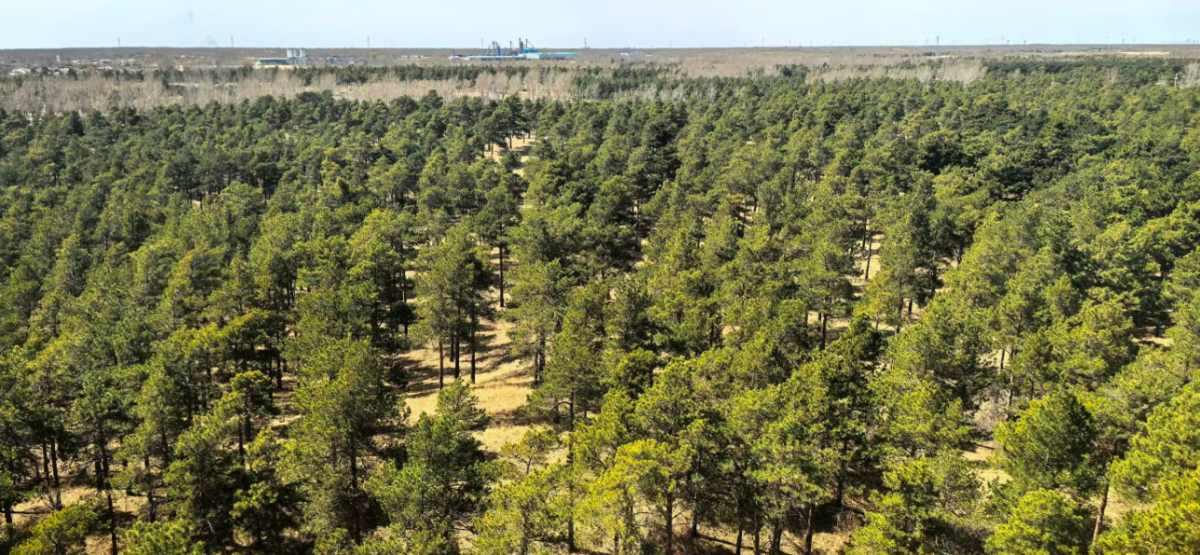
A successfully afforested area of the desert as it stands with medium-sized trees today.
China’s motivations behind this program were both environmental and political. While the unrestrained desert growth threatened surrounding farmland, the instability in western regions provoked clashes between ethnic tribes and the Han Chinese leadership. Whether environmental, political, or both, it offers a rare case study of desert greening in action and how, over time, afforestation can actually change the face of a desert.
Today, Taklamakan can pull as many as 60 million tons of carbon from the environment. For the global emission of 40 billion tons, the contribution is too small, but not insignificant. As Li pointed out, this is just one piece of the puzzle. The climate crisis cannot be solved by planting trees in deserts alone. However, by understanding where and how much carbon dioxide can be drawn down and under what conditions, the situation can be improved.