
New Map Accurately Pinpoints Which U.S. National Parks Will Face Climate Change's Worst Consequences
Published March 3 2026, 8:09 a.m. ET

A woman reads a map of America's national park system
America’s park system was created on the principle of fixed boundaries. Parks were sewn like precious, protected green jewels into its jagged, trapezoid-shaped architecture. Climate change has breached these boundaries and is slowly eroding them bit by bit, making it challenging for the parks to retain their respective ecological identities. Regarded as sanctuaries for safeguarding nature’s resources and concentrating elemental forces, the parks are now being pushed to the threshold, so much so that managers think it is impossible to preserve their historical identities anymore. Instead, they are focusing their strategies on how best to manage the ongoing transformation. In a study published in Conservation Letters, researchers documented an atlas of maps that assess the vulnerability of different parks that might guide them towards change.
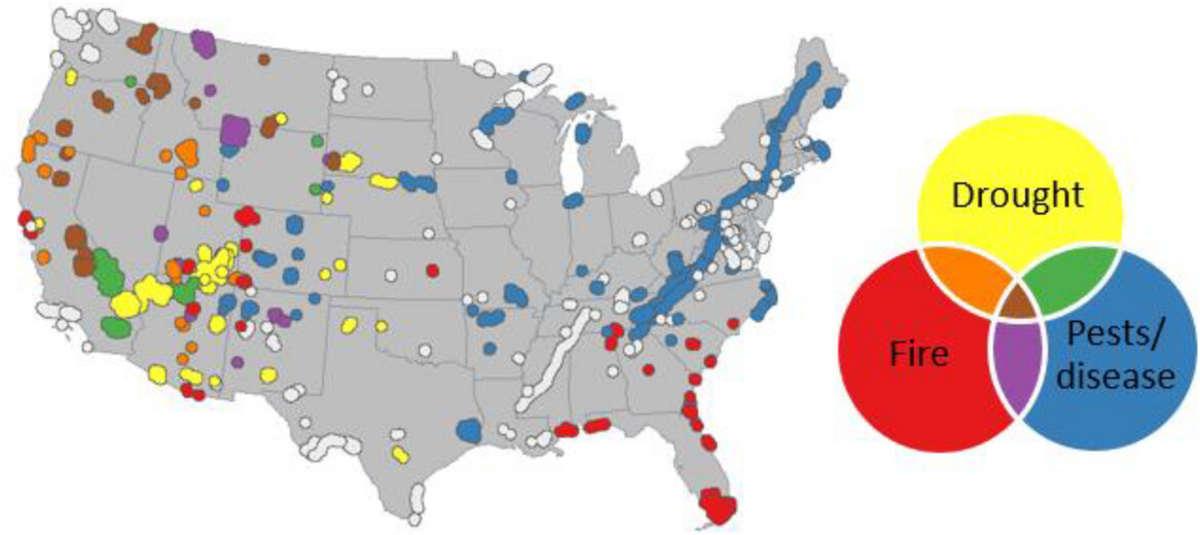
Parks most at risk of potentially transformational impacts associated with fire, drought, and/or forest pest or disease. (Image Source: Conservation Letters/ Michalak et al (2026))
The goal, researchers mentioned, was to identify high-priority threats, estimate the extent of vulnerability, and develop strategies for intelligent management of the park's resources. A nationwide analysis revealed that most of the national parks in the US, at least 77% of them, are highly vulnerable to climate change, with many facing risks that might propel them towards an irreversible transformation. Not a positive transformation, unfortunately. Blame goes to wildfires, droughts, bugs, and floods.
The first step was to understand how parks will respond to the transformation in the next few years. This required some math. Two factors were evaluated for each park: the cumulative vulnerability score and transformation factors. Based on these values, they assessed patterns of vulnerabilities, top risks, and compounding disturbances. The “cumulative vulnerability score” was calculated by adding “exposure” and “sensitivity” and subtracting "adaptive capacity,” an equation used in most of the traditional climate science frameworks.
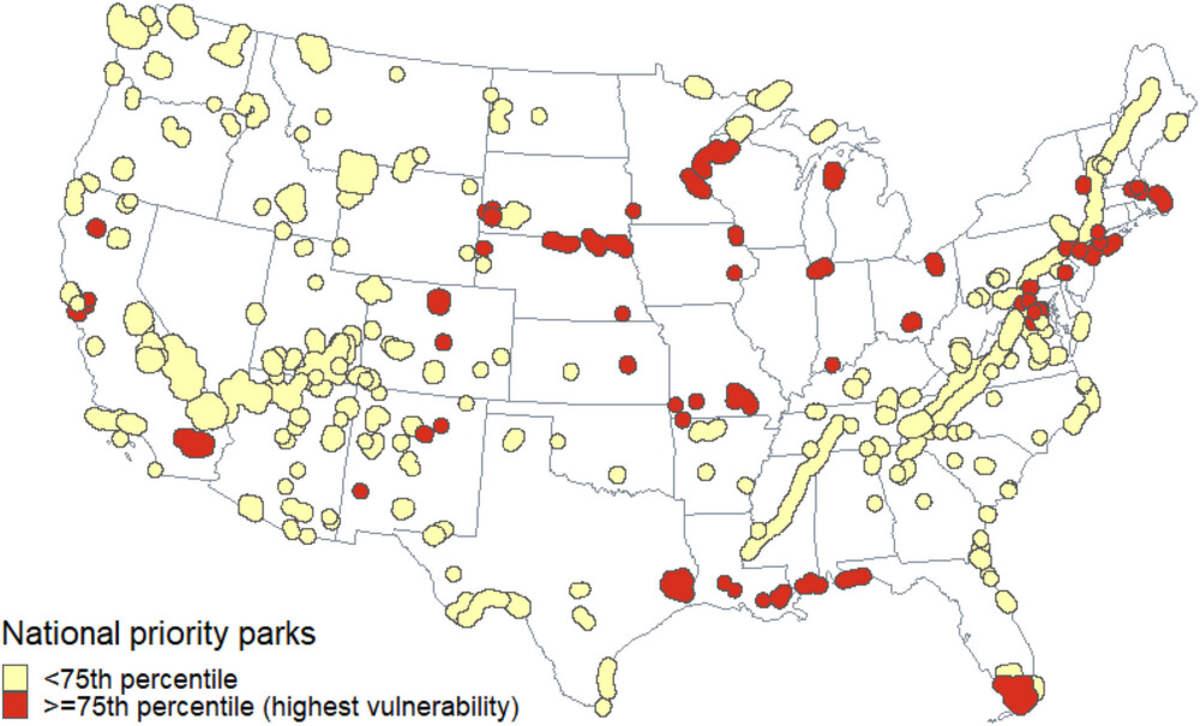
Priority parks at the national scale, which were identified as those ranking at or above the 75th percentile in total cumulative vulnerability scores. (Image Source: Conservation Letters/ Michalak et al (2026))
Exposure indicated the scale of climate change. Sensitivity was to assess how strongly the park would respond, and the “adaptive capacity" was the measure of the ability of the park to adapt and adjust to the changing conditions. Using this trio of values, researchers evaluated 259 park units across the U.S. To their astonishment, the parks displayed uneven vulnerability, probably due to their distinctive geography.
Parks in the Midwest and Eastern U.S. displayed the greatest vulnerability, likely stemming from their fragmented habitats, aggravating pollution, colonization of invasive species, and limited capacity to adapt. Western parks, on the other side, are more resilient when exposed to environmental disturbances. The elevation gradients created by their rugged terrains offer microclimates that serve as refuges against differing climate conditions. But as they encounter a bombardment of transformative disturbances, this resilience seems misleading.
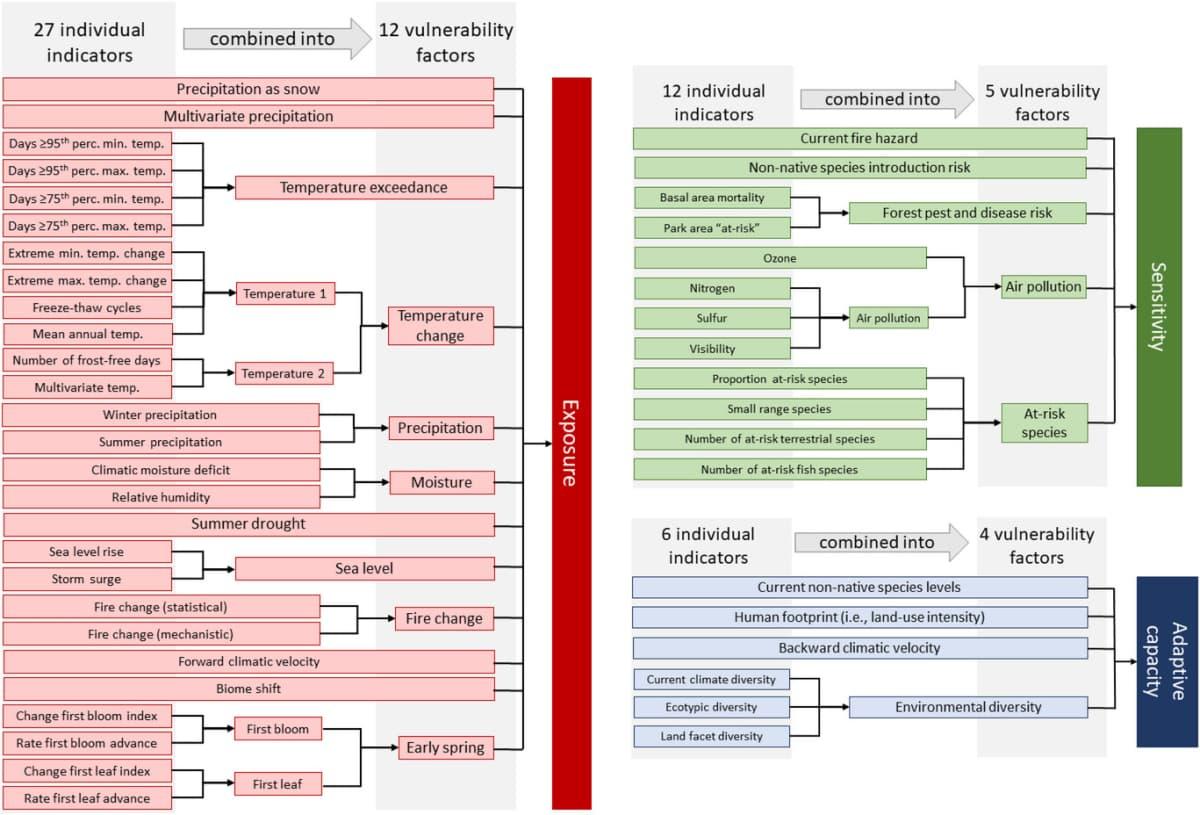
Indicators combined into vulnerability factors underpinning exposure, sensitivity, and adaptive capacity.
As climate pressure builds up and government policies are rendered weak, park managers have no choice but to shift their focus from preserving the historical ecosystems to managing ongoing transformations. It is no longer possible to preserve the parks as “static vignettes of an earlier America.” It isn’t just feasible. Relinquished into powerlessness by the uncontrollable transformation, the managers had to follow an intelligent strategy. They began with “acknowledgement,” as the paper describes. The next step was to create a new management philosophy, which they spelled as "resist, accept, direct.” Looking ahead, this philosophy may initiate collaborations between managers of different parks, thereby integrating the work on the whole park system.
The strategy is not without challenges, though. From staff reductions to funding constraints, the list is long. The widening gap between the scale of change and the institutional ability to manage it cannot be denied either. National parks, researchers said, were once imagined as places “outside of time,” but now they are becoming places where “time is accelerating.” However, as Bill Gates wrote in a post, the problem might become less severe with a little shift in perspective. Climate change, Gates said, is a serious problem, but it will not be the end. By shifting the doomsday outlook into an optimistic attitude, managers can better plan how to support the parks during this vulnerable transformation phase.