
Two Massive 'Blobs' Hidden Deep Inside Earth May Be Secretly Controlling Its Magnetic Field
Published Feb. 5 2026, 8:33 a.m. ET

Simulated maps of Earth’s magnetic field (L) can only look like those of the real field (R) if Earth’s core is assumed to have hot blobs of rock sitting directly on top of it.
About 1,800 miles beneath our feet, an energetic geomagnetic waltz is constantly washing our Earth in electricity. The drama starts in the planet’s inner core, the centermost layer. This layer is a gigantic alloy of metals like iron and nickel. Burdened by immense pressures from the upper layer, the metals cool down and freeze into solid rocks. As they freeze, they abandon lighter elements, which rush towards the outer core, where they are electrified by convection currents. Rising and falling in spiraling columns, this hot metal soup crashes against the existing magnetic field and catches electric currents. As Earth rotates, these sloshing electric waves align with the magnetic field, harmoniously enveloping the crust to guard the planet.
What may sound like some futuristic electricity-generation machine is actually Earth’s in-built geodynamo, or internal heat transfer system that consistently empowers its magnetic boundary. Without it, Earth would be just like its neighbor Venus: enchanting but magnetically dead, as Andrew Biggin, Professor of Geomagnetism, University of Liverpool, described in The Conversation. Biggin, who specializes in studying Earth’s magnetic field, and his team published research in Nature Geoscience documenting two hidden contributors that are sitting in a mysterious nook of this geodynamo, secretly supporting this magnetic boundary.
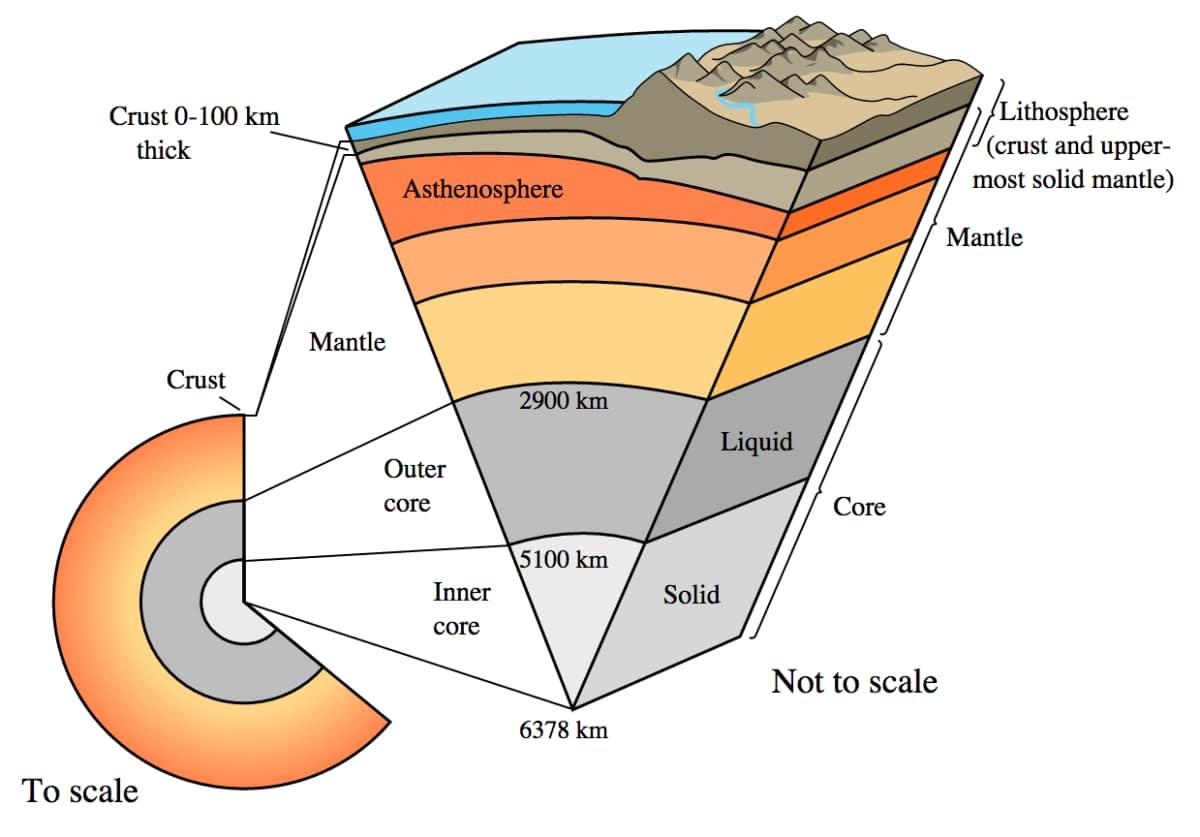
Cutaway views showing the internal structure of the Earth.
The magnificent magnetic field has been protecting Earth for billions of years. But it isn’t easy. This process cannot occur without a tremendously high amount of energy. All this energy packed in the core was delivered during Earth’s formation. For so many years, scientists believed that the energy travelled through the Earth’s deep interiors and generated the magnetic field. An ideal visual was that of streams and ribbons of this metallic material travelling through the solid inner core, the liquid outer core, the rocky mantle, and ultimately to the solid crust.
But what exactly happened in each layer lingered in mystery. For this study, Biggin and his colleagues chose to investigate a mysterious layer to unravel some insights on the whole mechanism: the core-mantle boundary. He concluded that two continent-sized rocks sitting in this layer are quietly influencing and shaping our magnetic field. Enter the “big lower-mantle basal structures,” or “blobs.” The blobs lie at the base of Earth’s mantle, around 1,802 miles beneath Africa and the Pacific.
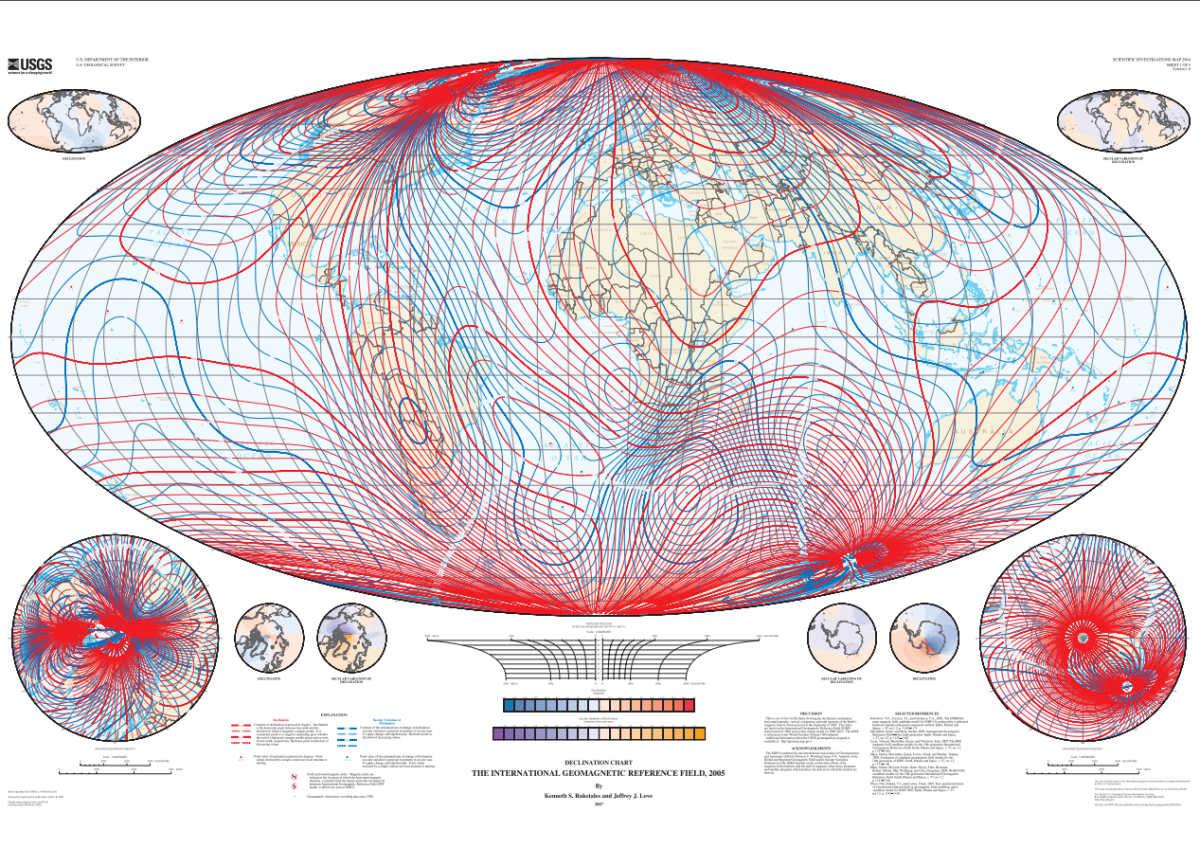
Chart showing the Earth’s magnetic field
Picture someone baking a multi-tier cake and secretly embedding two diamonds in one of the creamy disks. If someone eats this portion of the cake, they would block the process of eating, and their teeth would break. No one is eating the layered cake of Earth, but interestingly, these two blobs are governing the way in which heat moves through the system. The two blobs of superheated material are sitting surrounded by a ring of cooler rocks, creating a thermal contrast on both axes.
To study the deep-Earth features, researchers combined paleomagnetic observations with computer simulations of the geodynamo. This provided them with the information of Earth’s behaviors over the past two centuries. Results showed that the outer core’s upper boundary was not uniform in temperature and showed strong thermal contrasts. Furthermore, they found that some parts of the magnetic field stayed relatively stable for millions of years and, unlike others, remained unchanged over time.
“Our study reports new evidence that these Blobs are hotter than the surrounding lower mantle. And this has had a noticeable effect on Earth’s magnetic field over the last few hundreds of millions of years at least,” Biggin noted in The Conversation.