
Scientists Create New Plastic That Self-Destructs After Use in Breakthrough Research
Published March 11 2026, 5:43 a.m. ET

(L) A bag of plastic bottles; (R) Rutgers University researchers. (Cover Image Source: (L) Pexels | Sarah Chai; (R) Rutgers University)
Plastics are rotting the world, turning natural habitats into junkyards. More than 90% of manufactured plastics end up in the environment, polluting landscapes and water bodies, harming ecosystems, and impacting human health. Humanity’s economic model of take-make-waste in linear manufacturing of plastics is the complete opposite of the natural system. Nature works in a cycle where every nutrient drawn eventually returns and replenishes the Earth, like how nutrients from animals and plants are returned to the soil. Even though plastics are made of natural materials, they don't bring the same value back and instead pile up and pollute the environment. Scientists at Rutgers University were inspired by the circularity of natural materials and aimed to achieve the same for plastics in a recent experiment.
The researchers believe they have found a groundbreaking solution that would enable the circularity of hazardous materials such as plastics. In the study published last November in Nature Chemistry, the researchers elaborated on their newly developed molecular structure for plastic. Similar to natural materials, this new structure of plastic would self-destruct after completing its lifespan. Scientists have hopes that this timely self-destruction can be included in future manufactured plastic products, making plastic waste disposal sustainable by a large margin. “Biology uses polymers everywhere, such as proteins, DNA, RNA, and cellulose, yet nature never faces the kind of long-term accumulation problems we see with synthetic plastics,” said Yuwei Gu, an assistant professor in the Department of Chemistry and Chemical Biology in the Rutgers School of Arts and Sciences.
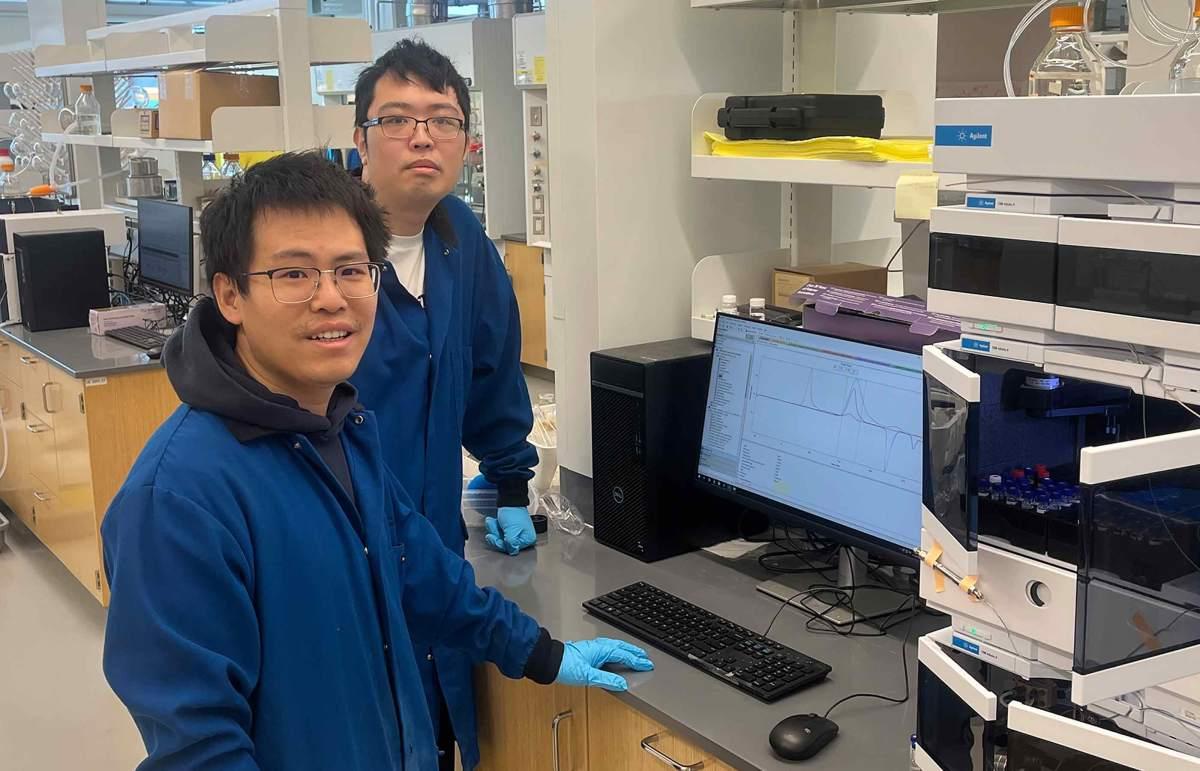
Chemist Yuwei Gu (L) and graduate student Shaozheng Yin employ a gel permeation chromatography machine to measure the size of polymers and how they break down.
“The difference has to lie in chemistry,” he added. Gu argued that if natural polymers serve their purpose in nature and disappear, there must be some chemical composition that would make the same possible for plastics. That's what he and his fellow researchers focused on and aimed to tackle "one of the biggest challenges" in modern-day plastic disposal. “Our goal was to find a new chemical strategy that would allow plastics to degrade naturally under everyday conditions without the need for special treatments," Gu, who also led the research, added. Polymers can be compared to beads on a string as they are constructed with several smaller units tied together. Just like proteins, RNA, DNA, and more, plastics are also a type of polymer.
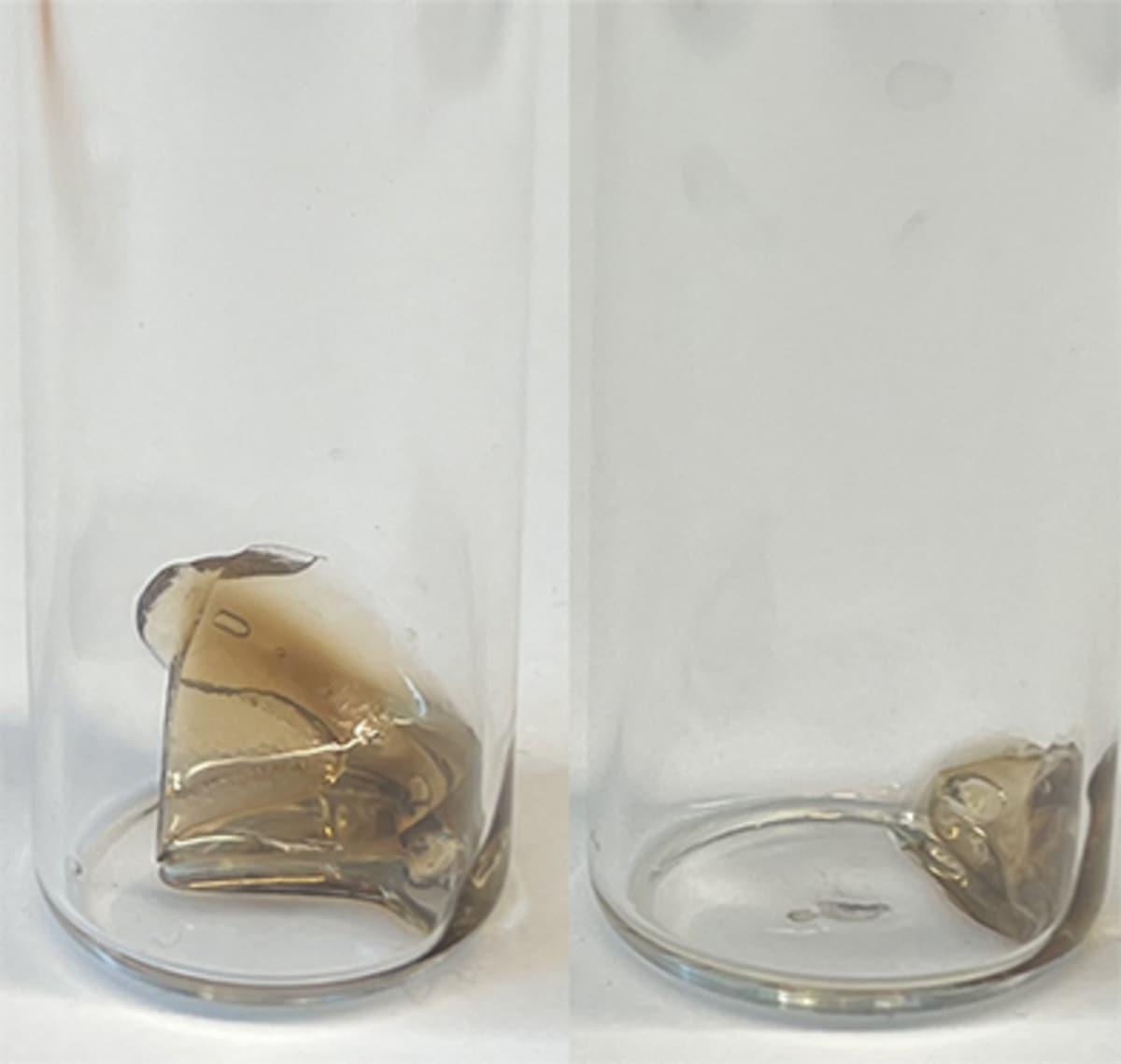
A sample of poly(dicyclopentadiene) plastic, which is a material often used in car bumpers and farm equipment that is difficult to degrade. On the left is the original sample; on the right is the same sample after 18 hours in the open air.
Plastics are hard to break down because the "glue" that holds atoms of the polymer together is quite strong. The plastic structure developed by Gu and his research team had chemicals arranged in a way that an external trigger would immediately initiate the breakdown. The process can be compared to "pre-folding" a piece of paper so that the researchers are aware of the creases that are vulnerable to tearing when triggered. “Most importantly, we found that the exact spatial arrangement of these neighboring groups dramatically changes how fast the polymer degrades,” the researcher explained. “By controlling their orientation and positioning, we can engineer the same plastic to break down over days, months, or even years," he added.
Researchers propose that this methodology can be used differently for different types of manufactured plastic depending on their required durability. For example, the plastic take-out containers don't need to last more than a day, so their self-destruct can be timed accordingly. “This research not only opens the door to more environmentally responsible plastics but also broadens the toolbox for designing smart, responsive polymer-based materials across many fields,” Gu added.