
Scientists Build New Arctic Forecast Model to Predict Sea Ice Loss Months in Advance
Published Feb. 4 2026, 9:38 a.m. ET

Map of the daily sea ice concentration in the Northern Hemisphere in 2025
In a world where exceeding glacier melt is raising concern, predicting it would be a blessing for humanity. Scientists have been relying on real-time tracking of sea ice extent (SIE), which means water areas with minimal traces of sea ice, to get early signs of sea ice melt. However, breakthrough research may have found a better and more efficient way of analyzing the Arctic ice system. In the journal Chaos, published by AIP Publishing, a research team from the U.S. and the U.K. reported a new method that can provide accurate real-time predictions of Arctic sea ice extent. The experts believe that September is a crucial month for monitoring sea ice health decline, as Arctic ice cover is the lowest this time of year.
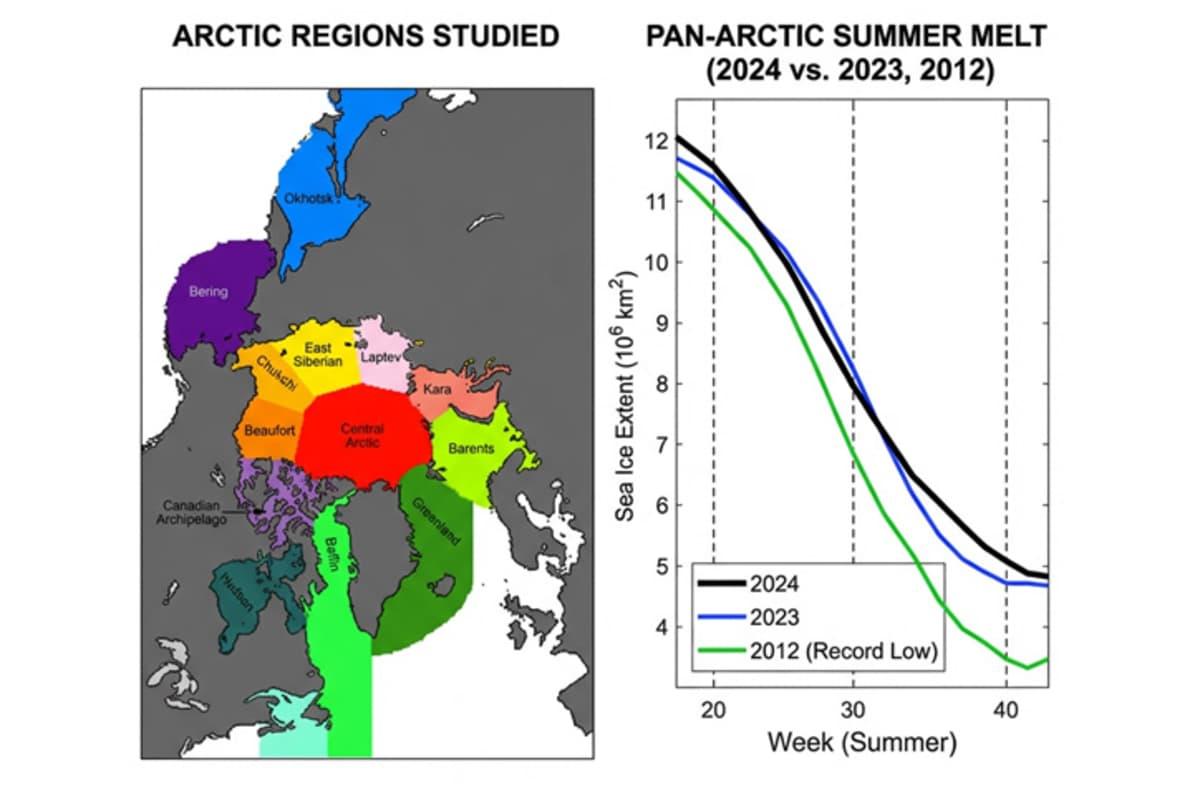
Regional subdivisions (left) and seasonal decline of total Arctic sea ice extent during summer melt (right), highlighting 2024, 2023, and the record low of 2012.
Since several Arctic and sea creatures rely on ice for survival, tracking its condition in real-time will be essential to prevent habitat loss. “Indigenous Arctic communities depend on the hunting of species like polar bears, seals, and walruses, for which sea ice provides essential habitat,” said study author Dimitri Kondrashov. “There are other economic activities, such as gas and oil drilling, fishing, and tourism, where advance knowledge of accurate ice conditions reduces risks and costs," he added. The researchers believe that the sea ice change depends on multiple interacting factors: long timescales, annual seasonal cycles, and fast-changing weather. They relied on the National Snow and Ice Data Center’s average daily SIE across the wide timeline to understand how these factors interact.
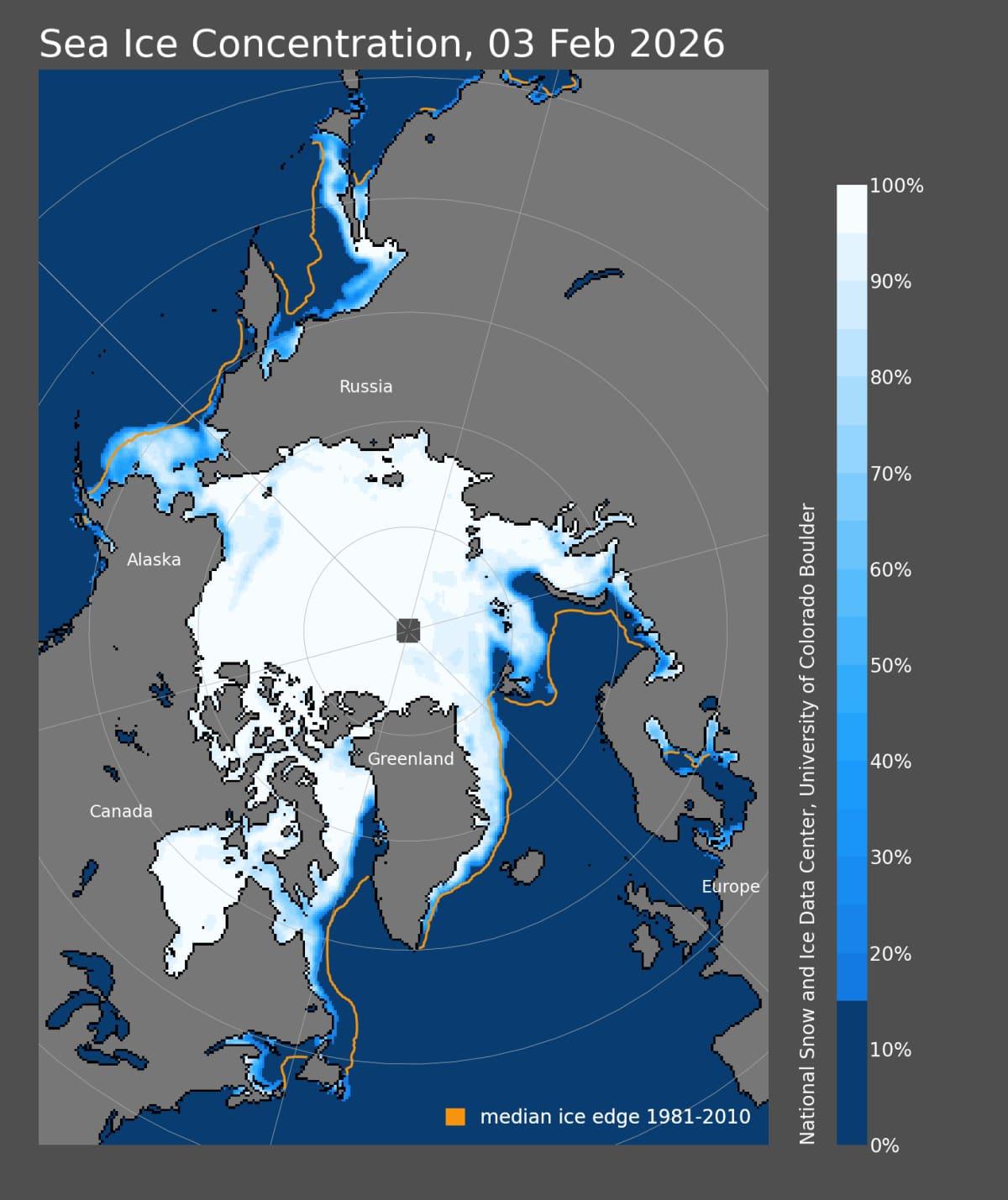
Image showing Arctic sea ice concentration on February 3.
By combining long-term interacting factors, the sea ice loss can be more accurately predicted. The researchers didn't simply claim the theory but also tested it under live conditions. In September last year, the team tested the new method live while analyzing September data from the past years. The result proved that their technique was more efficient than the pre-existing ones and provided more accurate predictions than previous methods did. Moreover, the new method reliably captured changes ranging from subseasonal to seasonal timescales. When they used the new method to predict SIE one to four months in advance, the result's accuracy surpassed all expectations, beating older prediction techniques.
In climate prediction in general, long-term predictions are much easier and more accurate than short-term ones. This was one setback that the team was willing to overcome. Therefore, they incorporated regional data into their model in hopes of improving short-term predictions, and much to their surprise, they were successful. “The model includes several large Arctic regions composing [the] pan-Arctic,” said Kondrashov. “Despite large differences in sea ice conditions from year to year in different regions, the model can pick it up reasonably accurately," he added. The successful experiment has given the scientists hope, making them more determined to improve the model by incorporating new factors. They have already revealed their plans to include oceanic and atmospheric variables in the prediction model.
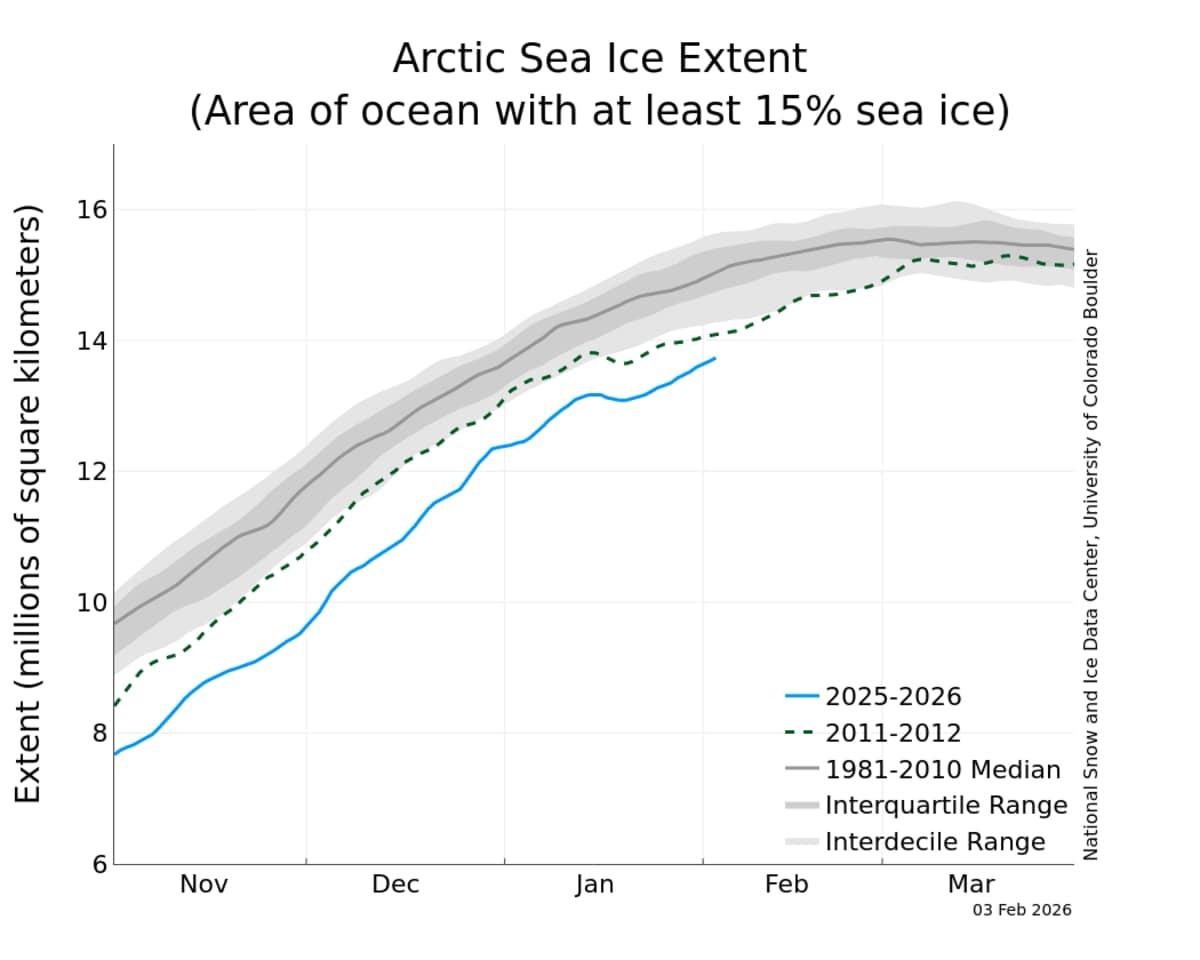
Graph showing Arctic sea ice extent over the years.
Factors like air temperature and sea level pressure are also on their list. These quick-changing variables will make real-time data detection more accurate, making it easier for researchers to make short-term sea ice melt predictions and weather estimates. The lack of these variables in the current model is perhaps why short-term prediction seems far-fetched for the researchers. Nevertheless, they are confident that the incorporation will lead to success to some extent, potentially providing them with data to improve summertime predictability of the Arctic sea ice.