
Russian Rivers Are Creating Mysterious New Clouds in the Arctic, Scientists Discover
Published Jan. 23 2026, 4:13 a.m. ET

High mountain landscape with sun in the French Alps (La Grave, La Meije)
Researchers have identified a Russian influence on Arctic cloud and ice information, as published in the journal Communications Earth & Environment. After investigating an understudied region of the Arctic Circle, the team has found meaningful insights about the organic matter present in rivers in the Russian part of the Arctic Ocean. The organic matter played a crucial role in creating certain clouds. Through this pursuit, the area’s overall temperature was also lowered. The organic matter brought by the rivers included soil, living biological material, rotting leaves, nutrients, and much more. The gases released by them become particles known as aerosols, which act as seeds for clouds.

White Clouds and Blue Sky
An international team of researchers and specialists from the University of Birmingham examined the understudied area of the Arctic Circle, which also included Russia's Siberian region. Their objective was to shed light on how conditions in the region impacted aerosol formation. They considered nine years’ data collected by the Tiksi meteorological observatory in Northern Siberia. This data was then combined with insights from satellite mapping. Through the results, they were able to understand how aerosols formed in the air masses when they moved above water rich in organic matter.
During the analysis, the team found that gases released by organic matter in the rivers of the Siberian region played a key role in the Arctic clouds. These gas particles turned into aerosols, which condensed the water vapor around them to facilitate cloud droplets. It also suggested that the quantity of aerosol in the air impacts the features of the clouds. Higher levels of aerosols result in longer lasting and more illuminated clouds. However, the higher the number of cloud droplets, the less efficient it will be at forming rain. It is because a larger number of droplets leads to clouds being smaller in stature, lighter in weight, and shinier in appearance.
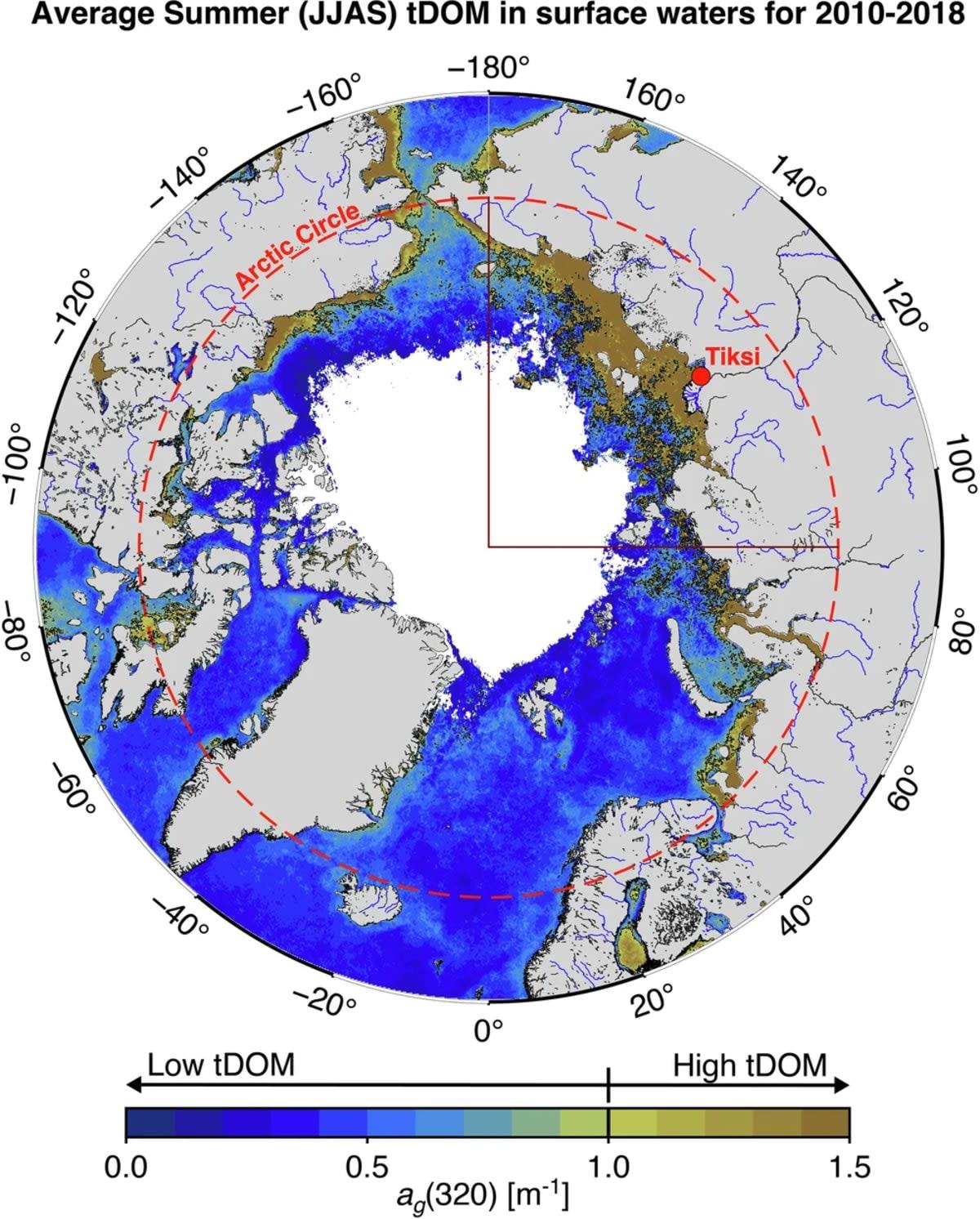
The colour scale represents the value of the remotely sensed absorption coefficient of chromophoric dissolved organic matter
The organic matter that released the gas came from the river runoff. Aerosol particles coming out from this gas not only formed 300% faster compared to other aerosols, but they also developed at a 60% faster pace. The elevated pace results in the formation of a higher number of aerosols and droplets, increasing the likelihood of brighter, long-lasting, and cooling clouds in the area. Researchers never knew about this connection between the organic matter from the Russian region, Arctic clouds, and, by extension, the Arctic climate.
The revelation that organic matter in river runoff can increase the likelihood of cooler clouds in the Arctic Circle is important. The Arctic is heating four times faster than other parts of the world. Scientists used several climate models to predict when this heating will cause the Arctic to become ice-free, and warn officials worldwide to take appropriate steps to mitigate the damage. This finding could help scientists improve the North Pole’s climate modeling.
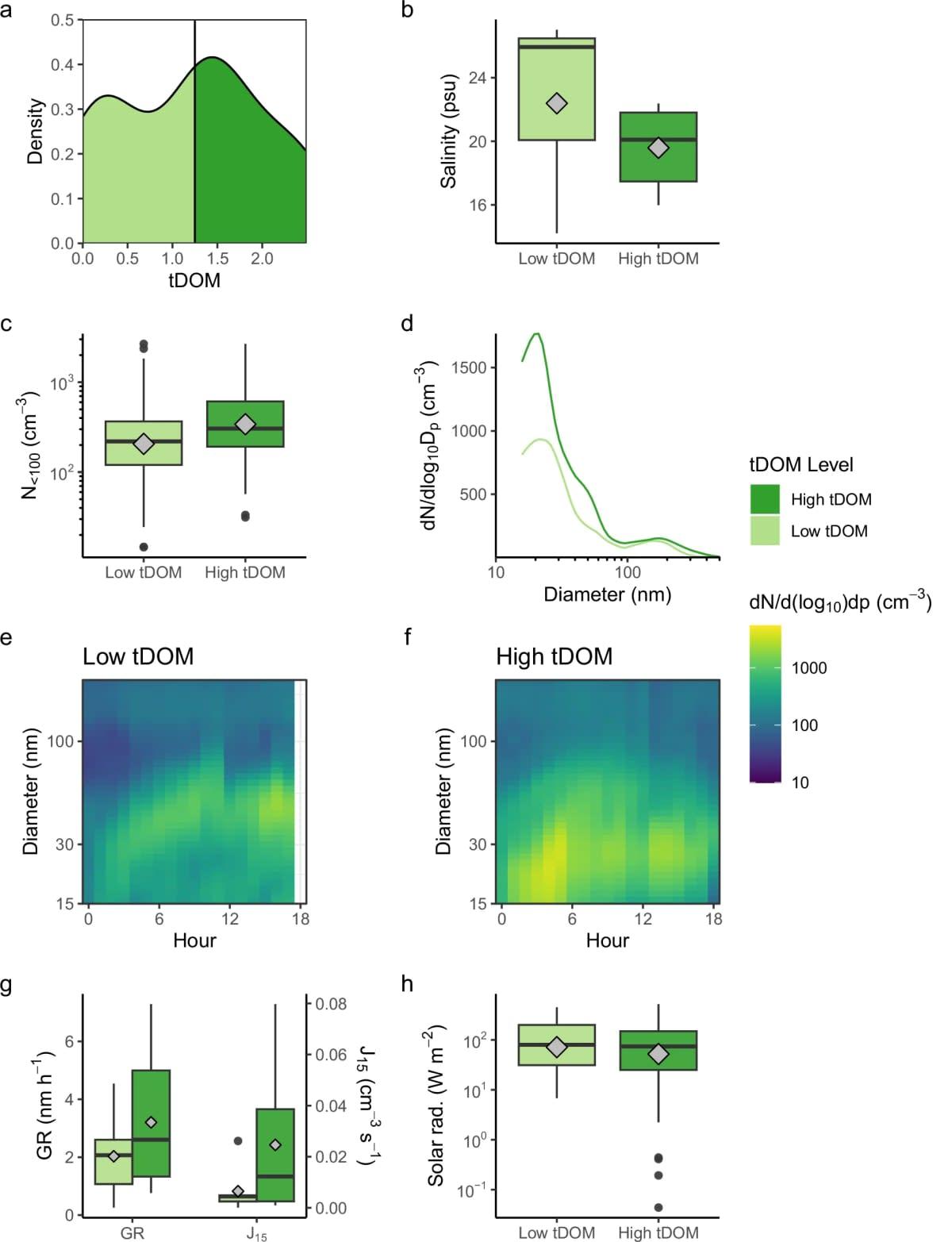
a The exposure of 24-hour HYSPLIT back trajectories to tDOM, splitting the data into two categories; b the salinity of the ocean from SMOS satellite; c N aerosol values and (d) the mean size distribution; e, f the contour plot for the mean NPF event in each category; g the particle growth rate (GR) and formation rate at 15 nm (J15); and (h) solar radiation
Dr James Brean from the University of Birmingham, first author of the paper, shared that clouds have a huge say in the temperatures of the Arctic region. Despite this, a lot is unknown about the formation of these entities in the Arctic. “Our new study shows that terrestrial organic matter carried by rivers is a key ingredient for seeding these clouds. By identifying this natural source, we can build more accurate climate models to predict when the Arctic may become ice-free,” Brean added, per Phys.org.
These clouds regulate temperatures by trapping or reflecting sunlight. The findings imply that as the Arctic becomes hotter, more rivers would enter the sea, and the organic matter in it will facilitate a higher number of clouds. The presence of a higher number of clouds will impact the Arctic climate, which has not been investigated before. “Our study shows how international collaborations are important to understand our changing climate,” Dr Manuel Dall’Osto from the Spanish National Research Center CSIC, also a corresponding author of the paper, said.