
NASA Welcomes the New Year With a Sparkling New Look at Champagne Cluster
Published Dec. 31 2025, 2:55 a.m. ET

Man with telescope looking at the stars.
Just in time for the arrival of 2026, NASA has shared a stunning image of a renowned galaxy cluster. The Champagne Cluster holds special significance this time of year because it was discovered on New Year's Eve in 2020. The occasion and the galaxy cluster's bubble-like appearance helped researchers appropriately nickname it the Champagne Cluster, a much catchier name than its official designation, RM J130558.9+263048.4. In a recent announcement, NASA revealed that its Chandra X-ray Observatory and optical telescopes helped capture another breathtaking visual of the cluster. While most galaxy clusters take the shape of a closely-knit circle or oval, this one appeared strangely elongated. The image helped the scientists deduce that the Champagne cluster is actually two different galaxy clusters on their way to merge.
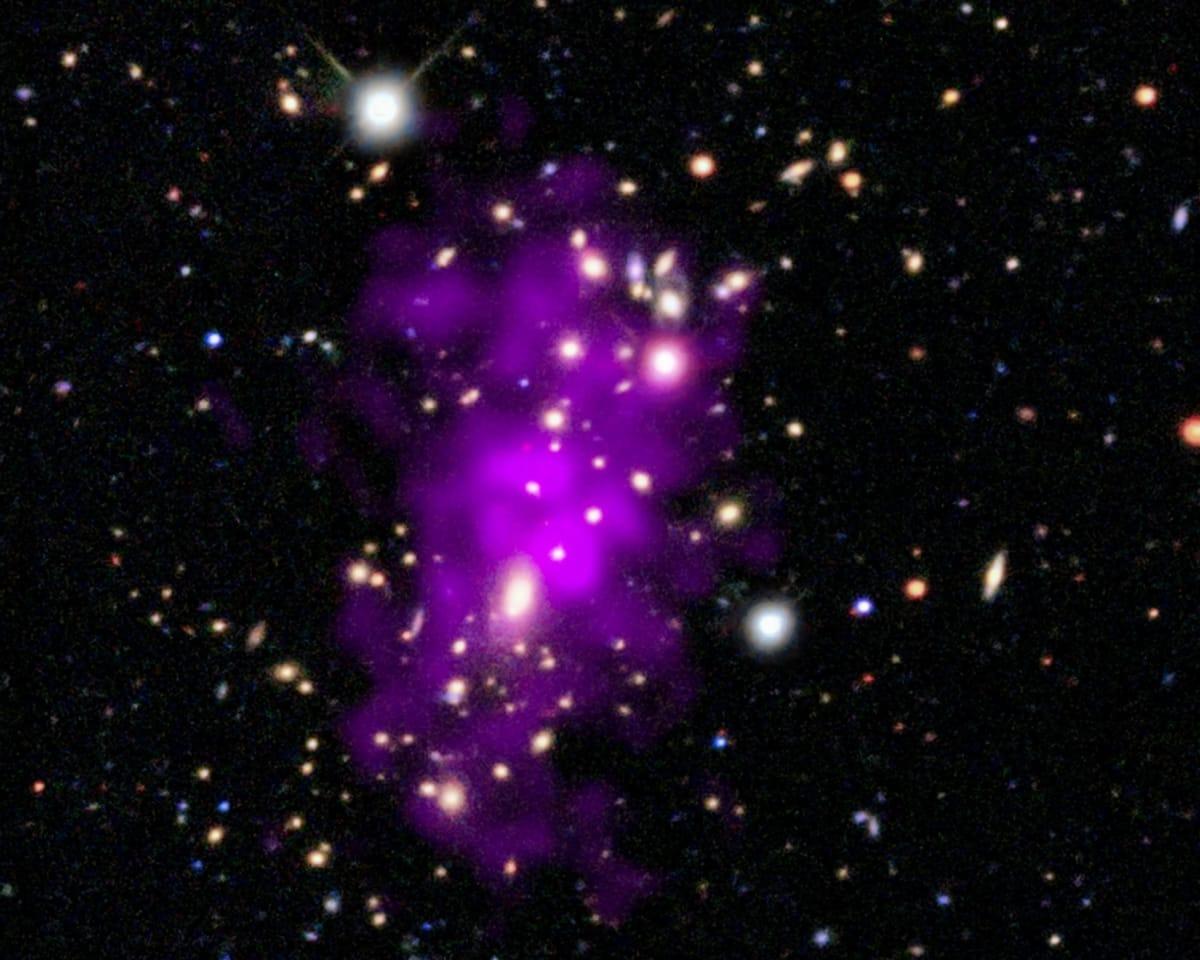
Champagne Cluster captured by NASA's Chandra X-ray Observatory and optical telescopes.
This explains why the Champagne Cluster appeared widely spread from top to bottom. As per the findings published in The Astrophysical Journal, the two clumps of galaxies can be seen at the top and bottom of the center of the colliding cluster. Between and around these galaxies lies extremely hot gas. Even if there are hundreds of galaxies, the mass of the superheated gas outweighs that of all the galaxies in the newly forming cluster combined. The cluster also contains dark matter in substantial amounts. Even though these matters are not visible, they are believed to be a major reason why galaxies are intact and not pulled in by gravity. "Dark matter is the invisible glue that holds the universe together. This mysterious material is all around us, making up most of the matter in the universe," according to NASA.
In addition to the Chandra data, the image includes optical observation from Legacy Surveys. The three complementary surveys were conducted using telescopes in Arizona and Chile. Combing these data gives a fuller picture of the cluster, allowing scientists to make accurate observations. The Champagne Cluster has been placed under a rare category of merging clusters, which includes the famous Bullet Cluster, among others. The galaxy clusters in this category showed slowed movement of gas after a collision. Based on previous patterns, scientists have concluded two possibilities behind the formation of the Champagne cluster that was recently observed.
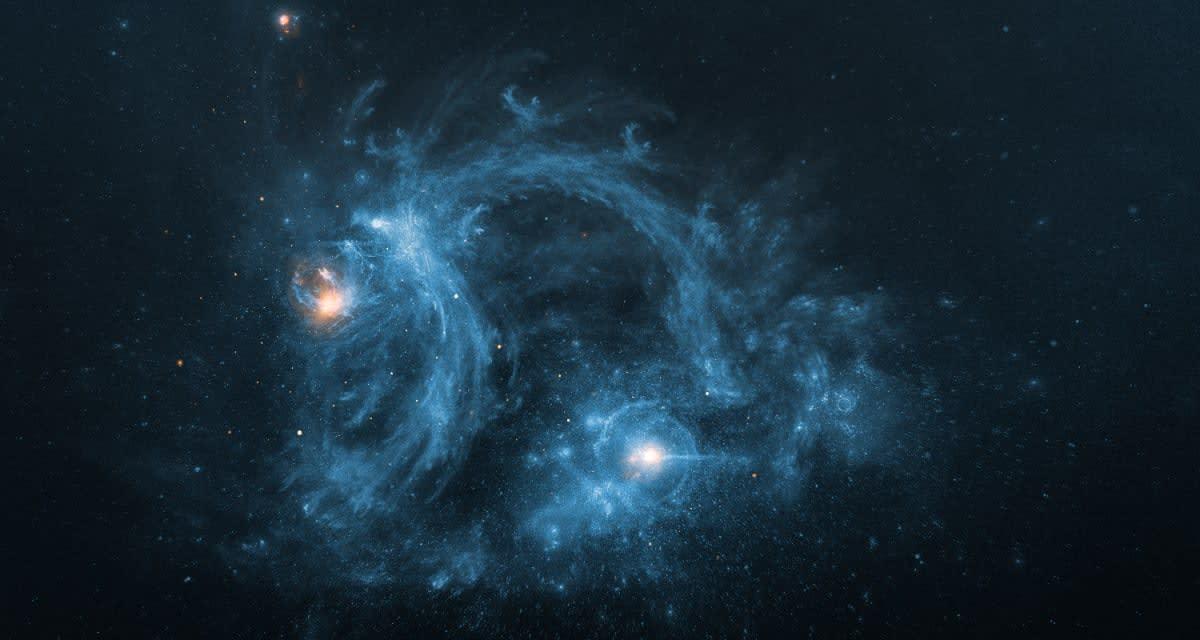
Image of distant galaxies merging.
One theory suggests that the two clumps of galaxies that seem to be hurling towards each other have already collided once, about two billion years ago. Following the usual pattern of a merging cluster, the two galaxies travelled outward after the collision only to be pulled back later by gravity. According to this theory, the individual clusters are headed for their second collision. In the other proposition, scientists believe that the first collision could have occurred about 400 million years ago, and the galaxies are traveling away from one another and not colliding. Although the jury's still out, scientists believe that the study of the Champagne cluster will provide powerful insights about dark matter in space and how it reacts to high-speed collisions.