
Melting Glaciers Expand Alaska’s Lakes Faster Than Expected. But There’s a Silver Lining
Published March 11 2026, 8:00 a.m. ET

Overview map showing ice-marginal lakes, glacier extent, and mapped glacier-bed overdeepenings
A new study published in the journal PNAS states that Alaska’s glacial lakes are growing much faster. Between 2018 and 2024 alone, they expanded by more than 58 square miles (150 square kilometers). Scientists say they could eventually grow to over four times their current size as glaciers continue to melt and pull back. Although glaciers may appear frozen, they are actually always moving very slowly. Their huge weight and gravity push them downhill across the land. As they slide along, they scrape and dig into the rock beneath them. Due to this, they carve deep bowl-shaped pits known as overdeepenings. When the climate warms, these huge pits quickly fill with meltwater, creating new lakes.
Since most of these basins are hidden under thick glacier ice, it makes it hard for scientists to measure them. However, the team led by Daniel McGrath from Colorado State University combined existing data with computer models that estimate ice’s thickness. It helped them get a much clearer idea of what’s going on beneath the glaciers. The researchers also looked at satellite images taken between 2018 and 2024 to track how the lakes have changed over time. By comparing those images year by year, they could see how much new land was being filled with water as glaciers pulled back.
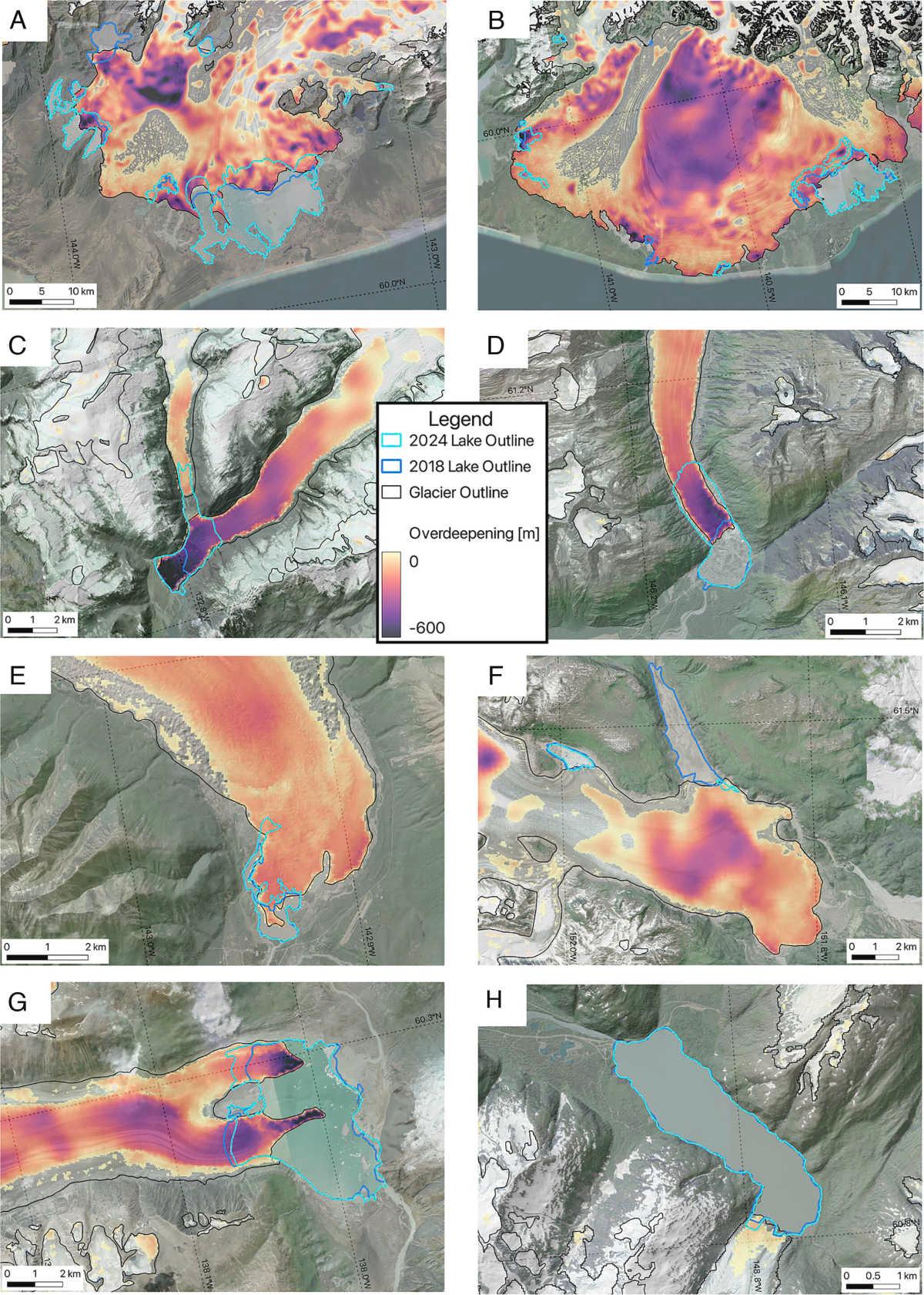
Mapped glacier-bed overdeepenings and ice-marginal lake change between 2018 and 2024
“Our findings show that ice-marginal lake growth was closely correlated with glacier retreat through glacier-bed overdeepenings, providing a simple explanation for historical growth and a tool for identifying lakes/glaciers that may experience rapid change in the coming years to decades,” the team wrote in the paper. The team subtracted the estimated thickness of the ice from the surface height of the land to figure out the size of the hidden basins. Moreover, they also studied how quickly the ice near the front of the glaciers was moving, which helped them understand how the growing lakes might be affecting the glaciers themselves.
A lot of Alaska’s glaciers end on land rather than flowing into the ocean. When they melt, the water runs downstream and usually leaves behind wide, rocky areas with very little vegetation. Because the water carries lots of loose sediment from the glacier, the streams often split into different channels. They keep changing their paths and constantly reshape the area. “Those habitats are fairly inhospitable for a lot of fish,” Jonathan Moore, an aquatic ecologist, said, per Science News.
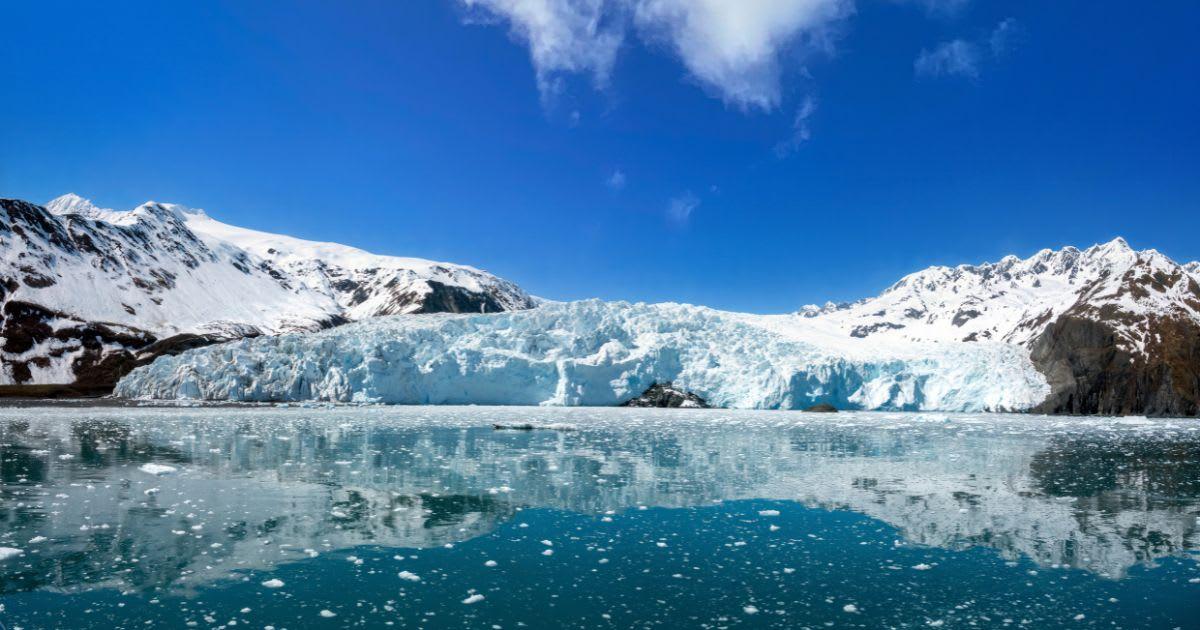
Glacial lakes in Alaska have rapidly grown over the past few years.
However, there is a kicker. When glaciers start pulling back into lakes, and those lakes get bigger, the meltwater behaves a bit differently. Instead of rushing straight into rivers full of debris, the water first sits in the lake for a while. It gives the sediment time to settle to the bottom, and the water also warms up slightly before flowing downstream. Because of that, the rivers carry less sediment and are less likely to keep shifting and splitting into new channels. Jeffrey Moore and Diane Whited found that this was happening in southeast Alaska in their study.
In the paper, they saw that glacial lakes expanded by looking at nearly four decades of changes. The rivers downstream became more stable. That stability made it easier for plants like willows and shrubs to spread across the floodplains, slowly turning rocky areas into greener landscapes. According to another study by Moore and Erwig Hood, it suggested that glacier retreat could actually help some fish in the long run. They estimated that by 2100, melting glaciers in southeast Alaska could turn over 3,700 miles (6,000 kilometers) of rivers into good habitat for certain local salmon species.