
NASA Captures Florida’s Oceans Dramatically Change Color Following Record Arctic Blast
Published Feb. 24 2026, 4:28 a.m. ET

Before (Jan. 24, 2026) and after (Feb. 3, 2026) satellite images reveal the water’s dramatic color changes.
Some interesting changes have been observed in the West Florida Shelf. Experts claim that an Arctic air wave has changed the deep azure waters of the Gulf of Mexico to a bright mixture of blues and greens, according to NASA. This phenomenon unfolded during late January and early February 2026. During this period, two massive winter storms, named Fern and Gianna, occurred. A connection exists between the color change and winter storms. This water change on the West Florida Shelf was captured through the Moderate Resolution Imaging Spectroradiometer (MODIS) tool on NASA’s Terra Satellite on February 3, 2026. More images came from Landsat 9’s Operational Land Imager (OLI).
Researchers believe that the pale blue color of the waters was caused by aggravated calcium carbonate mud, according to Popular Science. This mud is mainly composed of the remains of marine beings. NASA scientists speculate that the mud swirled due to a cold air event that occurred in the region. This event caused stronger winds, leading to a dramatic fall in ocean temperatures. Both of these factors pushed the cold, shallow waters towards becoming denser and ultimately moving offshore with the tides. These instances mostly occur during hurricanes, but can also unfold in winter storms, as evident by the West Florida Shelf situation.
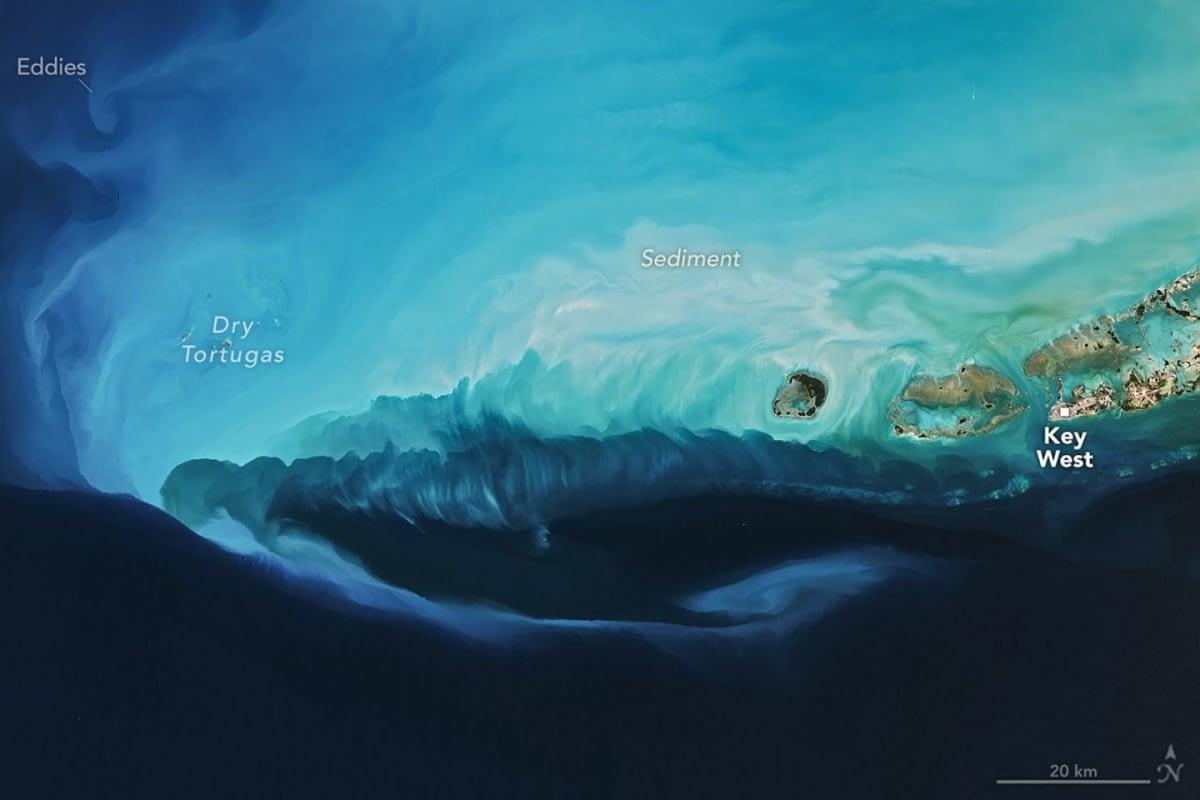
Image Captured of West Florida Shelf by the OLI (Operational Land Imager) on Landsat 9
The color change is rare, as the outbreak of intense winter weather that has seemingly caused it is reportedly infrequent. The winter weather was triggered by surges of Arctic air entering eastern North America in late January and early February 2026. The wintry conditions this phenomenon enabled caused big areas in the US to go under a blanket of snow and ice. Temperatures also went below freezing in many counties of Florida at the start of February. The infiltration of cold air formed cloud streets in the atmosphere and a colorful display in the shallow marine waters.
The colorful display of blue and greens unfolded because carbonate sediment spread out on the seafloor was pushed up by the wind-stirred ocean waters. The image captured by NASA’s Terra satellite was provided alongside a photo of waters over the West Florida Shelf before the cold air arrived. The contrast shed light on how much suspended calcium carbonate (CaCO3) mud has overtaken the waters in just a short period of time. Experts also added that when dense water flows offshore, it transports some sediment toward the shelf’s edge. Such sediment suspension events had been noted previously with Hurricane Melissa in 2025.
The images captured by the OLI (Operational Land Imager) on Landsat 9 provide a more detailed view of the phenomenon. James Acker, a data support scientist at the NASA Goddard Earth Sciences Data and Information Services Center, claimed that “hammerhead” eddy features are evident along the slope of the West Florida Shelf. Such features typically form due to narrow streams of denser chilled seawater carrying sediment offshore, coming face-to-face with slower-moving Gulf waters. Often, this encounter makes them turn into pairs of counterrotating eddies, which are “hammerhead” eddy features.
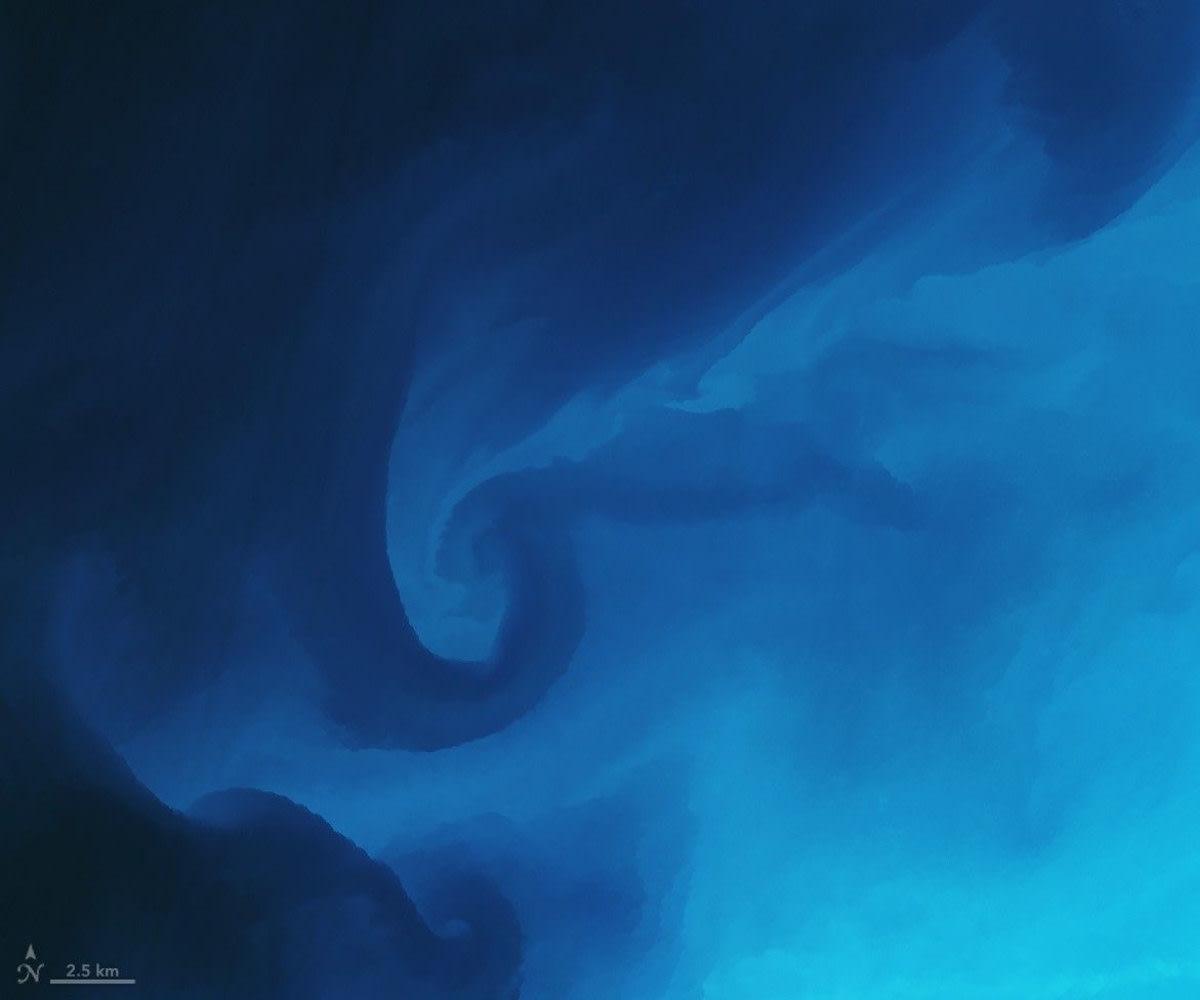
The “hammerhead” eddy
The eddy features were noteworthy, as scientists have detected them in natural events unfolding on Mars. Researchers also observed a patch of bright water in the pictures that suddenly concluded with a vertical, sharp edge. The sudden end is a consequence of sediment-laden water moving out of the shelf area through the south channels, and then being abruptly swept east by the Loop Current. Researchers are ecstatic to have one more example of carbonate sediment suspension events to investigate. It is because such events play a significant role in the planet’s carbon cycle.
To date, researchers have understood that tropical cyclones are the primary phenomenon after carbon present in shallow-water marine sediments, moving to deeper waters. However, they have yet to figure out how cold fronts contribute to the process. The West Florida Shelf event suggests that the cold fronts function on a local level by stirring sediment, which causes a change in ocean color. It does not seem that they participate much in the large-scale movement of material into the deep ocean.