
Experts Say This Interstellar Comet's Tail Is One of the Strangest Ever Seen
Published Dec. 16 2025, 9:01 a.m. ET

Two people are looking at the night sky.
Imagine noticing a new animal in your backyard, a cat with a massive size, a cat with a tail on its forehead instead of its rear end. Avi Loeb, a Harvard astrophysicist, used the analogy of this odd "cat” to reflect upon our latest interstellar visitor, 3I/ATLAS. Ever since this interstellar comet was spotted in our solar system's backyard, it has left scientists adrenalized with curiosity. With a size so massive and speed so monstrous, the cosmic entity rendered even the powerful gravity of the Sun utterly powerless. Adding to the library of mysteries that 3I/ATLAS has unlocked for scientists, a new mystery has materialized in the form of a long, glowing cigar-shaped tail. In contrast to the tails of most comets, this tail is pointing towards the Sun, not away from it. In a recent post on Medium, Loeb contemplated and deconstructed this mysterious tail, rather “anti-tail.”
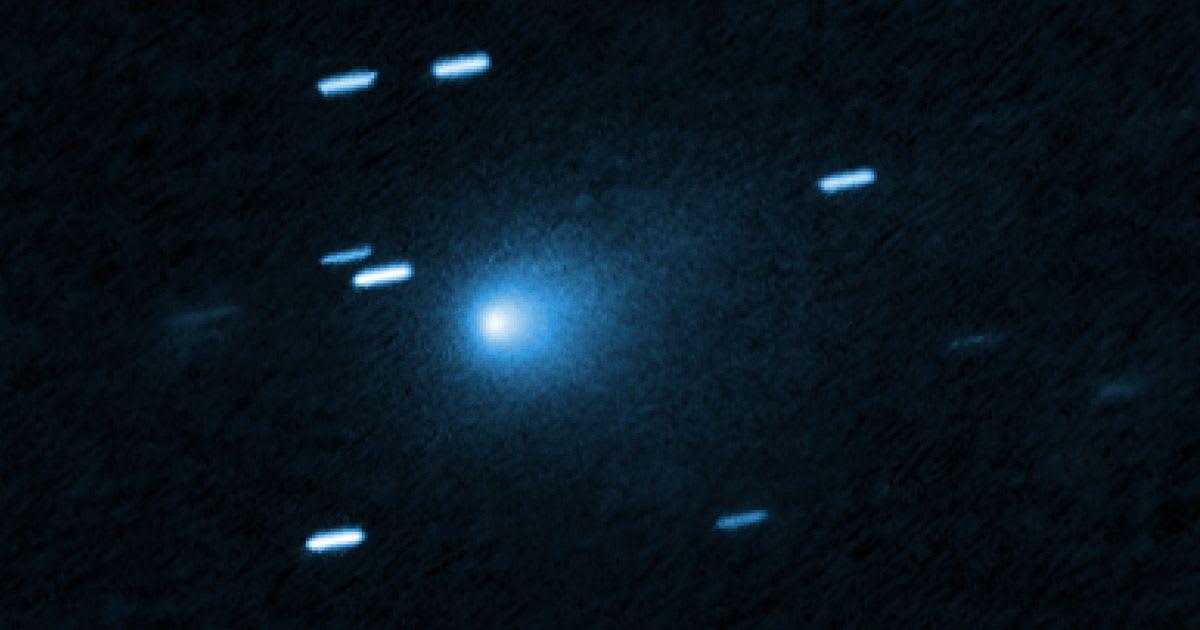
Image Source: NASA, ESA | David Jewitt (UCLA), Joseph DePasquale
Every comet has a tail. When a comet arrives close to the Sun, the immense heat weakens and melts away its icy nucleus, dismantling some of it into dust and gas. The violent solar winds blasted by the Sun then push this trail of dust and gas away from itself, which forms a tail-like structure that points away from the Sun. But weirdly enough, 3I/ATLAS doesn’t have the typical tail, but a rather bizarre one that is pointing towards the Sun. Scientists hypothesize that it is just the heavier dust particles that were left behind on the comet’s orbital path as it moved away after meeting the Sun. But there’s another peculiar detail that has caught the scientists’ attention. The tail is unusually long.

Avi Loeb speaks about space exploration.
Loeb, who has often been suspicious that 3I/ATLAS may be some sort of alien technology, laid out an interesting mathematical breakdown that illustrates the scope of this unusual length. By analyzing some images of the comet captured from December 14 and December 15, Loeb points out that the tail extends 310,685 miles away from the nucleus of 3I/ATLAS towards the Sun. This length, he noted, is larger than the average distance from the moon, approximately 238,855 miles.
The astrophysicist shared two of the latest images captured by Toni Scarmato. One image was taken on December 15, on a telescope in Calabria, Italy. The bottom panel shows a brightness map from a Larson-Sekanina rotational gradient filter on a fraction of the entire field of view, featuring an anti-tail going out to 310,685 miles from 3I/ATLAS in the sunward direction towards the lower left. “An anti-tail of this size had never been observed before for a comet,” Loeb exclaimed.
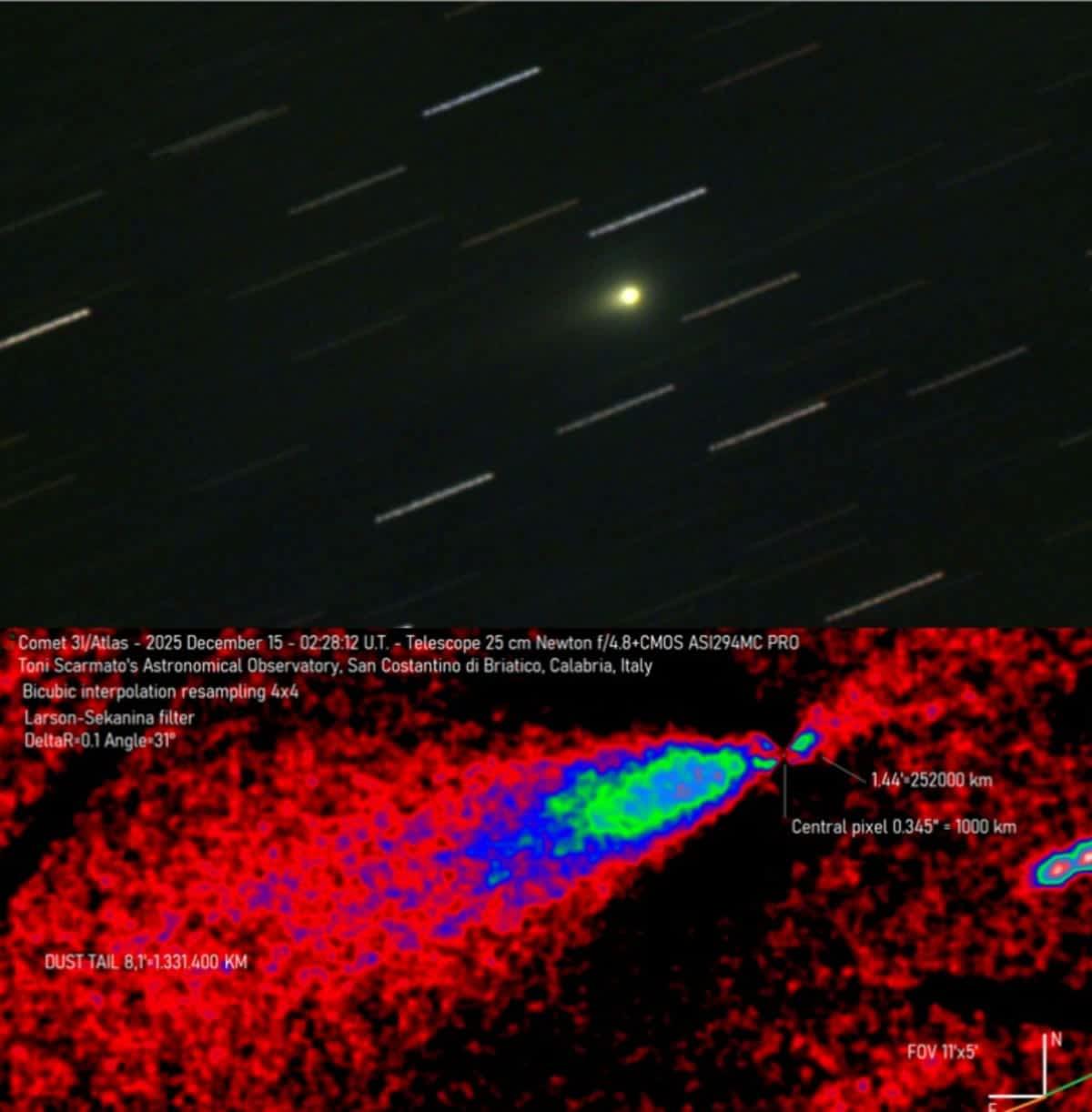
Image of interstellar comet 3I/ATLAS captured on December 15 by a telescope in Italy
Calling out on some of the state-of-the-art telescopes like PanSTARRS, ATLAS, or Rubin, Loeb said they can only detect the reflection of sunlight from interstellar objects that are larger than 328 feet in diameter, roughly the size of a football field, within a distance comparable to the Earth-Sun separation. With instruments that are not too exact, he said, the information is not sufficient to assess how unusual or ordinary 3I/ATLAS’s behaviors are. It's like a vast “interstellar dating pool,” he described. Unless scientists sample a lot of interstellar candidates, they can’t possibly know the basis of comparison, and whether or not a comet is unusual. Sadly, however, only three objects have been discovered so far that came from another solar system, 3I/ATLAS being the third one.
Meanwhile, scientists and astronomers continue to remain bamboozled by this strange, glowing interstellar object that has got them occupied with a whole Pandora's box of mysteries that doesn’t have any end. It seems, even when 3I/ATLAS departs from our solar system in early 2026, its short visit will etch an unforgettable story in the books of scientists, detectives, and those who write science fiction.