
NASA Says This Passing Interstellar Comet Is Loaded With Life-Forming Ingredient
Published Dec. 11 2025, 7:39 a.m. ET

A man watches a comet pass by.
Back in the summer this year, scientists were studying unusual objects hovering around Earth. ATLAS, one of the telescopes in NASA’s planetary defense network, displayed something that left them scratching their heads. When they first spotted it, the mysterious interstellar comet was travelling at about 137,000 miles per hour. After getting pulled by Sun’s gravity, in October, it sped up at 153,000 miles per hour. Eventually, they realized that the comet, named 3I/ATLAS, was too fast to be bound by the Sun’s gravity, and it seemed that it was just passing through our solar system, greeting the planets. As time went by, the name 3I/ATLAS began flooding the news bulletins, broadcasting streams, headlines, tickers, and social media. A phalanx of studies filled the astronomy journals. A latest discovery, published on the arXiv server, details the remarkable chemistry of 3I/ATLAS that has now revealed a “key ingredient of life.”
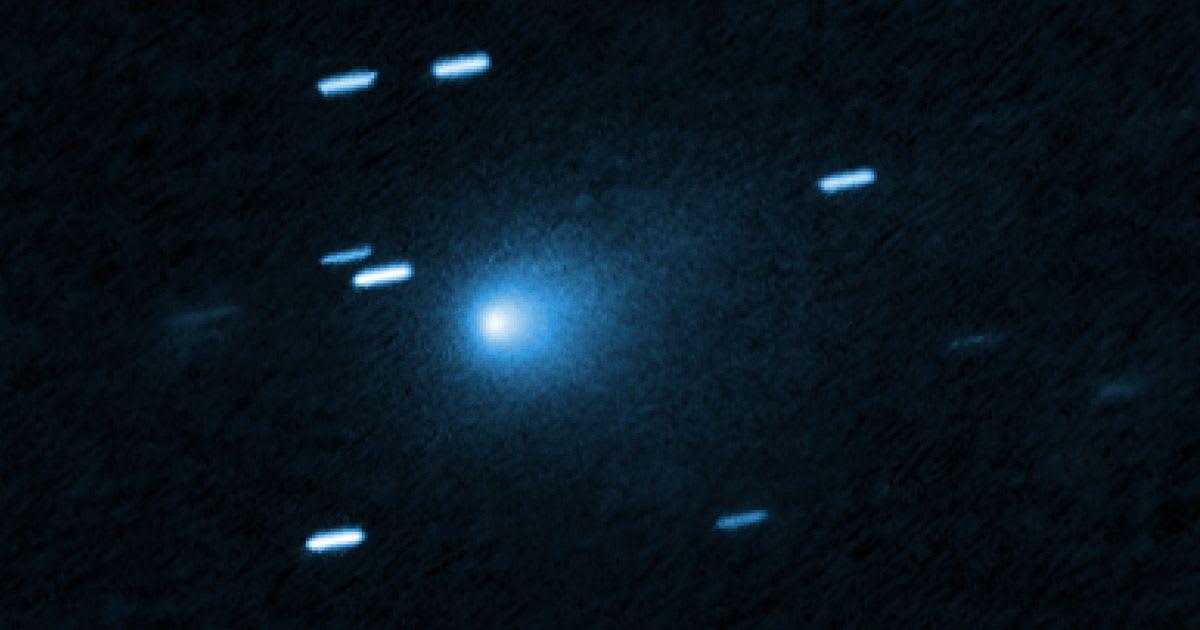
Image Source: NASA, ESA | David Jewitt (UCLA), Joseph DePasquale
The mysterious nature of 3I/ATLAS has left scientists both curious and excited about the possibilities they can unravel about the cosmos. When scientists first detected it, while it was approaching the Sun’s orbit, they noticed that its icy nucleus was getting heated by the scorching radiation. A halo of dust and gas formed around the comet, flung and swept into a glowing tail that was getting longer with every passing moment. Other studies documented features like a rhythmic heartbeat pulsing and jets of icy volcanoes shooting from it.
The latest study has revealed something even more thrilling. Rumbling within the comet is an abundance of carbon-rich material, which, scientists believe, is one of the key ingredients of life. As 3I/ATLAS got closer and closer to the Sun’s boundary, instruments detected a dramatic rise in this ingredient, a.k.a. methanol. Methanol is a toxic, colorless, flammable liquid that resembles alcohol, the same substance you may find in your laundry detergent, perfume, or cosmetics.
Methanol in a bottle sitting on a counter.
Billions of years ago, methanol was deposited on Earth, which became a precursor of life. It is the same substance that forms the basis of DNA, RNA, and proteins, regarded as the building blocks of life. Currently, this is just a hypothesis, but still, the sheer concentration of menthol, along with hydrogen cyanide, in 3I/ATLAS is beyond surprising. The interstellar guest isn’t just carrying a bag full of this gassy material. It is loaded with it.
Every part of 3I/ATLAS revealed the traces, including the rocky core, the coma, and the cloud surrounding the nucleus. Around eight percent of the vapors being ejected from the comet were found to be brimming with methanol. The gases were first detected by Martin Cordiner, an astrochemist at NASA’s Goddard Space Flight Center, and his team, who locked the ALMA telescope in Chile on the comet. In conversation with New Scientist, Cordiner reflected that although these molecules are found in many comets, they are in trace abundances and not as dominant constituents. “Here we see that, actually, in this alien comet, they’re very abundant.” Unless the comet had a very high chemical complexity, it wouldn’t be producing such boatloads of methanol, he added.
Bright glowing comet hurtling in space
The presence of ancient gases in 3I/ATLAS has unlocked a new cave of mysteries for scientists to explore. It is fascinating to imagine that a comet like this could have birthed life billions of years ago. And who knows, that comet could have been 3I/ATLAS itself. If yes, then we don’t have much time left to study its cosmic sparkles and stellar tantrums. After pulling itself from Sun’s gravity, the comet is predicted to have a close encounter with Earth on December 19, following which it'll head towards Jupiter, and by March 2026, it will depart from our solar system, disappearing into the vastness forever.