
Scientists Find Key Life Ingredient in Space — And It’s Never Been Seen Outside Earth Before
Published Feb. 3 2026, 8:50 a.m. ET

In the heart of our galaxy, scientists discovered the first sulfur-bearing six-membered ring molecule hiding in an interstellar cloud.
Sulfur, the big S that sits below oxygen in the periodic table, holds clues to one of the greatest questions, the mystery of how exactly life originated on Earth. It is one of the key ingredients in the cocktail of life-birthing chemicals: amino acids, sugars, and RNA. Lurking in everything from car batteries to matchsticks and wines, sulfur is the tenth most abundant element in the universe by mass. Over billions of years, probably, this element was delivered to our planet, bit by bit in traces, via meteorites and assorted space rocks. Scientists always thought that there was a bulk of sulfur sloshing in the cold, dusty, dark spaces between stars.
When they gazed into this space, a.k.a. interstellar space, they didn’t find any. And then recently, they found it, billowing and pulsing inside the heart of our Milky Way. On the surface, it looked like a ring-shaped chemical, but when they investigated deeper, they realized that it was the largest sulfur-bearing molecule detected beyond Earth. They documented the finding in Nature Astronomy.
The sulfur element in the periodic table with number 16 and symbol S
Sulfur-bearing molecules govern some of the key biological processes of life, but when scientists didn’t detect one in space for several years, it was confusing, if not frustrating altogether. In the latest study, astronomers from the Max Planck Institute for Extraterrestrial Physics (MPE) and the CSIC-INTA Centro de Astrobiología (CAB) were examining space when their instruments whirred with the detection of a sulfur-bearing hydrocarbon, a 13-atom chemical called thiepine, or 2,5-cyclohexadiene-1-thione (C₆H₆S).
The chemical was detected inside a molecular cloud named G+0.693–0.027, located 27,000 light-years from Earth. Molecular clouds are gassy regions in space where accumulated hot dust and gas float around as raw material that will birth baby stars. Deep within this cloud, the scientists observed luxurious traces of sulfur trapped within this chemical compound. The discovery fills a long-standing gap in astrochemistry and strengthens the idea that the raw ingredients of life began forming long before the birth of stars, planets, and even Earth itself. It also illuminates the complex interplay of interstellar space and planetary systems.
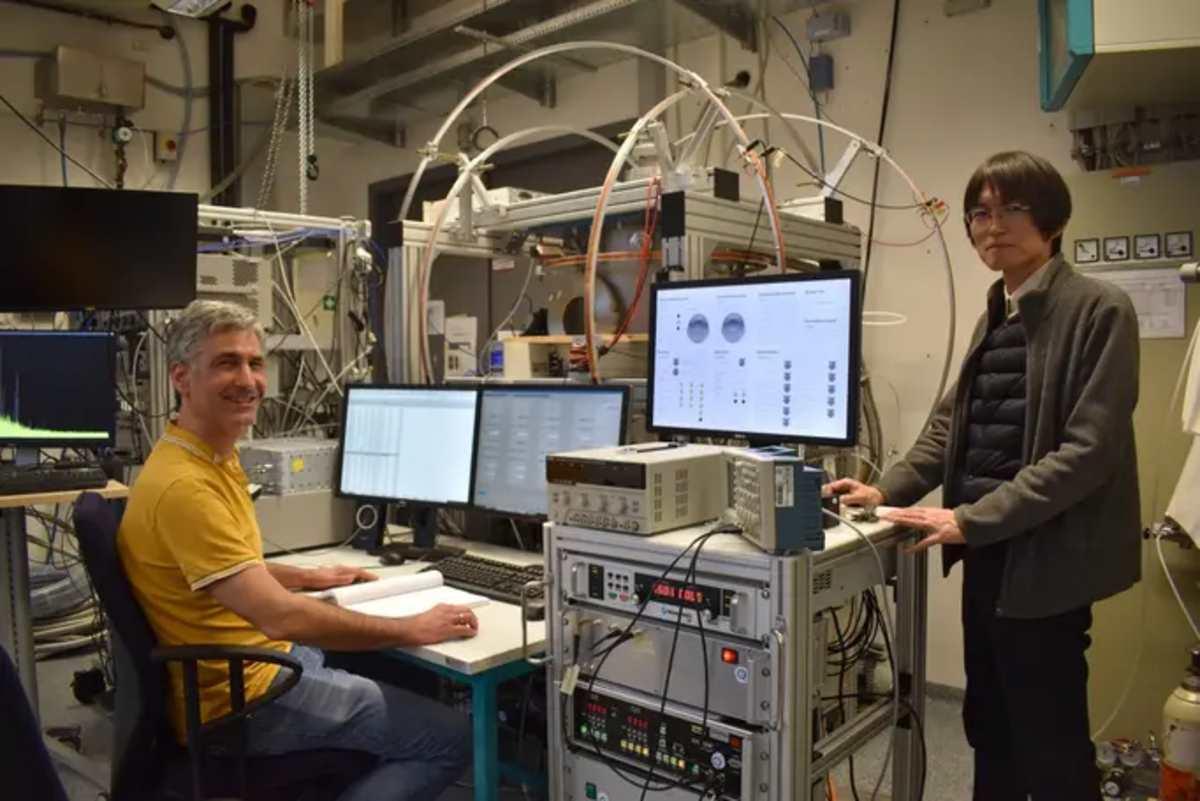
MPE scientists at a state-of-the-art self-developed laboratory spectrometer
The story started when scientists fired a 1,000-volt electric current through a repulsive-smelling sulfur-containing liquid called thiophenol (C₆H₅SH). They broke apart the molecules and allowed them to recombine into new forms, mimicking the energetic conditions of space. After combining astronomical observations with laboratory experiments, they proceeded to the next step: identification. In space, molecules and chemicals aren’t detected by sight but by radio waves. They emit radio waves as they rotate. Scientists utilized spectrometers to trace these radio fingerprints and then referred to the catalogue of fingerprints in astronomical data collected by two powerful radio telescopes in Spain. The data showed signatures of this molecular cloud nestling in the center of the Milky Way galaxy.
The cloud hasn’t even birthed any stars yet. This observation was interesting, as it indicated that the newly discovered chemical could have existed from a time when there were no stars in the universe. “Our results show that a 13-atom (sulfur) molecule structurally similar to those in comets already exists in a young, starless molecular cloud. This proves that the chemical groundwork for life begins long before stars form,” Valerio Lattanzi, one of the study authors and a scientist, said. Lead author Mitsunori Araki reflected that this is the “first unambiguous detection of a complex, ring-shaped sulfur-containing molecule in interstellar space” and also a “crucial step in understanding the chemical link between space and the building blocks of life.”