
Astronomers Spot Mysterious Rainbow-Like Shock Wave Around a Dead Star
Published Jan. 13 2026, 3:46 a.m. ET

The central square image, taken with the MUSE instrument on ESO’s Very Large Telescope, shows shock waves around the dead star RXJ0528+2838.
Nothing much happens to a dead star, residing light-years away from the Earth. Occasionally, shock waves are created from gas and dust striking the surroundings of the star. But when astronomers observed the white dwarf star RXJ0528+2838 through the European Southern Observatory’s Very Large Telescope (ESO’s VLT), they couldn't believe what they had witnessed. Scientists presumed that the dead star, located 730 light-years away, should not have any surrounding structure, considering its small size. “We found something never seen before and, more importantly, entirely unexpected,” says Simone Scaringi, associate professor at Durham University, UK, and co-lead author of the study, published in Nature Astronomy. The researchers observed a multi-hued shock wave, resembling a rainbow, around the star.
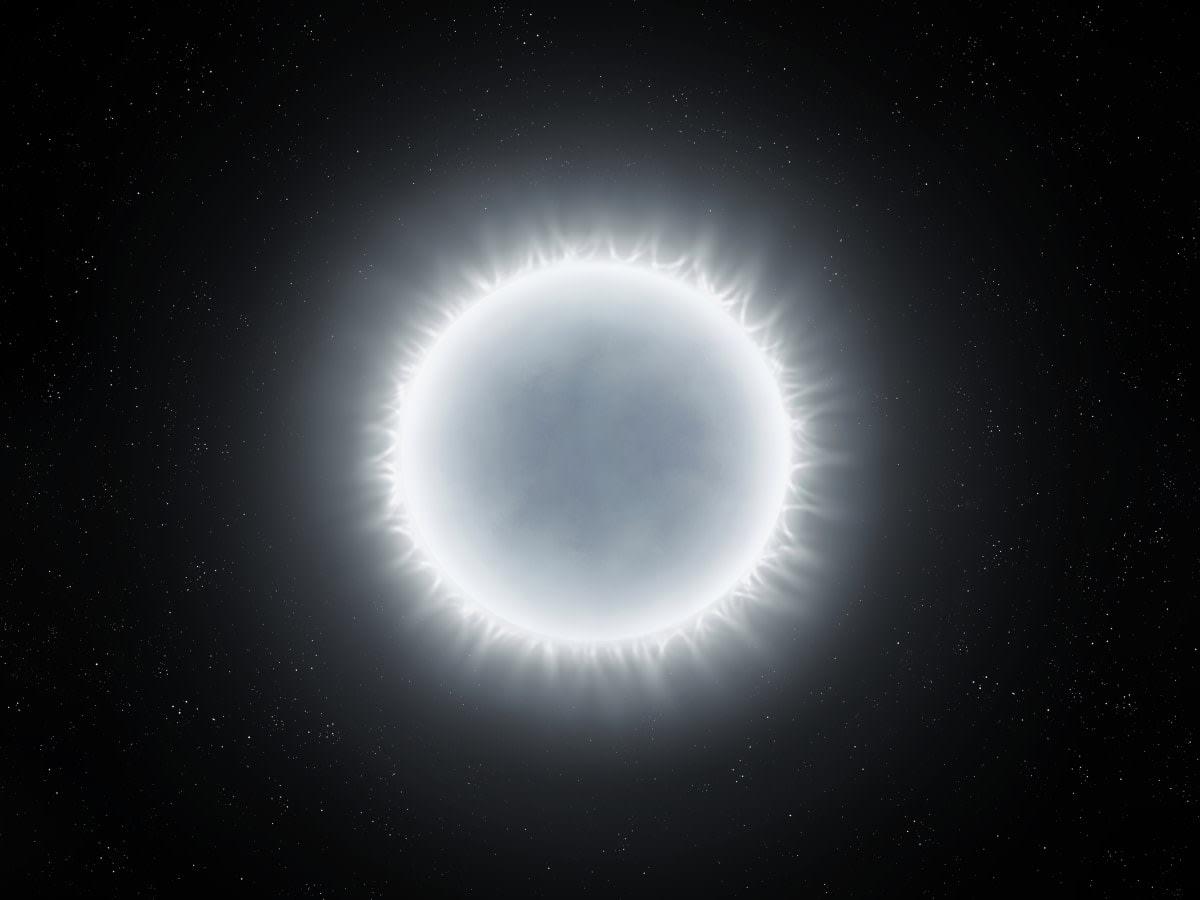
A white dwarf isolated in space.
“The surprise that a supposedly quiet, discless system could drive such a spectacular nebula was one of those rare ‘wow’ moments,” Scaringi added. The white dwarf stars like the Sun revolve around the center of our galaxy, and while traversing through space, in between the stars, they encounter gases. This interaction produces a shock wave, also known as the bow shock. According to Noel Castro Segura, research fellow at the University of Warwick and collaborator in the study, the bow shock waves appeared to be a curved arc and resembled the waves formed when a moving ship cuts through water. The shock waves are typically formed of materials released from the central star, which makes the shock waves emerging from the white dwarf star an anomaly.
Dead stars like the RXJ0528+2838 are remnants of a dying low-mass star. These white dwarf stars pull materials from their companion stars and form an accretion disk around them. The dwarf stars are formed when a star runs out of hydrogen to fuel its glow and isn't massive enough to explode. What's left behind is a dense chunk of matter with mass as large as that of the Sun, according to NASA. For an entity that takes material from its companion star, having a multi-hued structure was out of the question. That was until the recent observation that left researchers puzzled and surprised. “Our observations reveal a powerful outflow that, according to our current understanding, shouldn’t be there,” says Krystian Iłkiewicz, a postdoctoral researcher at the Nicolaus Copernicus Astronomical Center and study co-lead.
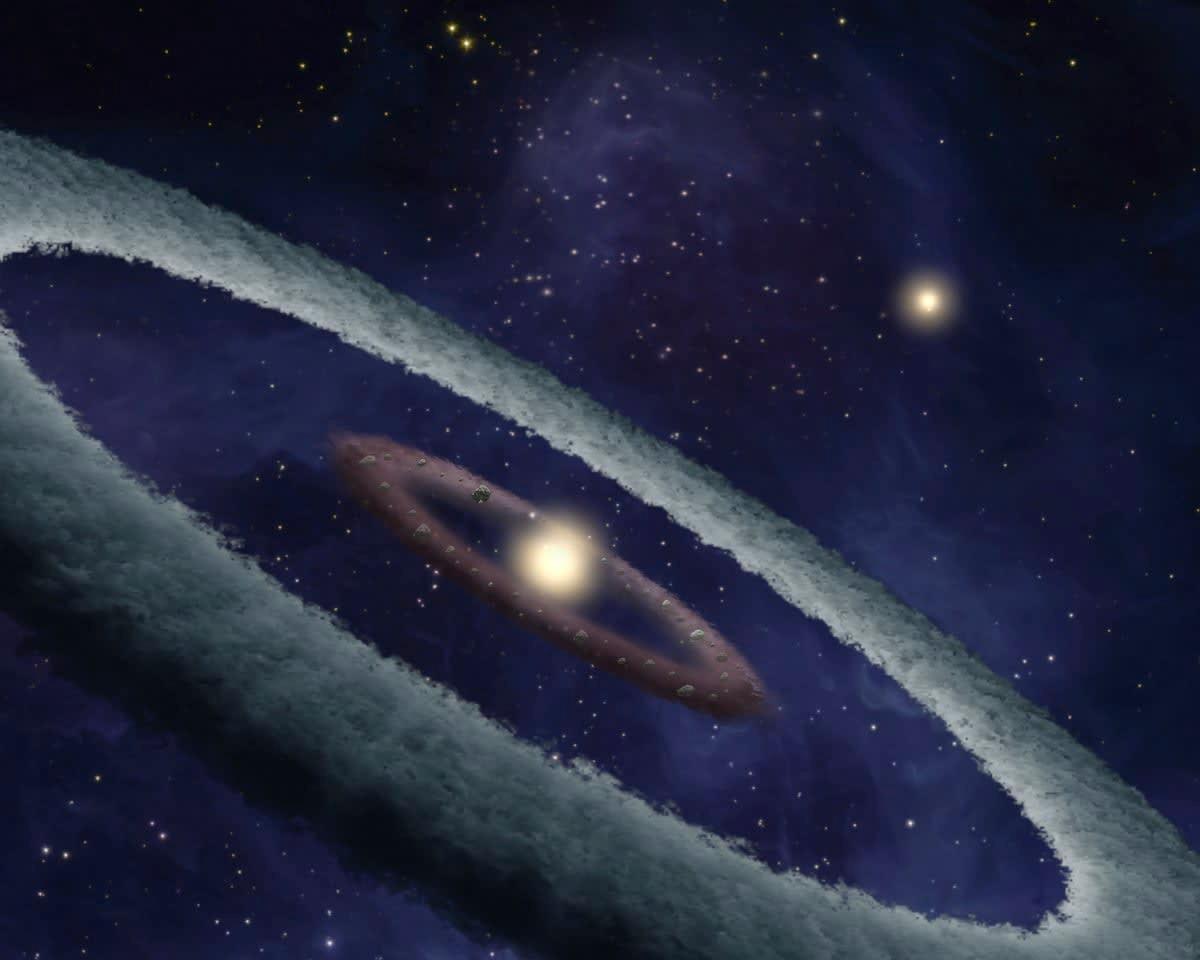
The artist's conception shows a binary star system.
The rainbow-colored nebula was first spotted in images captured by the Isaac Newton Telescope in Spain. They doubled down on the research by using the MUSE instrument on ESO’s VLT for the next observation. “Observations with the ESO MUSE instrument allowed us to map the bow shock in detail and analyse its composition. This was crucial to confirm that the structure really originates from the binary system and not from an unrelated nebula or interstellar cloud,” Iłkiewicz said. Indeed, the bow shock was released from the white dwarf system continuously for at least 1000 years, as interpreted by the shape and size of the shock wave. The materials accreted from a companion star only form a disk around a dwarf star if the magnetic field isn't strong enough.
However, in the case of RXJ0528+2838, the material landed directly onto the star instead of forming a disk. “Our finding shows that even without a disc, these systems can drive powerful outflows, revealing a mechanism we do not yet understand. This discovery challenges the standard picture of how matter moves and interacts in these extreme binary systems,” Iłkiewicz added.