
Antarctica's Future Hinges on Emission Choices Today. Experts Reveal Best and Worst Case Scenarios
Published Feb. 23 2026, 4:03 a.m. ET

Differences in sea ice concentration for the Antarctic Peninsula, comparing the years 2020–2029 and 2090–2099 CE under three different SSPs. Sea ice margin in the year 2024 is shown (red line).
Antarctica is undergoing potentially irreversible changes amidst increasing global warming and climate change. The icy landscape essential for reflecting solar heat is now melting at a concerning rate. Scientists tried to paint a picture of the worst- and best-case scenarios if this pattern continues. While the stakes are high for potential sea level rise and habitat and food chain destruction, the experts have also deduced the best that can be done to prevent such harms. “The Antarctic Peninsula is a special place,” said Bethan Davies of Newcastle University, lead author of the article in Frontiers in Environmental Science. “Its future depends on the choices that we make today. Under a low emissions future, we can avoid the most important and detrimental impacts," he noted.
However, under a higher emissions scenario, the risk of losing sea ice, ice shelves, glaciers, and iconic species such as penguins is high. The Earth is woven together by flowing water, so even though Antarctica is on the edge of the world, it will have a planetary impact. The changes in sea level, oceanic and atmospheric connections, and circulation will affect the rest of the world equally.
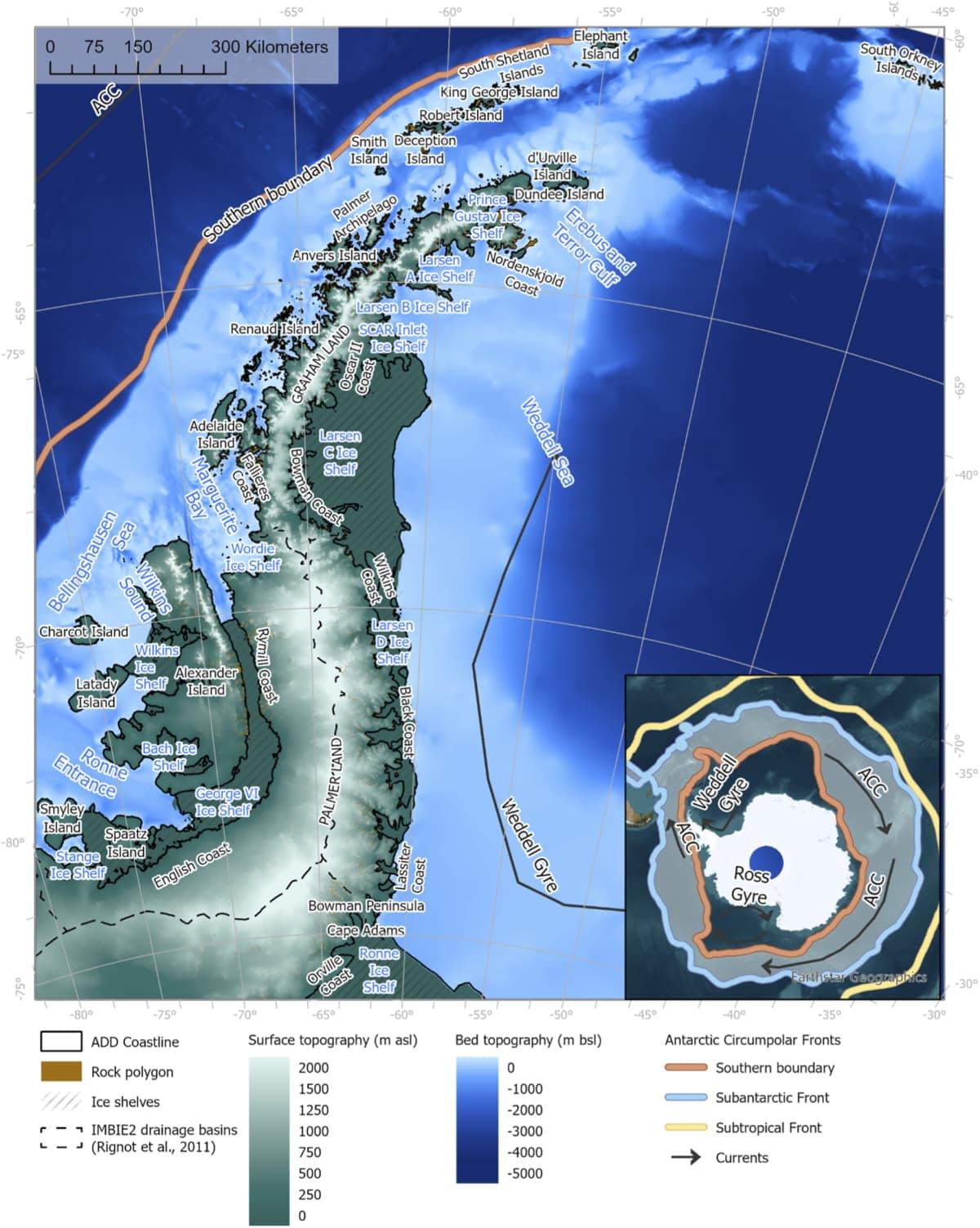
A map of the Antarctic Peninsula.
"Changes in the Antarctic do not stay in the Antarctic," Bethan added. For the research, the scientists focused on the Antarctic Peninsula, which has been extensively explored through research, tourism, and fishing. The well-studied region is vulnerable to anthropogenic changes, making it easier for scientists to track the effects of climate change.
Peter Convey of the British Antarctic Survey and co-author of the study revealed that he had spent some time in the South Orkney Islands, from November 1989 to April 1991. “For a casual visitor, the first impression is still inevitably that the region is ice-dominated. However, to those of us that have the privilege to go back multiple times, there are very clear changes over time," he explained. Scientists developed climate scenarios to understand the potential changing landscape of the Antarctic Peninsula. During low future emissions, the temperature increases by 1.8°C. In the medium emissions scenario, the Antarctic Peninsula warms by 3.6°C, and very high future emissions would increase the temperature by 4.4°C.
During the study, the scientists focused on eight aspects of the Antarctic Peninsula that would be impacted by climate change, including marine and terrestrial ecosystems, land and sea ice, ice shelves, the Southern Ocean, the atmosphere, and harmful events like heatwaves. “In 2019, we demonstrated how the Antarctic Peninsula would be affected by the 1.5°C climate scenario. Now, in 2026, we share what exceeding 1.5°C looks like for the Antarctic Peninsula, which is a frightening prospect," said Martin Siegert of the University of Exeter and co-author of the study.
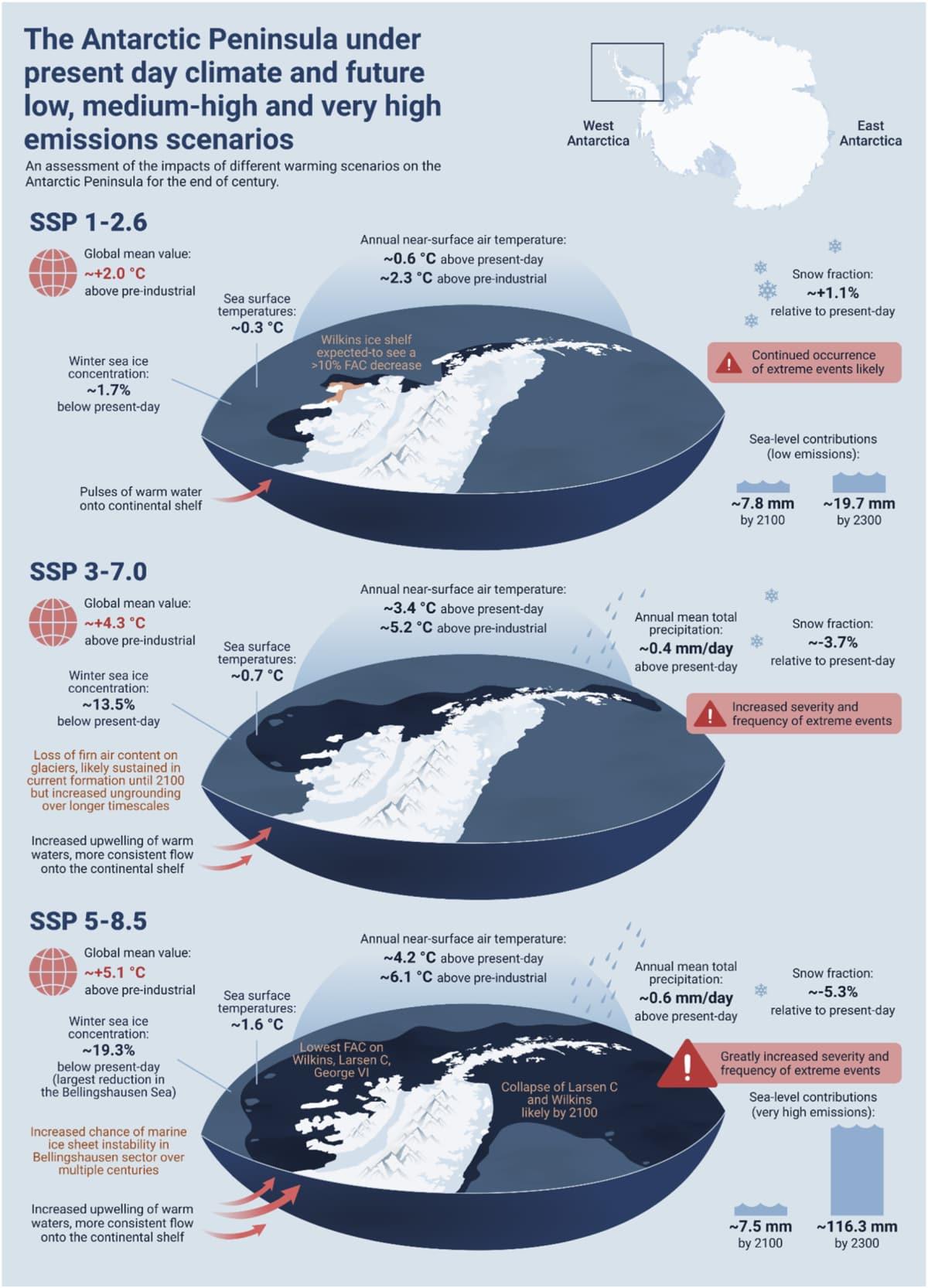
Schematic illustration of how the Peninsula will change under different climate change scenarios.
Scientists found that in the highest emission scenario, 20% of Antarctica's sea ice coverage would collapse. In the aftermath of this devastating loss, important species that rely on sea ice, such as krill, which serve as crucial prey for whales and penguins, will face habitat loss. It would also increase ocean warming across the globe.
It's challenging to predict the full extent of ecosystem damage from climate change, but scientists suggest that many species will migrate to the south to escape the rising temperatures. While warm-blooded predators might adapt to the hot environment, if their prey dies, they might starve to death. “What concerns me most about the higher emissions scenario is just how permanent the changes could be. These changes would be irreversible on any human timescale. It would be very hard to regrow the glaciers and bring back the wildlife that makes Antarctica special," said Davies.