
Climate Change Is Making Frogs More Attractive. Scientists Say It Could Also Affect Their Future
Published Feb. 13 2026, 9:53 a.m. ET

A Pacific tree frog in the Sierra Nevada.
Researchers have caught intriguing changes in frog calls, and they believe climate change is responsible for these alterations. The team followed several frogs and found that in early spring, mating calls by male frogs are sluggish in quality. As the temperature increases in the water, possibly due to global warming, these calls become quicker. Some suggest that the calls sound “sexier” because of this pacing. Though meant for females, even humans can note these subtle changes if they hear the calls long enough. Findings have been published in the journal Frontiers in Ecology and the Environment.
The evaluation was conducted by researchers from the University of California, Davis, according to BBC Science Focus. The team focused on the frog population in Quail Ridge Ecological Reserve and Lassen Field Station. The love songs belted by male frogs to attract partners were captured through microphones installed at the edges of ponds. After recording the frog calls, researchers looked for changes in environmental elements that aligned with alterations in the calls.

After a slow start in early spring, male Sierran treefrogs pick up the pace of their mating calls as the weather warms. The females prefer these more energetic love songs, which also serve to let them know the environment is right for laying eggs, a UC Davis study found.
Lead author Julianne Pekny, who serves as director of conservation science at the Amphibian and Reptile Conservancy in North Carolina, claims that the results reveal the relationship between frog calls and water temperatures. “As ponds warm, male frogs go from sounding slow and sluggish to faster and almost desperate. I can hear it with my human ears, and female frogs are also paying attention,” she added.
The study suggests that water temperature impacts both the sound and quality of male frogs’ mating calls, according to UC Davis. Researchers also determined that female frogs do note the difference. The song changes have some influence on their choice. The “sexy” songs made males more attractive to the females, and at the same time, possibly gave them hints about the current environmental conditions. Pekny believes that female frogs may be tracking seasonality through these male calls.
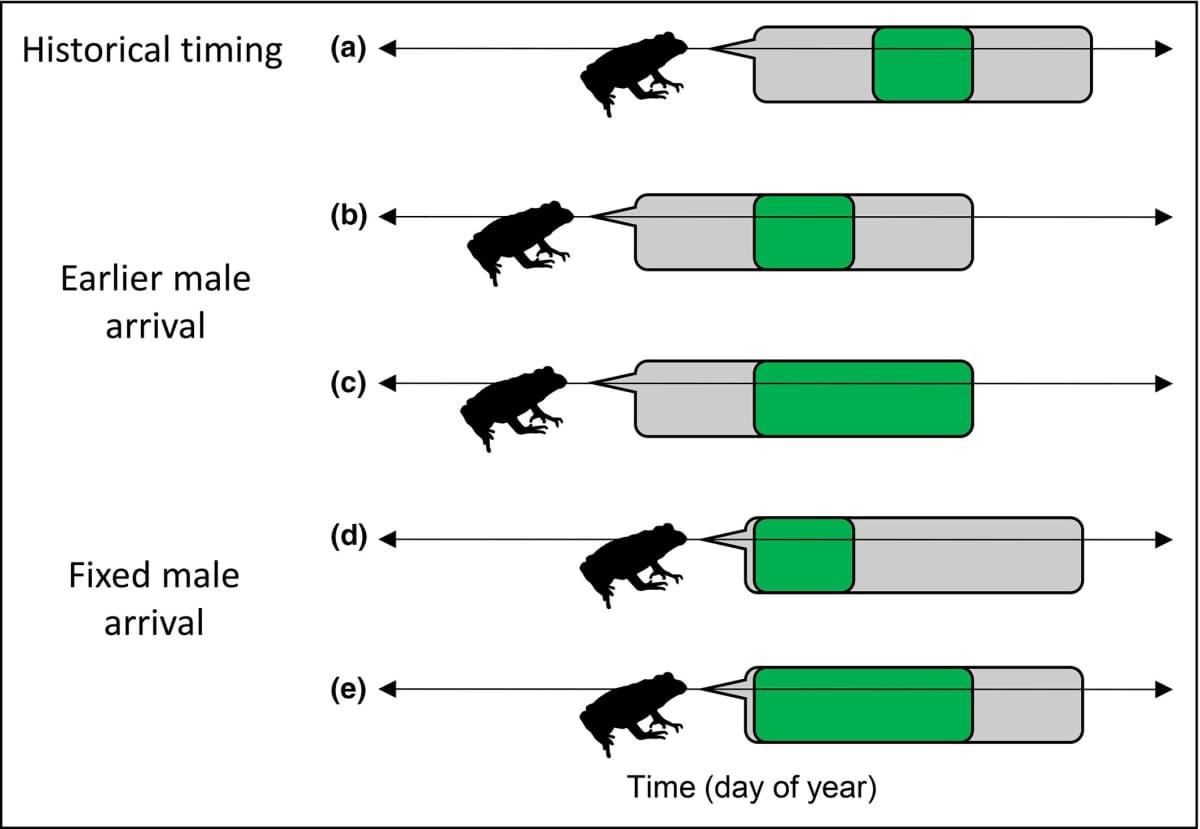
Relative to historical conditions (a), the onset of attractive calls (green) may advance with advancing seasonality (b–e) regardless of earlier (b and c) or fixed (d and e) male arrival. Earlier onset of attractive calls may contribute to shifted (b and d) or expanded (c and e) reproductive timing.
As breeding time approaches, male frogs arrive in large numbers near ponds and other aquatic areas. It has been noted that males try to outdo each other in terms of arrival. There is a possibility that earlier, a male frog arrives, the better their chance to attract a partner. Females supposedly arrive only when they believe the time is right. The decision is made based on the male’s song quality. If it is “sexy,” then it means the water is warm, ideal for their eggs to survive. Females arrive at the scene when they believe their reproductive pursuit would be successful.
The study highlights how phenological responses are influenced by climate change. “We’re emphasizing a new understanding of the role of springtime vocalizations by frogs and toads. Males may be unwittingly signaling nuances about the appropriateness of environmental conditions for breeding, and females interpret these signals beyond the intentions of males,” UC Davis Professor Eric Post, senior author on the study, shared. These findings are crucial for conservation. Around 41% of amphibian species are under the threat of extinction. Insights into the timing of their breeding, how it alters when faced with climate change, and what drives these alterations are essential when it comes to protecting such species.