
Antarctica Has Lost Ice 10x the Size of Los Angeles. And Something Mysterious Is Fueling Parts of It
Published March 3 2026, 8:28 a.m. ET

A study led by UC Irvine researchers using 30 years of satellite data has shown that 23 percent of Antarctica’s ocean-reaching glaciers are undergoing rapid retreat.
In the remotest areas of the Southern Hemisphere lie vast stretches of snow-covered land, embodying a ticking time bomb for inevitable destruction. Despite its serene appearance, the snow-clad areas are melting almost like a poetic injustice. One of the major reasons driving this ice melt is global warming and warm oceans. However, a recent study has uncovered a mysterious force as an underrated factor that's gradually melting the Antarctic. A comprehensive 30-year study led by the University of California, published in Proceedings of the National Academy of Sciences, has used satellite data to conduct a detailed overview. The researchers produced a circumpolar ice grounding line migration map of Antarctica. The result: some parts of Antarctica are losing Greater Los Angeles-sized ground ice every three years.
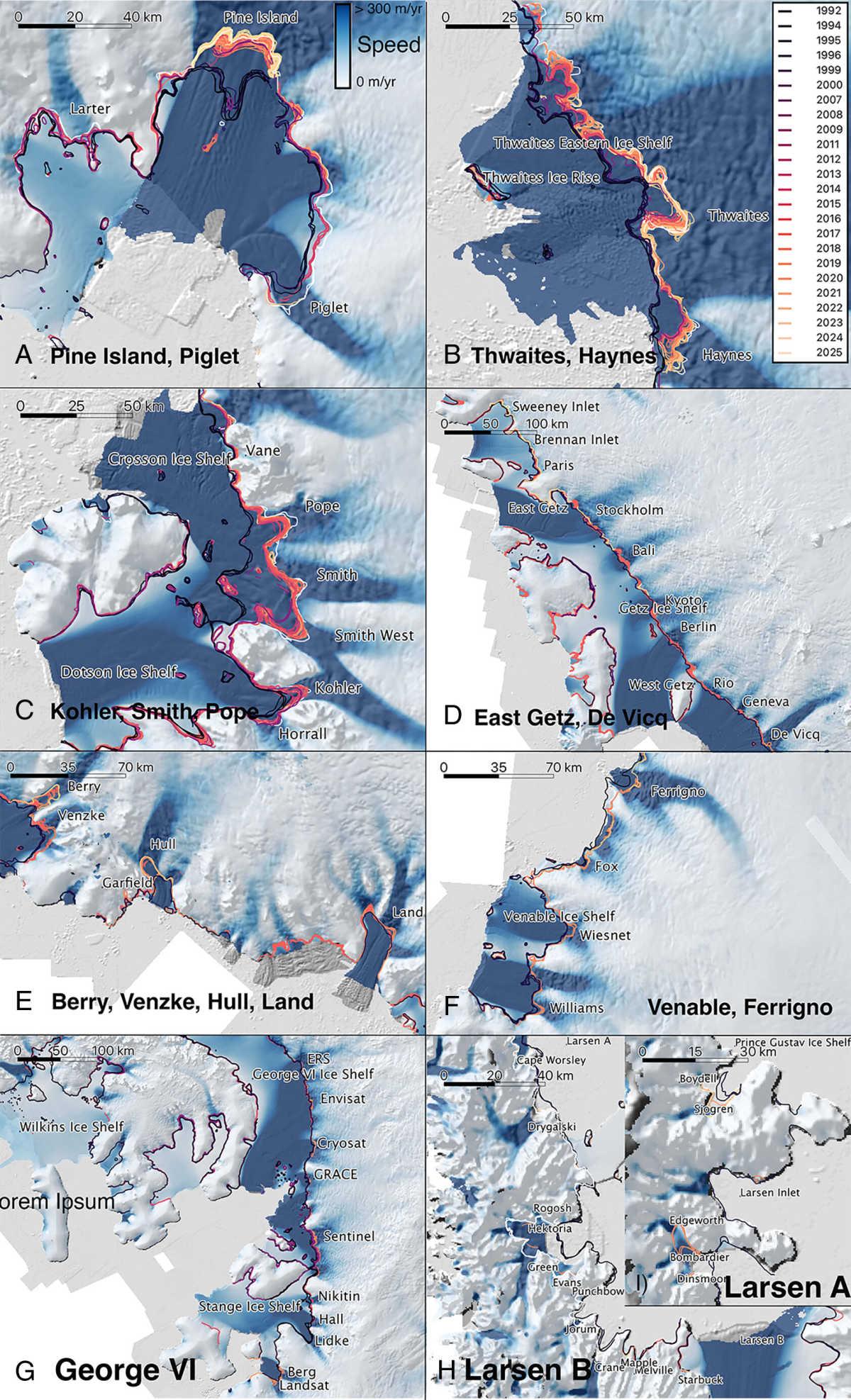
GL retreat in West Antarctica and the Antarctic Peninsula from 1992 (black) to mid 2000s (orange) to 2025 (white) [Image Source: Rignot et al., Proceedings of the National Academy of Sciences, 2026]
“The grounding line [GL] is where continental ice meets the ocean, and measuring the movement of grounding lines with satellite-based synthetic aperture radar has been our gold standard for documenting ice sheet stability,” lead author Eric Rignot, UC Irvine Distinguished Professor and Donald Bren Professor of Earth system science, said in a statement. “We’ve known it’s critically important for 30 years, but this is the first time we’ve mapped it comprehensively across all of Antarctica over such a long time span," he added. According to the study, the ice sheet in the grounding line of Antarctica is retreating at the rate of 442 square kilometers or 170.66 square miles per year. “Where warm ocean water is pushed by winds to reach glaciers, that’s where we see the big wounds in Antarctica,” Rignot explained.
“It’s like the balloon that’s not punctured everywhere, but where it is punctured, it’s punctured deep," he added. The researchers managed to connect most ice melts to the intrusion of warm water. However, when they traced the ice sheet retreat on the grounding line along the northeast Antarctic Peninsula, it puzzled them. “A lot of these places have warm ocean water in proximity, but on the east coast of the peninsula, there’s substantial retreat, and we don’t have evidence for warm water,” Rignot revealed. While the team has suspected some other environmental stressor at play, they have yet to narrow down or define the issue. “Something else is acting—it's still a question mark," the researcher admitted.
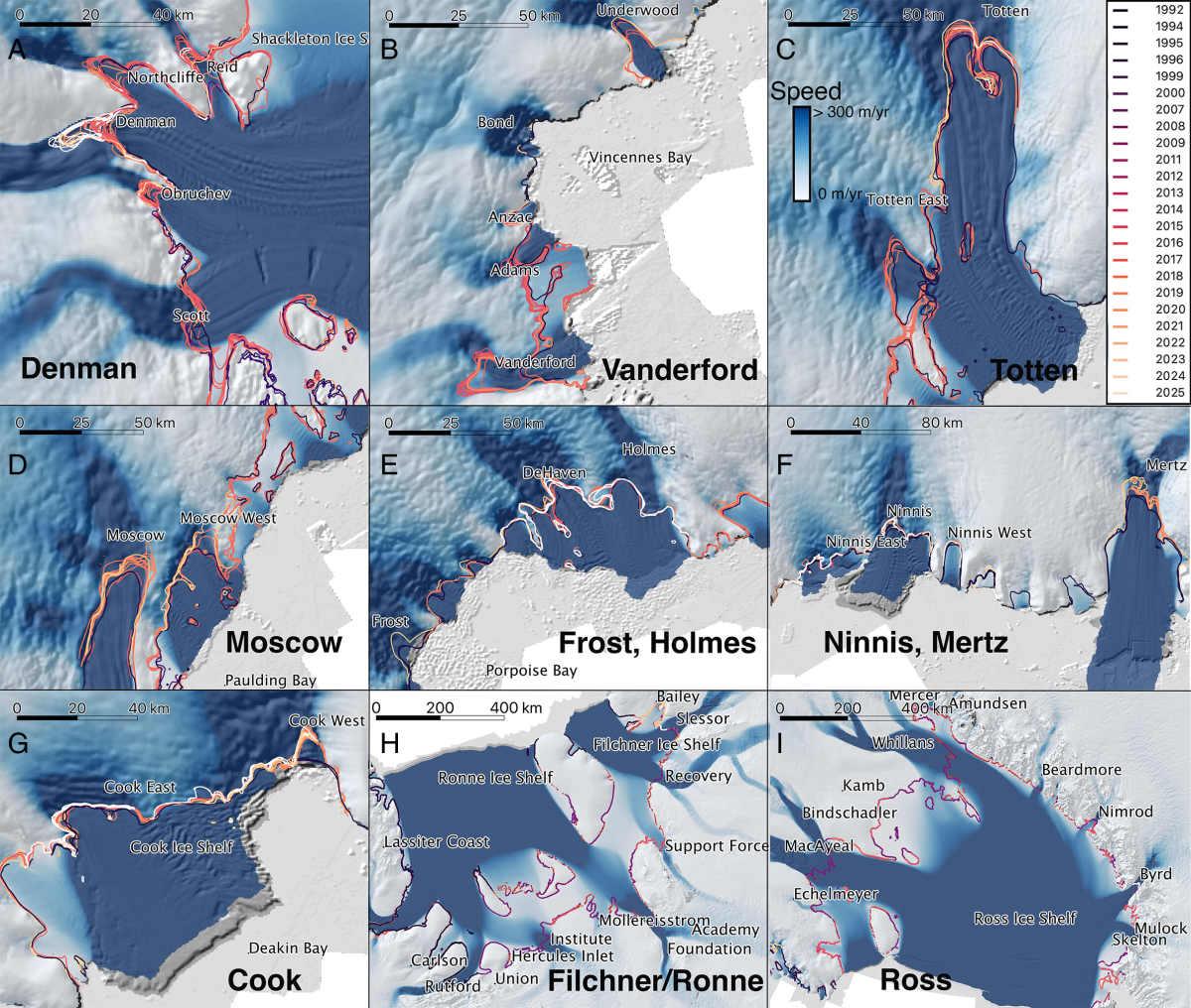
GL retreat in East Antarctica from 1992 (black) to 2025 (white) [Image Source: Rignot et al., Proceedings of the National Academy of Sciences, 2026]
The region where there's been no evidence of warm water intrusion has experienced multiple ice shelf collapses before the study. In fact, prominent glaciers like Edgeworth, Boydell, Sjogren, Bombardier, and Dinsmoor have also lost a significant amount of ice. Rignot, who’s also a senior research scientist at NASA’s Jet Propulsion Laboratory, believes that this research can act as a benchmark for next-generation ice-sheet models that would be created to measure sea level rise. “That’s the real value of this observational record: knowing that this grounding line migration has happened. If a model can’t reproduce this record, the modeling team will need to go back to the drawing board and figure out what boundary condition or physics are missing," he pointed out.
On the other hand, 77% of the Antarctic landscape remains highly stable, which makes up for the unlikely result obtained from the observation of East Antarctica. Moreover, this comprehensive report identifies areas of the Antarctic that are largely vulnerable to ice loss. “The flip side is that we should perhaps feel fortunate that all of Antarctica isn’t reacting right now, because we would be in far more trouble. But that could be the next step," Rignot added.