
Ancient Mammals May Have Developed Advanced Hearing 50 Million Years Earlier Than Experts Thought
Published Jan. 5 2026, 8:31 a.m. ET

Deer hiding in a field with its ears perked up
A sharp sense of hearing is a virtue for mammals, especially for those who must stay wary of predators. Mammalian hearing is believed to have developed quite early, but a new study suggests that its origin dates back earlier than previously assumed. In the study published this week in PNAS, a team of paleontologists at the University of Chicago used detailed CT scans of an ancient mammal to analyze how their anatomy interacts with sound waves of different pressures. They carefully studied the jawbones and skull of Thrinaxodon liorhinus, a mammal believed to have lived about 250 million years ago, using different engineering techniques to get an accurate analysis. The results blew their minds and made them question the previously assumed theories of mammalian hearing.
A depiction of sound traveling into a human ear.
According to their model, the mammal species likely had an eardrum that could easily detect and react to airborne sounds. The finding implies that the ancient mammals developed advanced hearing about 50 million years before what scientists previously assumed. “For almost a century, scientists have been trying to figure out how these animals could hear. These ideas have captivated the imagination of paleontologists who work in mammal evolution, but until now we haven’t had very strong biomechanical tests,” Alec Wilken, a graduate student who led the study, said in a statement. “Now, with our advances in computational biomechanics, we can start to say smart things about what the anatomy means for how this animal could hear," he added.
The Thrinaxodon species had features transitioning from those of reptiles to resemble mammals. Their bodily structure was slightly advanced with improved teeth, palate, and diaphragm, enhancing metabolism and breathing. In earlier mammal species, including Thrinaxodon, the ear bones were attached to their jawbones, which eventually separated to form the middle ear, a crucial part of the structure. It was Edgar Allin, a paleontologist at the University of Illinois Chicago, who first speculated the presence of an advanced eardrum in the early cynodonts like Thrinaxodon. Before Allin challenged the old beliefs, scientists presumed that the listening among these species happened through bone conduction. A process, also known as "jaw listening," where the mammals pressed their mandibles or lower jawbone against the ground to pick up vibrations.
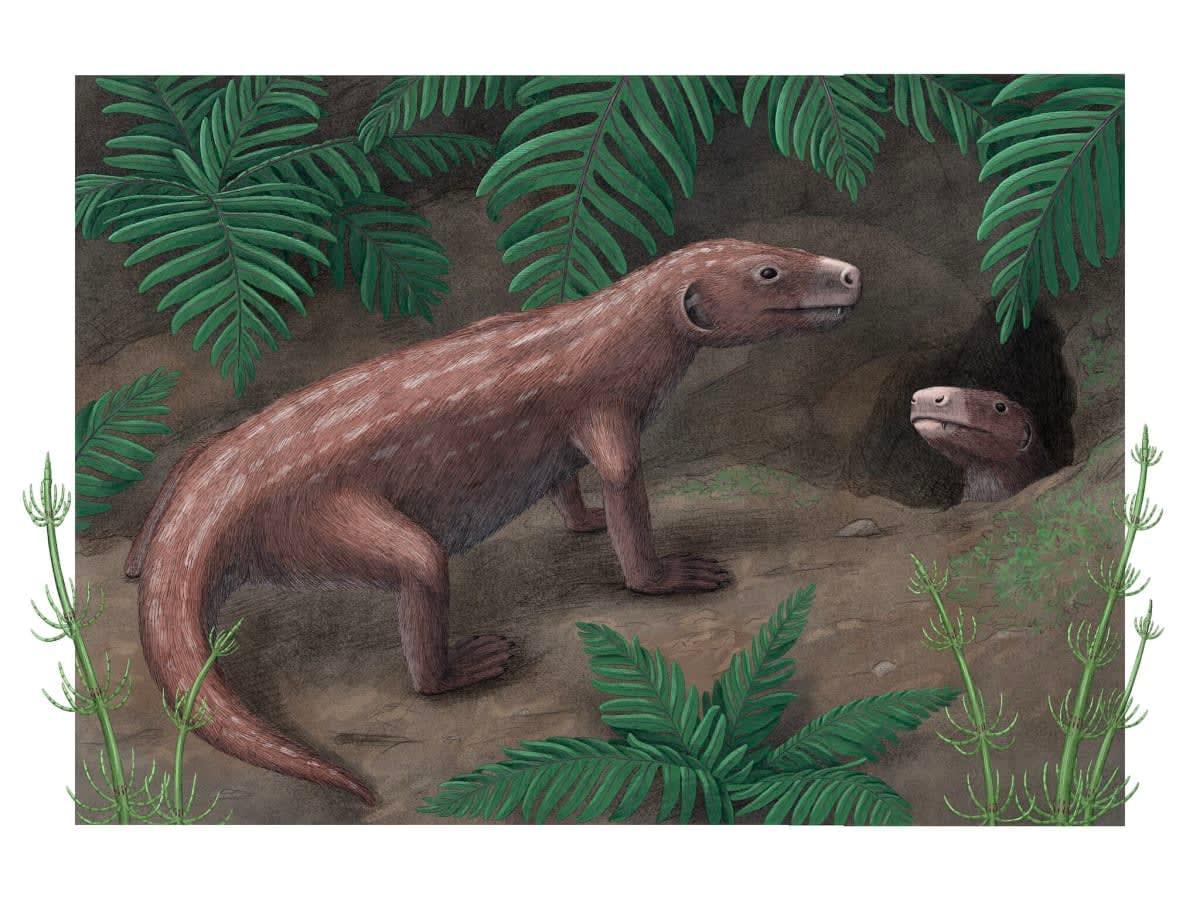
3D models of the jaw and associated middle ear bones of the Triassic mammal ancestor Thrinaxodon
Although the idea of these ancient mammals bearing a sturdy eardrum sounded fascinating, it was just considered a theory when Allin proposed the idea 50 years ago. However, modern-day scientists, with the help of revolutionized technology, managed to find evidence to support this theory. Wilken and his colleagues, Zhe-Xi Luo and Callum Ross, took a well-known Thrinaxodon specimen from the University of California, Berkeley Museum of Paleontology for their research. Scanning the fossil sample in UChicago’s PaleoCT Laboratory provided a detailed reconstruction of its skull and jawbones. The 3D model enabled scientists to conduct a holistic observation of the specimen from all angles, shapes, and curves. The follow-up step included a software tool called Strand7, which allowed scientists to analyze finite elements.
The software is often used to resolve complex issues like predicting stresses on bridges, aircraft, and buildings, or other engineering challenges. Therefore, it quite efficiently determined how the anatomy of Thrinaxodon reacts to sound waves of different pressures. The result clearly showed that Thrinaxodon possessed an eardrum on its jawbone. “We took a high concept problem—that is, ‘how do ear bones wiggle in a 250-million-year-old fossil?’--and tested a simple hypothesis using these sophisticated tools. And it turns out in Thrinaxodon, the eardrum does just fine all by itself," Wilken added.