
9,500-Year-Old Cremation Site Is Challenging What We Know About Early Human Burial Practices
Published Jan. 2 2026, 8:33 a.m. ET

Silhouette of person in front of fire
Archaeologists may have just found evidence of hunter-gatherer funerals that might challenge previous theories. Charred remains were uncovered in an ancient rock shelter in the heart of Malawi, at the base of Mount Hora. The 9,500-year-old remains were discovered to be of a woman who was between 18 and 60 years old when she died. According to the study published in Science Advances, a large pyre was prepared for the cremation ceremony of the woman. The pyre was built as part of a deliberate funerary ritual at a site that had been used for mortuary practices for at least 8,000 years. "The earliest evidence for intentional cremation in Africa, the oldest in situ adult pyre in the world," the team writes. The researchers found evidence of a community of hunter-gatherers in central Africa who cremated the woman—whose charred remains were discovered—in an open pyre centuries ago.
“Cremation is very rare among ancient and modern hunter-gatherers, at least partially because pyres require a huge amount of labor, time, and fuel to transform a body into fragmented and calcined bone and ash,” lead author Jessica Cerezo-Román, an associate professor of anthropology at the University of Oklahoma, said in a statement. Thanks to the recent study, archeologists gained more insights into the earliest cremation in Africa. "Not only is this the earliest known cremation in Africa, it was such a spectacle that we have to re-think how we view group labor and ritual in these ancient hunter-gatherer communities," said Jessica Thompson, a senior author of the study and assistant professor of anthropology at Yale University. Although the discovery provided important details, it isn't the oldest in-situ pyre recorded.

A tribe of hunter-gatherers in a forest.
The ancient remains previously discovered in the Xaasaa Na’ (Upward Sun River) archaeological site in Alaska were about 11,500 years old. However, the remains belonged to a three-year-old child. Hence, the recent find provided the first solid evidence to confirm early adult cremation. Specifically in Africa, the earliest known cremation was about 3,300 years ago, before the recent discovery in Mount Hora. The researchers revealed that in Africa, the ancient food-producing societies practiced cremation more than their early hunter-gatherer communities. The Malawi site where the charred remains were discovered was first identified by archeologists in the 1950s as a burial place used by early hunter-gatherers. Further examination showed that the place was first inhabited about 21,000 years ago and was used for mortuary practices.
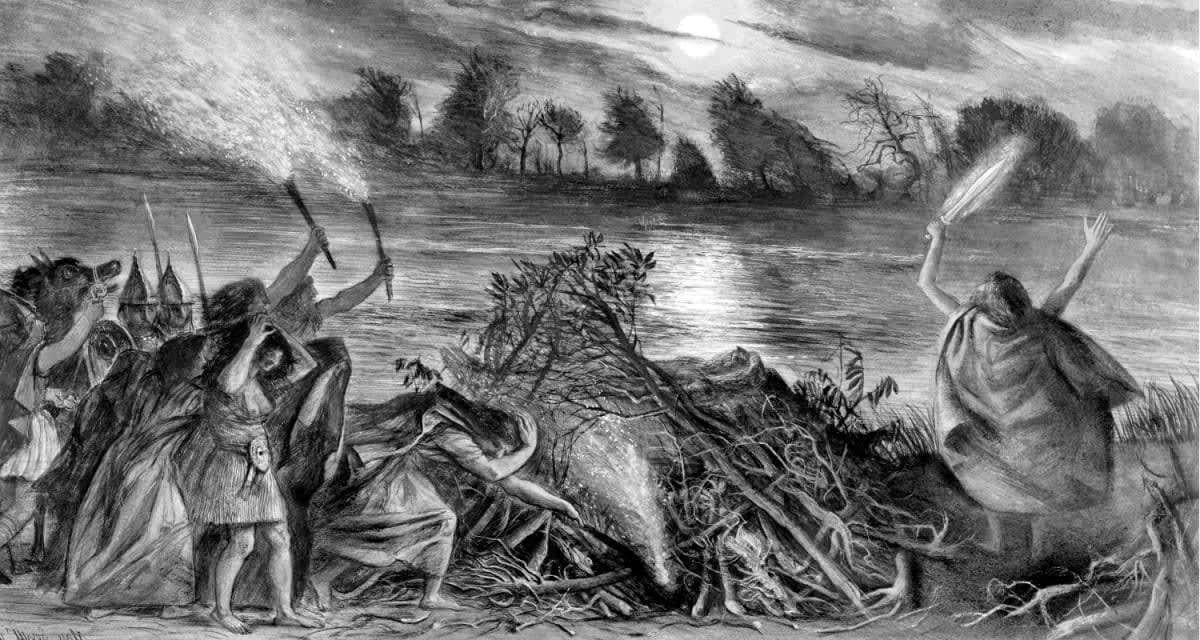
Artistic impression of an ancient funeral pyre.
However, the recent 9,500-year-old remains threw a curveball in the previous research. It consisted of a large ash layer containing broken remains of just one person. Moreover, there's no evidence that cremation was practiced there before or after that one funeral event. Further analysis of the 170 human bone fragments found in the pyre confirmed that it was a deliberate funeral pyre, and the woman's body was burned before decomposition. Researchers found severe cut marks on the limb bones, suggesting that certain parts were "de-fleshed" before the cremation. Elizabeth Sawchuk, curator of human evolution at the Cleveland Museum of Natural History, who was involved in the study, revealed that fragments of teeth and skull were missing from the remains.
“Because those parts are usually preserved in cremations, we believe the head may have been removed prior to burning," she said. But one question kept gnawing in the researchers' minds. “Why was this one woman cremated when the other burials at the site were not treated that way?” Thompson asked. “There must have been something specific about her that warranted special treatment," she speculated.