
Man Finds 2 Roman Cavalry Swords in a Field— Helps Discover 2,000-Year-Old Settlement
Published Dec. 18 2025, 7:13 a.m. ET

Metal detectorist discovers two ancient swords and helps archaeologists dig out a fascinating chapter of Roman history
For fifteen days straight, amid pouring January rains, archaeologists from Historic England and Cotswolds Archaeology worked laboriously to unearth some historic secrets from the ancient Roman period. Squatting in the trenches of a dusty field in Gloucestershire, these treasure diggers were intending to close the chapter that was accidentally unlocked by a metal detectorist in March 2023.
Deep in the northern heart of the Cotswolds, near the village of Willersey, two not-so-shiny metal swords lay entombed beneath a bed of soil, silt, and clay, just at the brink of getting lost in time forever. A scattering of rock fragments indicates that once upon a time, a grand Roman villa rose from this field, likely belonging to a 2000-year-old Roman settlement.
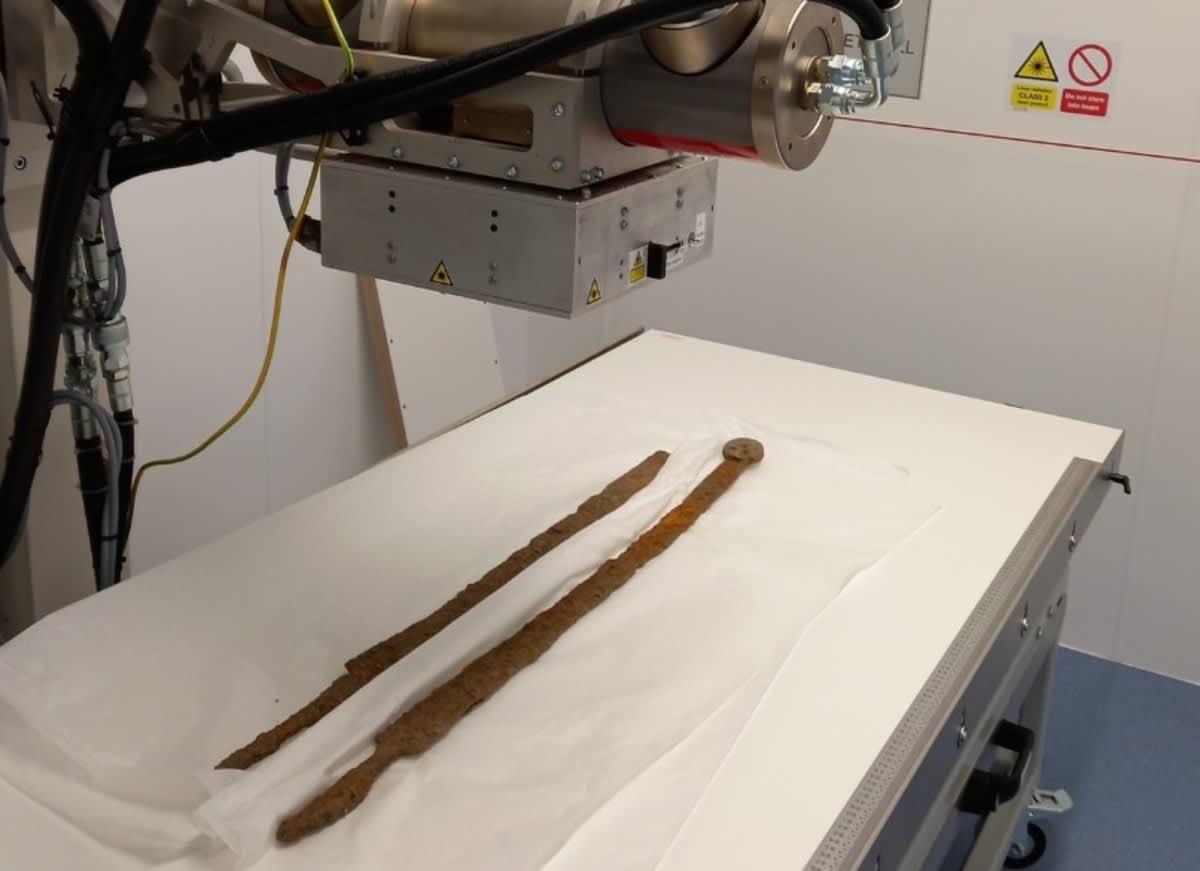
The two ancient swords.
Why were the two swords buried so close to the Roman villa? Perhaps, there was a conflict of interest. Maybe someone stowed them away underground to avoid getting robbed and then forgot about them or left the area. The timestamping of the swords, as estimated from analysis, unravels another possibility. It is possible that ancient Romans hid these swords to prevent them from falling into the hands of Saxons, who were rapidly invading the land at that time. If the weapons hadn’t been discovered lately, they would have rusted away and destroyed. The recurring clanging and banging of farm equipment had already misshapen their slinky metallic frames.
The story began in March 2023. Glenn Manning, a metal detectorist, ventured out on a weekend rally in the Cotswolds when his instruments plonked into these two swords. He reported the finding to the Portable Antiquities Scheme. The discovery prompted archaeologists from Historic England to continue the site’s excavation and dig up more interesting artefacts. They did find a lot of them. To begin with, the traces of scabbards that enwrapped the swords. “It was phenomenally lucky,” Peter Busby, a project officer for Cotswold Archaeology, told The Guardian. “The swords were within half an inch, no more than an inch, of oblivion.” The discovery, he said, was like “stars aligning.”
Depiction of an ancient Roman soldier standing in a field with a sword
Further investigation revealed that the swords, known as “spatha,” were Roman cavalry swords, likely used by Romans on horseback from early in the second century AD through to the third century AD. X-ray tests revealed that one sword features a decorative pattern, while the other sword’s blade is plain. Investigators deduced that the sword with the decorative pattern was more expensive than the plain one. Scabbards added “another dimension to this discovery,” said Emma Stuart, Director at Corinium Museum.
The site outside this mysterious Roman villa also revealed a whole gaggle of art pieces and materials from the era. A grave with remnants of a dead body, a horse skull. Shards of limestone walls, a large rectangular enclosure, ceramic roofing pieces, box tiles, and fragments of painted wall plaster that once decorated the villa’s rooms. The horse’s skull indicates that the dwellers likely practiced some occult ritual or sacrificial worship.

Archaeologist examining the tools and fragments they found during an excavation
The casket of treasures also included tiles that were part of an underfloor heating system called a hypocaust, likely used to warm the air from the bottom up inside the villa. And while more fieldwork is required to decipher the full historic story, Historic England is thinking about recommending this field to the Department for Culture, Media and Sport (DCMS) so it can be protected as a sheltered monument. Maybe there's another weapon buried in the soils that can tell tale of a time we cannot visit.