
You Can Catch the Sunrise and a Total Lunar Eclipse at the Same Time on March 3
Published March 2 2026, 8:13 a.m. ET

(L) Blood moon or full lunar eclipse over a mountain in Thailand; (R) Sunrise over the Alabama Hills (Representative Cover Image Source: Getty Images | (L) AumPhotography; (R) Jordan Siemens)
At about 6:04 a.m. EST on March 3, the Moon will slip into Earth’s shadow during the year’s first total lunar eclipse. After a faint penumbral dimming, a dark crescent will appear as it enters the umbra, before the Moon is completely drowned in Earth's shadow. At this point, light scattering from the Earth’s atmosphere will temporarily turn the Moon into a rusty red color, a phenomenon known as the "Blood Moon." On March 3, this point in time will mark a rare “cosmic coincidence” that will enable humans to witness the “impossible."
If being the first lunar eclipse of the year wasn’t enough, this one is a bit of an out-of-the-ordinary opportunity for skywatchers, a rare chance to witness the rising Sun and eclipsed Moon at the same time, a rare phenomenon scientists refer to as “selenelion.” Lasting for about 58 minutes, the total lunar eclipse will enable viewers to observe a perfect spectacle, with the Sun and the eclipsing Moon appearing together in a special, remarkable alignment. Only for about one to three minutes, though.
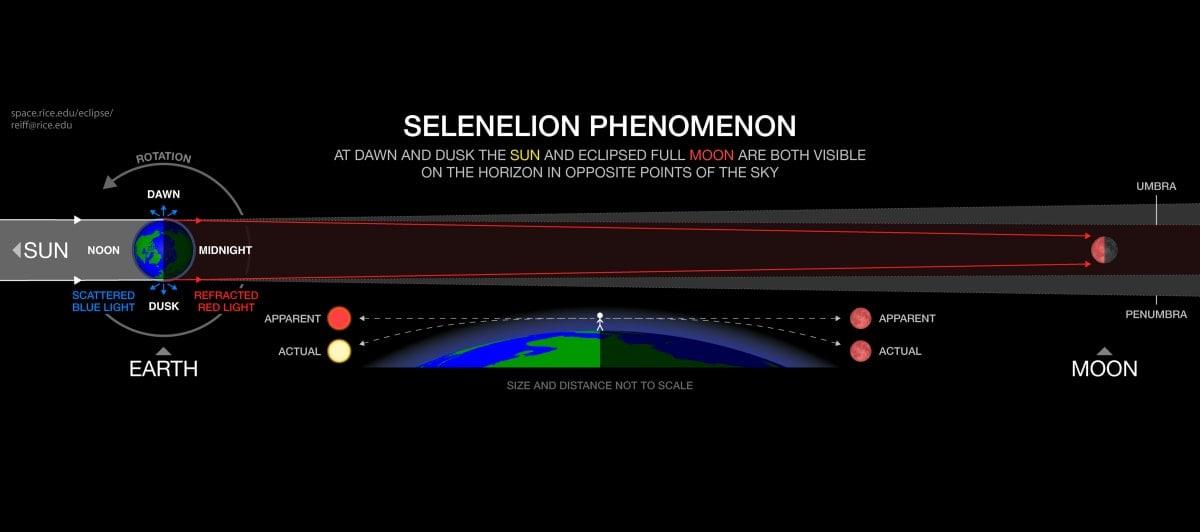
Diagram of the selenelion phenomenon.
The exceptional optics will be the courtesy of atmospheric refraction. If not for this process, the visual would have been impossible. The eclipse brings the Sun, Earth, and Moon in a straight line with the Earth in the middle. Additionally, the Sun and the Moon are aligned at a perfect 180-degree angle with each other, in a process called “syzygy.” If the Sun is above the horizon, the Moon should be below the horizon. To have Sun and Moon visible at the same time is seemingly impossible. The refraction, however, makes Earth's atmosphere act like a lens that bends the light and provokes this fascinating geometry that makes the impossible possible.
On Facebook, atmospheric scientist Michael A. Goss described the process. "The Earth's atmosphere bends light kind of how a spoon in water looks like it bends at the interface. This is because air's refractive index is larger than the vacuum of space," he said. This bending makes the objects rise in the sky and appear higher than they actually are. Meteorologist Matthew Cappucci mentioned that the sighting will be visible along the East Coast till roughly 6:25 am.
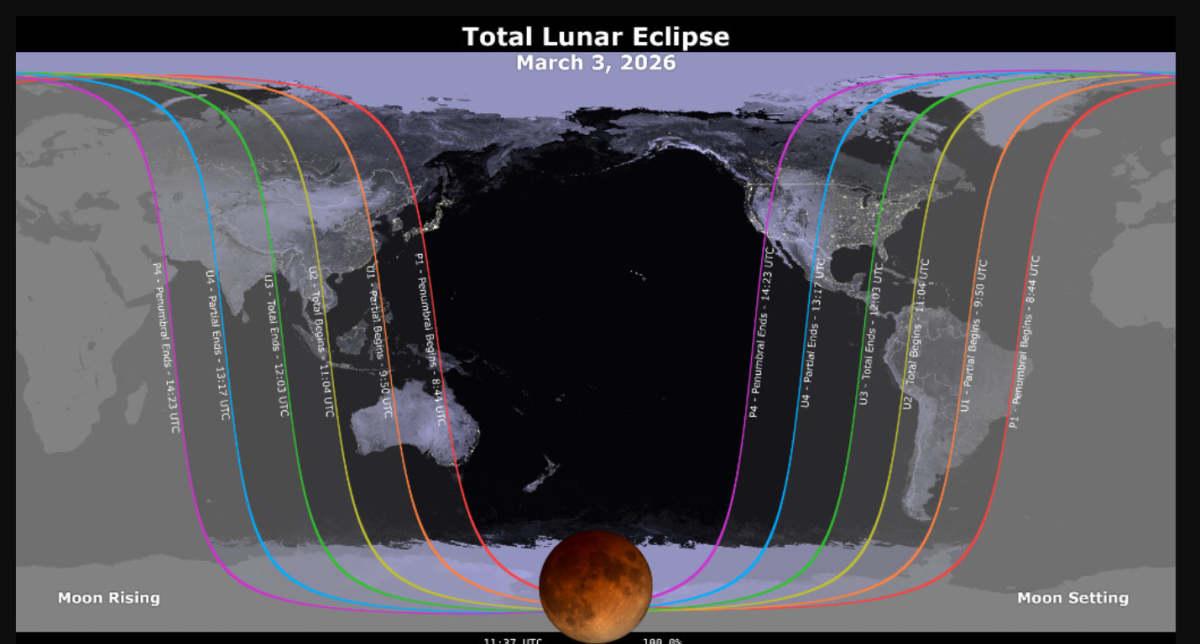
A map showing where the March 3, 2026, lunar eclipse is visible. Contours mark the edge of the visibility region at eclipse contact times.
“For folks on the Eastern Seaboard, you'll be able to see both the start of totality AND sunrise simultaneously on opposite horizons for just a few minutes... meaning you're in the midst of a PERFECT planetary alignment. It's rare to experience a selenelion in any given place,” Cappucci wrote. He would enjoy the spectacle from his high-rise building in Washington, DC, but apart from that, the best locations to witness the eclipse would be a hillside, a mountain, or a tall building. “If you are on an airplane, even better,” he proclaimed, adding, “Imagine being able to see sunrise out one window and a lunar eclipse out the other side!”
According to Space.com, the optical phenomenon might not be visible for residents of the west of the Continental Divide, unfortunately. However, for most of America, the delicious alignment, together with Moon’s shadowy performance, has dramatically made the impossible possible. “I guess it won’t be 'impossible' anymore,” remarked Reddit user u/MikeDavJ.