
A Once-In-A-Century Solar Eclipse Is Coming in 2027 — Here's Where to See It
Published Dec. 9 2025, 2:59 a.m. ET

Woman watching an eclipse through solar eclipse glasses
At around 10:06 AM UTC on August 2, 2027, the eerie shadow of the Moon will materialize on Earth, sweeping across North Africa, Europe, and the Middle East. For a few moments, the world will be enveloped by the cloak of darkness. On this day, we will witness the second-longest solar eclipse of the 21st century, according to the National Science Observatory (NSO). Along with the Indian and Atlantic Oceans, the total solar eclipse will cross Spain, Gibraltar, Morocco, Algeria, Tunisia, Libya, Egypt, Saudi Arabia, Yemen, and Somalia.
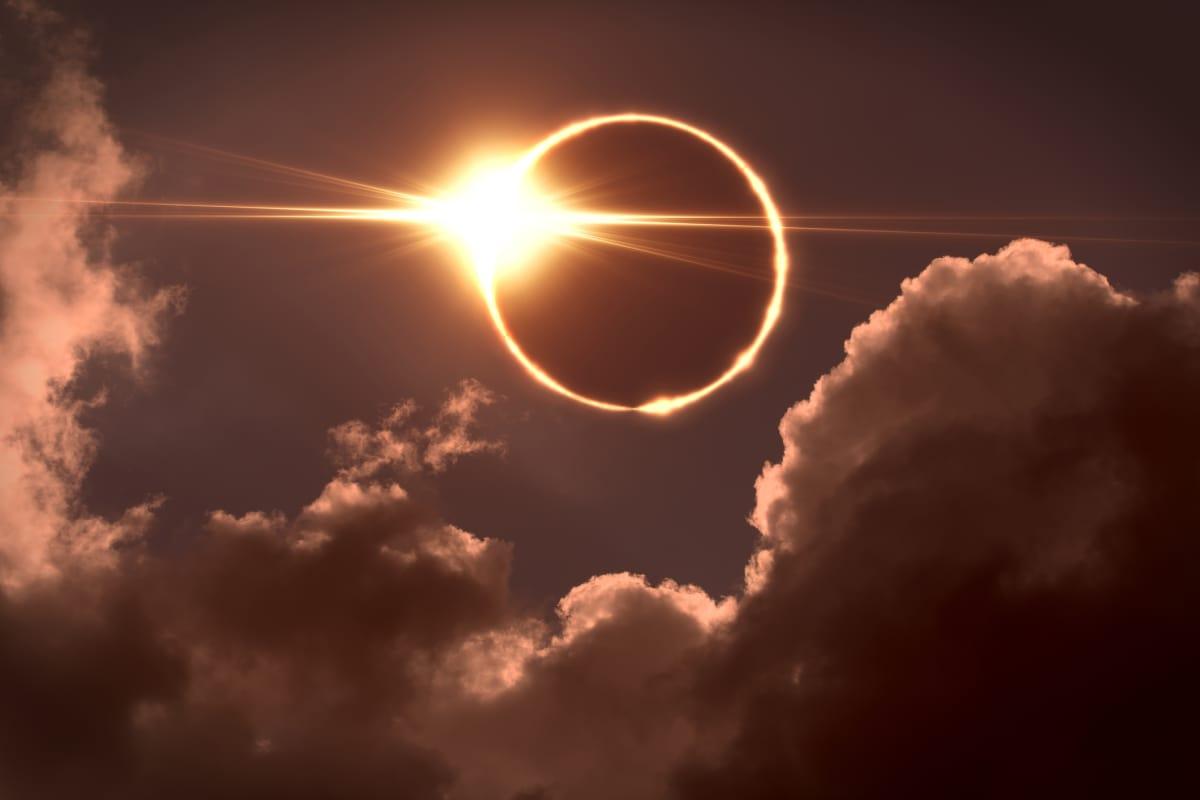
Solar eclipse materializing from within a cluster of glinting clouds
A total solar eclipse is not a rare event, but every time it materializes in the sky, it is just as fresh and seductive as the previous one. As mystical as scientific, this eclipse results from a mysterious cosmic geometry that governs the movements of the Sun, Moon, and Earth. As the Earth orbits the Sun and the Moon orbits the Earth, there come points of time when the Earth’s orbit intersects with the Moon’s orbit, resulting in a perfect alignment of the three celestial bodies. As the Moon pops up in the middle, it blocks the light traveling from the Sun to the Earth, creating a dark shadow, called the umbra.
The shadow often resembles a black hole punched into the sky where the Sun used to be. Trees project the crescent moon, shadows become darker, temperature drops, and animals tend to appear confused and disorientated. Glinting at the boundary of the lunar shadow appears a fiery ring that spectators have often described as a diamond ring, a necklace of sparkly beads, and similar descriptions.
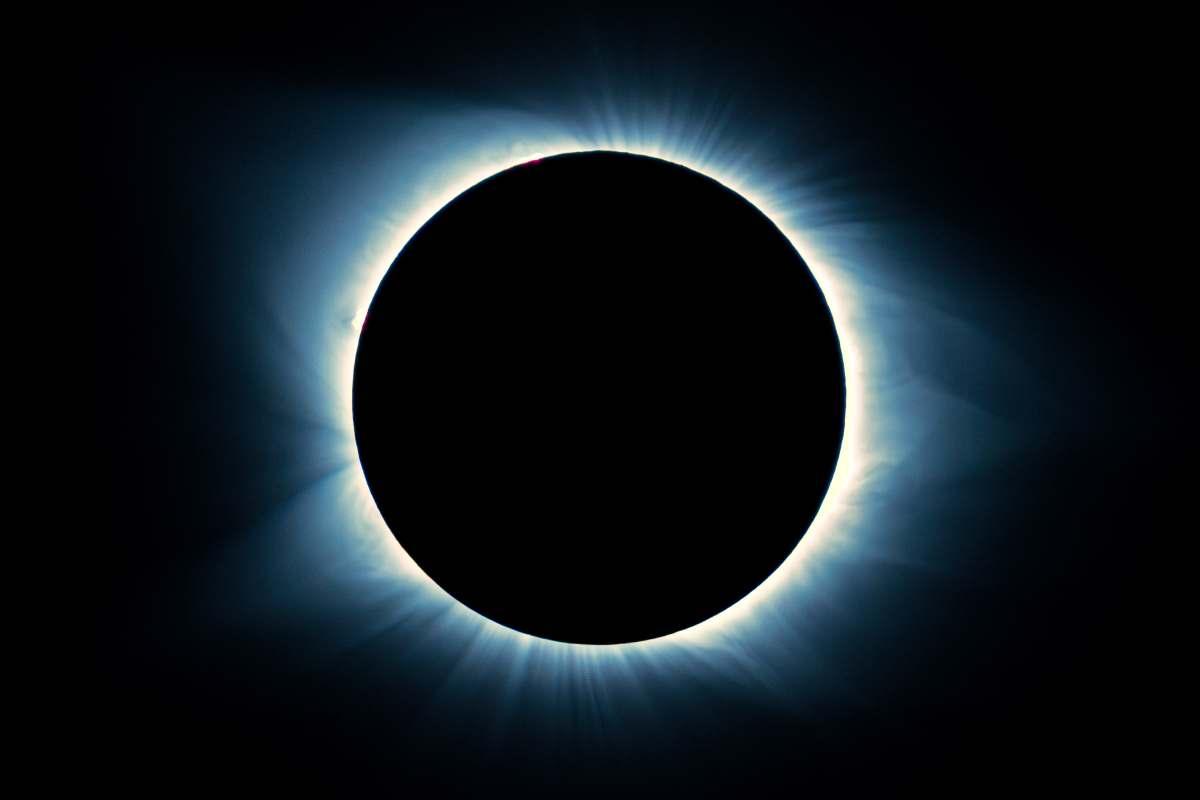
Depiction of a total solar eclipse where the shadow of the Moon covers the Sun, revealing only a glinting ring of light
The dramatic alignment between the Sun, Moon, and the Earth in the total solar eclipse occurs once in about every 18 months, National Geographic says. Although the Sun is roughly 400 times bigger than the Moon, the Moon is around 390 times closer to Earth. As size and distance cancel each other, the Moon’s dark shadow completely overlaps the Sun as they appear to be almost the same size, blocking its light, per TED-ED.
An eclipse is regarded as a scientific book that can unveil striking mysteries of the celestial bodies, their geometries, their movement patterns, and their changing behaviors. And this one, upcoming in the fall of 2027, is bustling with a whole gold mine of cosmic mysteries. It is unlike any other witnessed in the past 100 years. According to NASA, the eclipse will last about 6 minutes and 23 seconds. Cádiz, Spain, Tangiers, Morocco, Gibraltar, Benghazi, Libya, Luxor, Egypt, and Jeddah, Saudi Arabia are the cities under the path of totality.

A group of people watching a solar eclipse.
It is being hailed as "the eclipse of the century" by astronomers. The longest one occurred on July 11, 1991, and it lasted 6 minutes and 53 seconds, slightly longer than the upcoming 2027 event. Another eclipse came to pass on July 22, 2009, with a duration of 6 minutes and 39.5 seconds, over the Pacific Ocean, on the remote, uninhabited island of North Iwo Jima.
And although August 2027 sounds like a distant future, if you are a stargazer or eclipse chaser, you should mark your calendars, because this spectacular alignment of the three celestial dancers won’t occur again anytime in the rest of the 21st century. This shadowy ballet offers a glittering, once-in-a-lifetime opportunity that deserves your attention.