
Total Lunar Eclipse Is Happening March 3. New NASA Map Shows Exactly When to Watch the Blood Moon
Published Feb. 23 2026, 3:16 a.m. ET

A map showing where the March 3, 2026 lunar eclipse is visible. Contours mark the edge of the visibility region at eclipse contact times.
Beginning with the dusk on March 2, 2026, the Moon will display a ghostly performance that will continue through moonrise till dawn. Thanks to a distinctive geometry created by the intersecting orbits of Earth circling the Sun and the Moon circling the Earth, this performance, the total lunar eclipse, will be visible in the early morning in North and Central America and far western South America. When the skies go completely dark, the Moon orbiting Earth will come under its partial shadow zone, called the penumbra. Continuing its journey, the Moon will eventually become completely engulfed by the Earth’s shadow, or the umbra. This will mark the beginning of the total lunar eclipse, as light scattering from the Earth’s atmosphere will cause it to dip in a bright orange-reddish glow.
NASA’s Scientific Visualization Studio (SVS) recently rolled out a collection of shadow view maps and charts for those interested in understanding the phenomenon in detail before actually witnessing it on March 3 in the U.S.
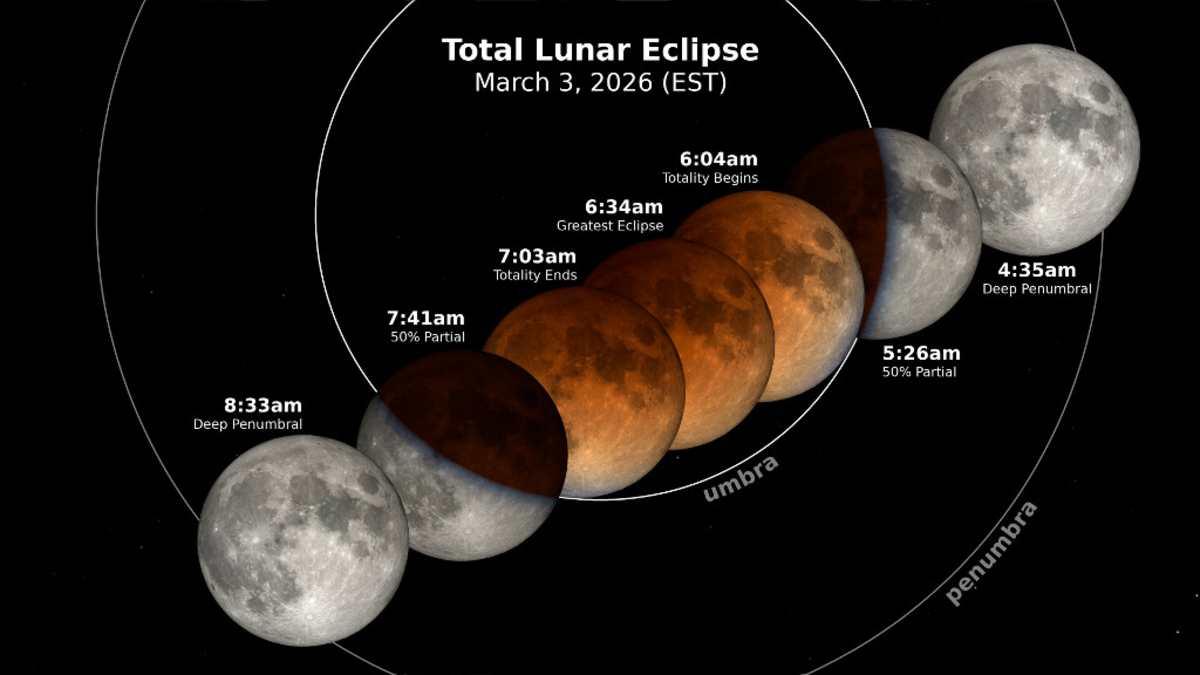
The Moon moves right to left, passing through the penumbra and umbra, leaving in its wake an eclipse diagram with the times at various stages of the eclipse.
Also known as the “Blood Moon,” this phenomenon occurs only when the moon is in its full moon phase, which is once every 29.5 days, per National Geographic. StarWalk estimates that the eclipse will be visible from 11:04 to 12:03 UTC/GMT, with the maximum phase at 11:33 UTC/GMT, with the totality lasting around 58 minutes and 15 seconds. In the U.S., totality begins at 3:04 a.m. PST, or 6:04 a.m. EST, and ends at 4:03 a.m. PST, or 7:03 a.m. EST, per NASA. It will be safe to watch with the naked eye, binoculars, or a telescope. Unlike a solar eclipse, this spectacle won’t require any special eye protection.
Since the Moon will be below the horizon during the eclipse, the Blood Moon will not be visible from Europe. Areas in the western half of the US will be able to witness the entire lunar eclipse, with those in Los Angeles, San Francisco, and Seattle being able to witness "the most dramatic stages of the eclipse." Residents in eastern Asia and Australia can observe the totality in the evening, and those in central Asia and much of South America will also be able to enjoy the sighting, but only with limited visibility. Similar to Europe, the phenomenon will not be visible in Africa.
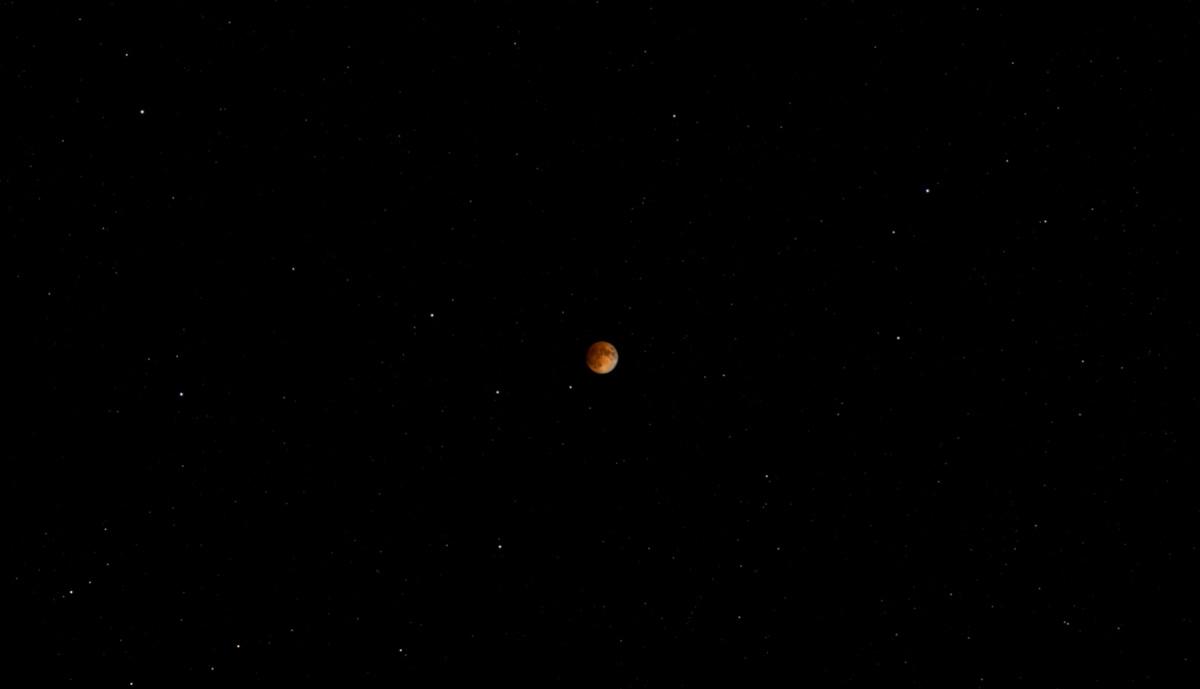
A screenshot from a video that shows a wide-angle view of the eclipse shows the Moon moving among the stars in the constellation Leo.
Although the full moon is not a rare appearance in itself, it’s the fiery red-orange glow that turns the whole sight mysterious. The Moon wheels around from penumbra to partial shadows and ultimately umbra, coming in perfect alignment with the Sun and the Earth. With the Sun's light completely blocked by the Earth, the Moon plunges into total darkness. Meanwhile, the Sun’s light falling on the Earth starts interacting with the particles of gas hovering in the atmosphere. In a process called the “Rayleigh scattering,” the blue light, which is of shorter wavelength, gets scattered in the Earth’s skies, while the longer-wavelength red light is unable to scatter as much. As a result, the Moon becomes drenched in this uncanny red glow. This is the same bloody eclipse that once saved Christopher Columbus, as Space.com notes.
NASA's graphics break down each phase of the eclipse and demonstrate the eclipse's estimated visibility and contact times through colorful contour line markings. The next "Blood Moon" will not appear until New Year’s Eve 2028.