
Yellowstone’s Notorious Steamboat Geyser Erupts in an Abrupt, Unforeseen Episode
Updated Jan. 5 2026, 5:10 a.m. ET

Steamboat Geyser in the Norris geyser basin in Yellowstone
Around 30 miles south in Yellowstone’s Upper Geyser Basin, the Old Faithful geyser continues to remain faithful to its consistent schedule of erupting every 90 minutes or so. The towering cone of Castle Geyser, too, is known for its punctual routine of erupting every 14 to 15 hours. In the Lower Geyser Basin, the Fountain Geyser spots every 4 to 7 hours, dancing in its typical fountain-like rhythms. Known fondly to resemble a churning teakettle, the Beehive Geyser flares up once or twice daily. The Steamboat Geyser, however, is a puzzler. Tucked away on the western side of the Norris Geyser Basin, the elusive geyser has baffled both scientists and park officials with its unexpected periods of dormancy and abrupt awakenings.
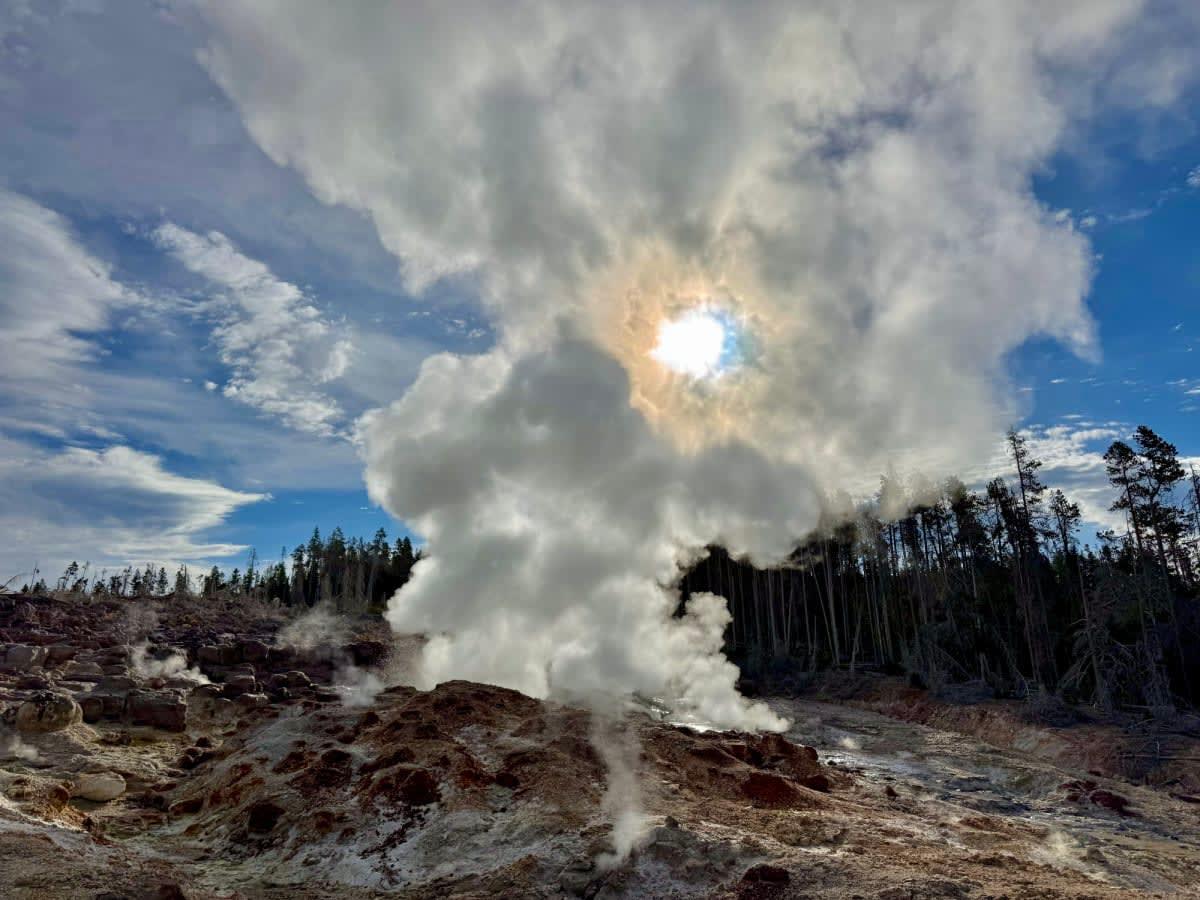
Tucked away in Norris Geyser Basin, Yellowstone's Steamboat Geyser is a puzzler
At about 10 pm on December 31, 2025, Steamboat blew up. Jeramey Hutchison, naturalist guide for Jackson Hole Wildlife Safaris, recorded footage of a white plume of steam rising from Steamboat at sunrise on New Year’s Day. The fact that the steam was still billowing in the morning hours illustrated the intensity of the eruption. This is the first major eruption episode Steamboat has displayed since April 14, 2025. Otherwise, the geyser is infamous and reputed for its unpredictable bursts, followed by prolonged intervals of dormancy. Until 1961, the geyser remained dormant for over five decades before launching in a massive eruption that year.
The cause of the unanticipated eruption was attributed to thermal energy shifts triggered by the Hebgen Lake Earthquake that struck the land in 1959, according to the National Park Service (NPS). The period of the 2000s was mostly marked by dormancy. It was next in March 2018 when the sleeping giant woke up and cried out in an impressive steam-spurting performance. Sitting in the northern rim of Yellowstone, which is known for its highly acidic environment, Steamboat boasts itself as the tallest geyser of the park and the tallest active geyser in the world. Surrounded by fumaroles, mudpots, rainbow-colored thermal pools, and hot springs, the geyser can be reached via a boardwalk leading from a bookstore.

Naturalist guide captured video of Yellowstone's Steamboat Geyser during a sudden eruption
The elusive appearance of the geyser has deluded scientists for generations. But the latest eruption hints that while Steamboat may appear as a sleeping giant on the surface, its bosom is constantly stirring in restlessness, the evidence of which can be seen in the towering spout of water it shot skywards. Rocketing more than 400 feet into the sky, the erupting geyser resembled a cascading jet of milky white cotton candy or a multistorey castle carved in white mist.
As NPS describes, Steamboat’s unpredictable tantrums are well-known among both the travelers and the residents who dwell nearby, as well as the park officials, of course. Visitors a mile north can hear the rumble when the geyser awakens after a long stretch of dormancy. Eruption initiates with a brief, intense water-ejection phase, which is then followed by a prolonged steam-release phase. Curtains of water fall to the slopes above the geyser and rush to the vents, spilling in torrents. Trees get killed. The massive lodgepole pines are broken by the force of the geyser’s intense discharge. A barrage of downpour coats everything with a glistening layer of silica.

Person in Yellowstone watching a volcanic geyser emitting plumes of steam
The cars parked around become slathered with debris of mud, water, and little rocks. Surrounding boardwalks often crack up and break in the same way as one got ruptured after the sudden eruption of Biscuit Basin.
Steamboat’s notorious behaviors and unforeseeable routines make it one of the most mysterious geysers in Yellowstone, and also the one that makes scientists curious to know more. The cryptic chemistry of Steamboat’s underbelly, together with the enigmatic rhythm of its dormancy and awakening cycle, makes it a fabulous and rare laboratory for studying the properties of re-awakening geysers.