
NASA Astronauts Capture Rare Lunar Halo Glowing Around the Moon
Published Dec. 31 2025, 6:50 a.m. ET

Lunar halo, a stunning optical phenomenon captured by NASA astronauts aboard ISS
Light in itself has no color. But when it possesses a material, it uses it as a medium to express itself, in color. When it passes from one medium to the other, it bends, projecting an arabesque of vivid colors, similar to what you see in your soap bubbles as your bathroom’s light shines upon them. When the sun rises, its white light too has no color of itself. It needs a medium to express itself. Earth’s atmosphere provides it a buffet of media to choose from. The vast blue sky above your head, a.k.a. Earth’s atmosphere, is a curious cake sandwiched with layers of several different materials.
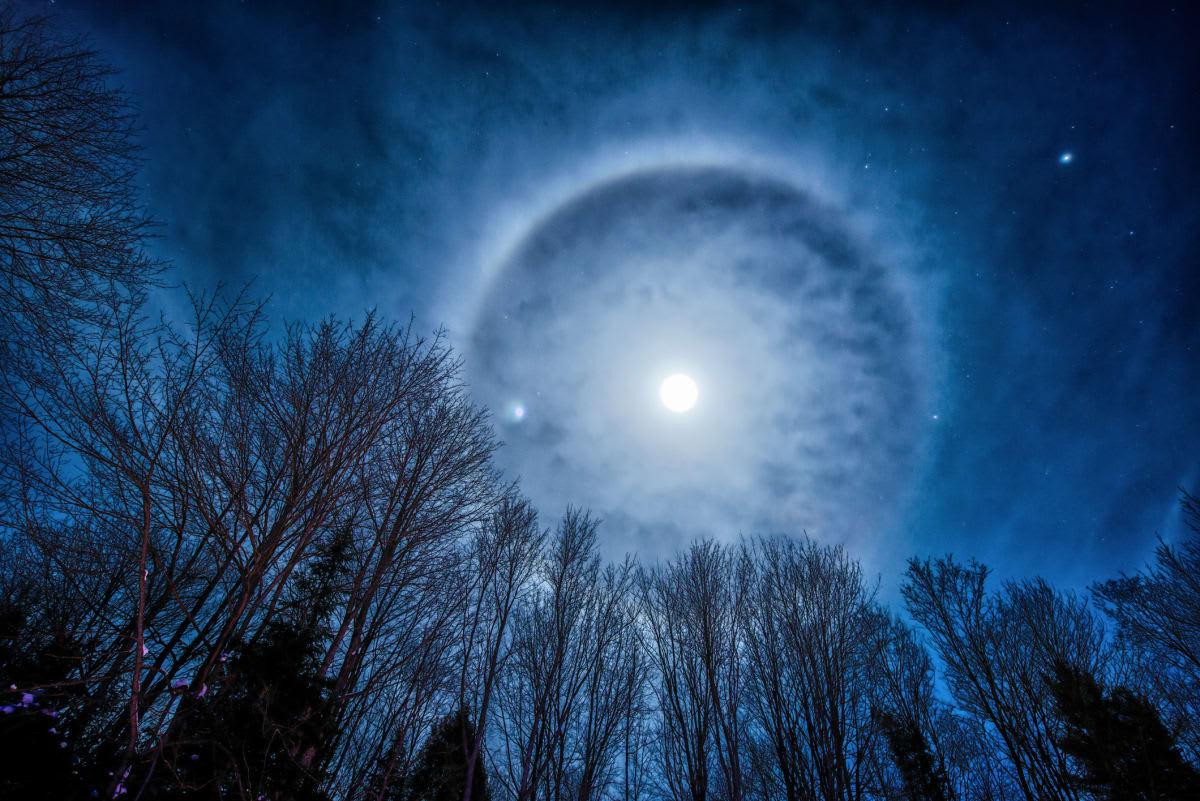
Gorgeous lunar halo captured from the bottom of towering snow-dusted trees
Depending on its position, the Sun passes its light through combinations of these materials to cast glowing patterns of colors, often serving them as optical treats for earthlings and passengers in airplanes. One such optical illusion was recently captured by a NASA astronaut in a dark sky, aboard ISS. 200 miles away from us, swimming in the starlit sky, the celestial supermodel Moon was in the mood to wear a gleaming silver necklace on a December night. Astronauts circling above the Indian Ocean snapped a photo to add to their cosmic fashion lookbook. Astronauts were working on a project led by the ISS Crew Earth Observations Facility at NASA’s Johnson Space Center. Their project is based on recording visual chronicles of Earth’s land, water, and atmosphere from up above, according to Earth.com.
The surreal photograph shows black space on the top with feeble, diamond-like stars sparkling here and there. At the bottom, Earth appears as another black strip, mirroring the darkness of space. Hiding behind the Moon, Earth seems to be playing a peek-a-boo game while the silver-grey Moon appears to be dressed in a crescent-shaped necklace glowing pearly white around its lower arc. Both the celestial objects are dancing in the helm between the black space and a blue strip that represents the upper atmosphere. Stacked below the blue layer is the white layer, which, NASA says, is the stratosphere. Finally, there’s a layer of troposphere appearing orange red in the photo.
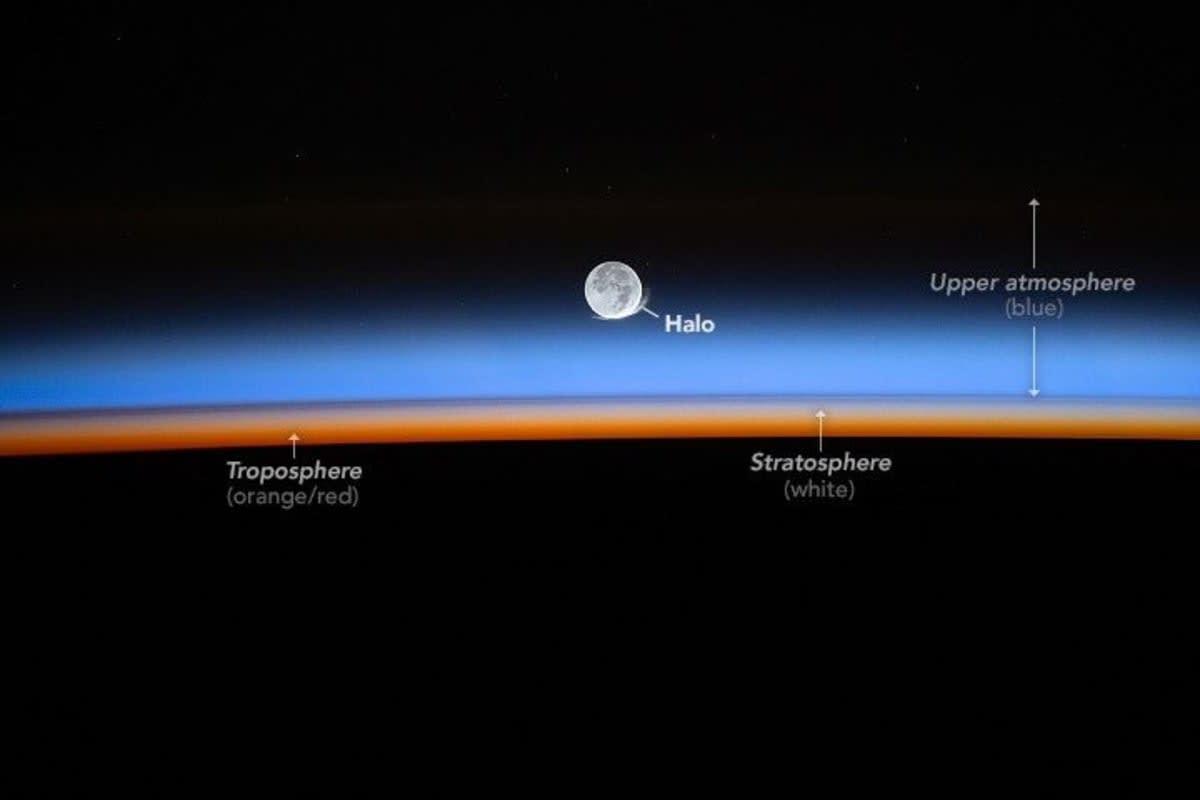
A Halo Above the Horizon
This colorful atmospheric cake became a fine medium for the Moon’s white light to pass and spin this magnificent illusion that scientists named “lunar halo.” Beyond the colorful layers that are visible in the picture, the magic unfolds inside a hidden layer called the mesosphere, which is concentrated with ice crystals formed in cirrus clouds. When moonlight travels through these crystals, it uses them as a medium to change its direction, break itself down into colors, and emit striking patterns of light like rings and arcs. A halo is a ring of light formed around the Sun or, in this case, the Moon.
A paper in Atmospheric Chemistry and Physics shares that the ice crystals form at about 30 to 54 miles above Earth’s surface. In this area, the temperatures plunge, which further buttresses the formation of ice. It’s not just ice, however, that contributes to the optical treat. The geometry of ice crystals matters too. Also, the flowing water on Earth.
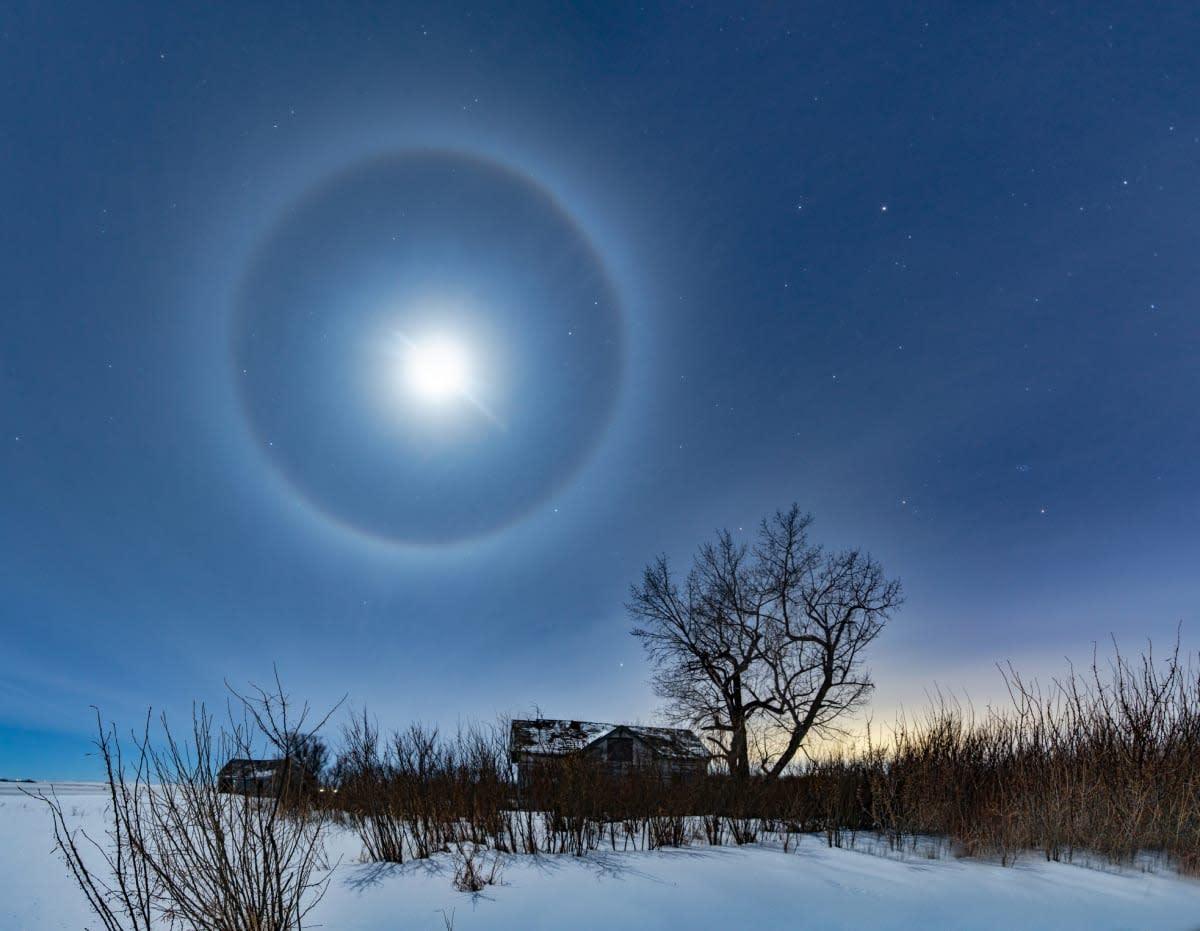
Stunning Moon halo appearing in the azure sky above a snow-covered field dotted with bushes and trees
In this case, there was also the artificial media like windows, mirrors, and camera lenses that contributed to the optical materialization. The Old Farmer’s Almanac has even speculated some nicknames for the phenomenon, such as “moonbow” and “night rainbow.”
NASA shared that the Moon was in a waxing crescent phase at the time when the photograph was taken. Only the crescent-shaped piece of the Moon was illuminated by reflected sunlight, creating the dazzling necklace. Camera settings like exposure, shutter speed, and aperture also influenced the visual by giving the impression of a full Moon. If the exposure had been longer, it’d amplify the faint glow called Earthshine, deepening the impression of a full Moon.