
This Year's First Solar Eclipse is Less Than a Month Away — And it will Form Rare 'Ring of Fire'
Published Jan. 20 2026, 4:40 a.m. ET

An annular solar eclipse forms the 'ring of light.'
Set your eyes to the sky as 2026 has a lot to offer, starting with this year’s first solar eclipse. On February 17, the Moon will pass directly between the Earth and the Sun, forming a “ring of fire.” It is not a total solar eclipse, where the Sun is covered entirely, but an annular eclipse where a circle of light from the Sun peeks through. While some areas will witness the stunning “ring of light,” others might not see the phenomenon. The annular solar eclipse will be visible in Antarctica, according to Time & Date. Whereas Argentina, Chile, Botswana, Zimbabwe, and other places will only witness a partial eclipse. The “ring of light,” where the Moon obscures just 92% of the Sun, is predicted to last up to 2 minutes and 19 seconds.
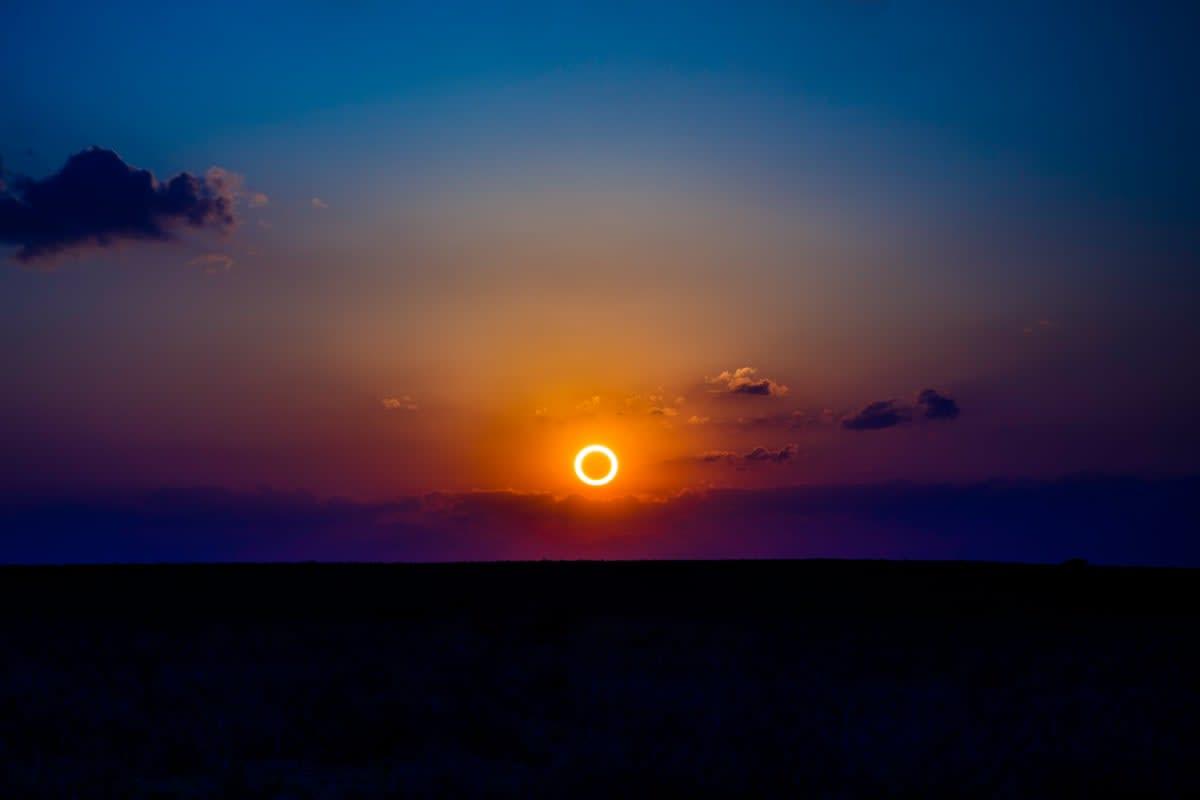
Annular solar eclipse on the horizon.
Since the solar eclipse will be visible in the remote areas of Antarctica, very few people will see it. However, people can expect a partial eclipse above Africa, South America, the Pacific Ocean, the Atlantic Ocean, and the Indian Ocean. An annular solar eclipse occurs when the Moon is at or near its farthest distance from Earth, according to NASA. Because the distance is wider than usual, the Moon appears smaller than the Sun and does not obscure it completely. It makes the Moon look like a dark disc, temporarily placing itself on top of the Sun. When the celestial body is not at its farthest distance from our planet, the solar eclipse entirely shadows the Sun, causing a total eclipse.
When the Moon passes between the Earth and the Sun, but the three bodies are not perfectly aligned, the former shadows only a part of the Sun, forming a partial eclipse. 2026 has much more in store, including a total solar eclipse on August 12, predicted to appear over Greenland, Iceland, Spain, Russia, and a small area of Portugal. People can witness a partial eclipse in Europe, Africa, North America, the Atlantic Ocean, the Arctic Ocean, and the Pacific Ocean. In the lineup of eclipses this year, next comes a total lunar eclipse where the Moon is eclipsed from Earth’s shadow. Watch out for the total lunar eclipse on March 3, 2026. Another lunar eclipse, but partial, will be visible from August 27 to 28.
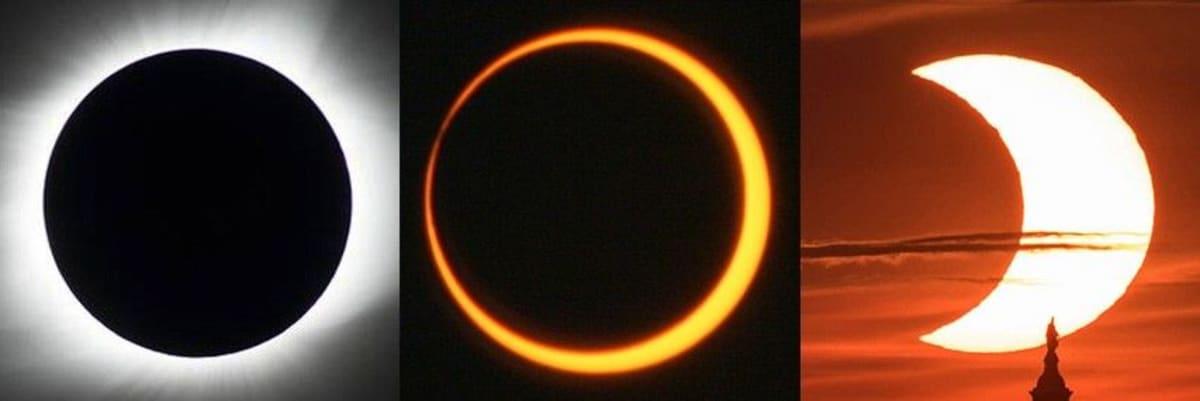
Image Source: (L) Total eclipse: NASA/MSFC/Joseph Matus; (C) annular eclipse: NASA/Bill Dunford; (R) partial eclipse: NASA/Bill Ingalls
The Americas, Europe, Africa, and Western Asia are the continents where the phenomena could be seen. It is a treat for researchers and sky gazers when back-to-back phenomena occupy the sky. For eclipse enthusiasts, 2027 awaits a once-in-a-century solar eclipse, the second-longest total solar eclipse of the 21st century. This monumental eclipse will take place on August 2, 2027, and will potentially be visible across Spain, Gibraltar, Morocco, Algeria, Tunisia, Libya, Egypt, Saudi Arabia, Yemen, and Somalia, as well as the Atlantic and Indian oceans, as per the National Science Observatory (NSO).
The duration of totality will be a whopping 6 minutes, 22 seconds long. The event has been dubbed the “Eclipse of the Century” because of its significantly long duration of totality and path of totality, as long as 160 miles, according to IFLScience. Moreover, this eclipse will not appear in the remotest corners of the Earth like the upcoming annular solar eclipse. Hence, people of Africa, Europe, and Asia will get to witness the historic phenomena.