
Scientists Tracked Ravens Trailing Yellowstone Wolves. Turns Out, They're Doing More Than Scavenging
Published March 13 2026, 7:39 a.m. ET
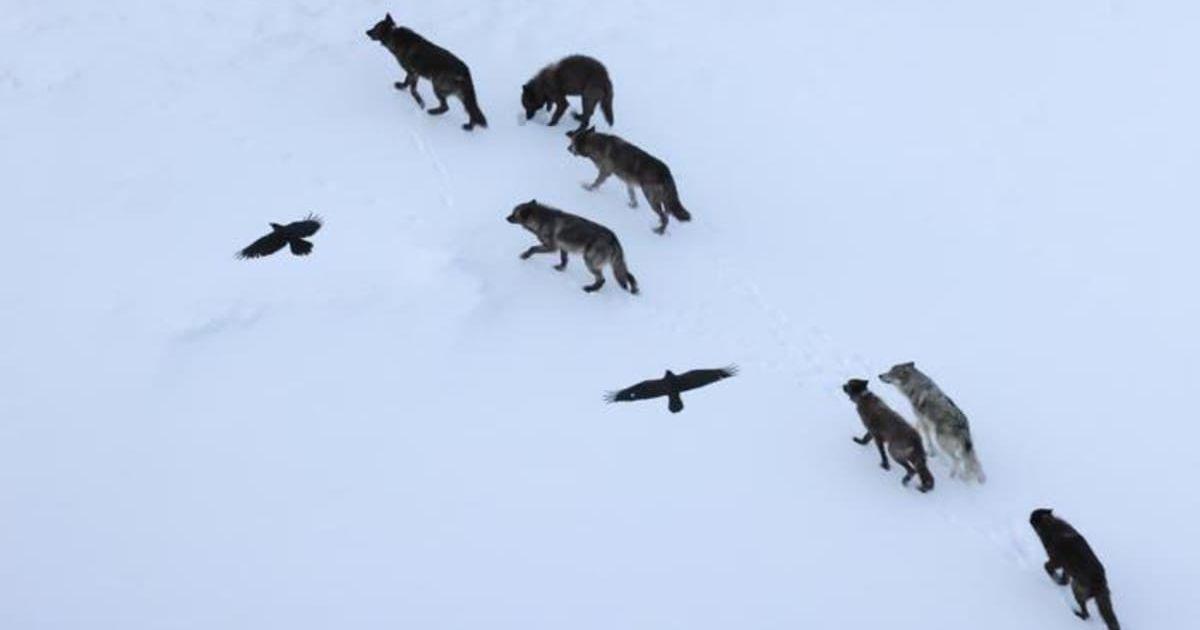
Two ravens soar above a wolf pack in Yellowstone. This type of short-distance following is common, but a new study shows that prolonged following is extremely rare.
A snowy valley in Yellowstone National Park appears to be dotted with a party of black silhouettes, a rampage of ravens crowding over what seems like a reddish, meaty carcass. With pointy beaks, the birds nibble and peck at the carcass, shredding it into tiny bits. A stone’s throw away, a pack of wolves can be seen voraciously feeding on hunks of the dead animal. A raven swoops down near a wolf to have a quick bite. Disturbed, the wolf stands up, its tongue lolling, teeth exposed in a growl, and mouth opening and closing in masticating motions to scare away the pestering bird.
This is a scene from the footage captured by University of Washington researchers who had been spying on ravens and wolves for quite some time. For several years, researchers have noticed ravens following wolf trails and responding to their howls. Initially, they assumed that ravens do this to steal the carcasses from the kill sites. But new research published in Science challenges this assumption, suggesting that ravens may have greater goals behind following wolves than just the agenda of satiating their hungry bellies.
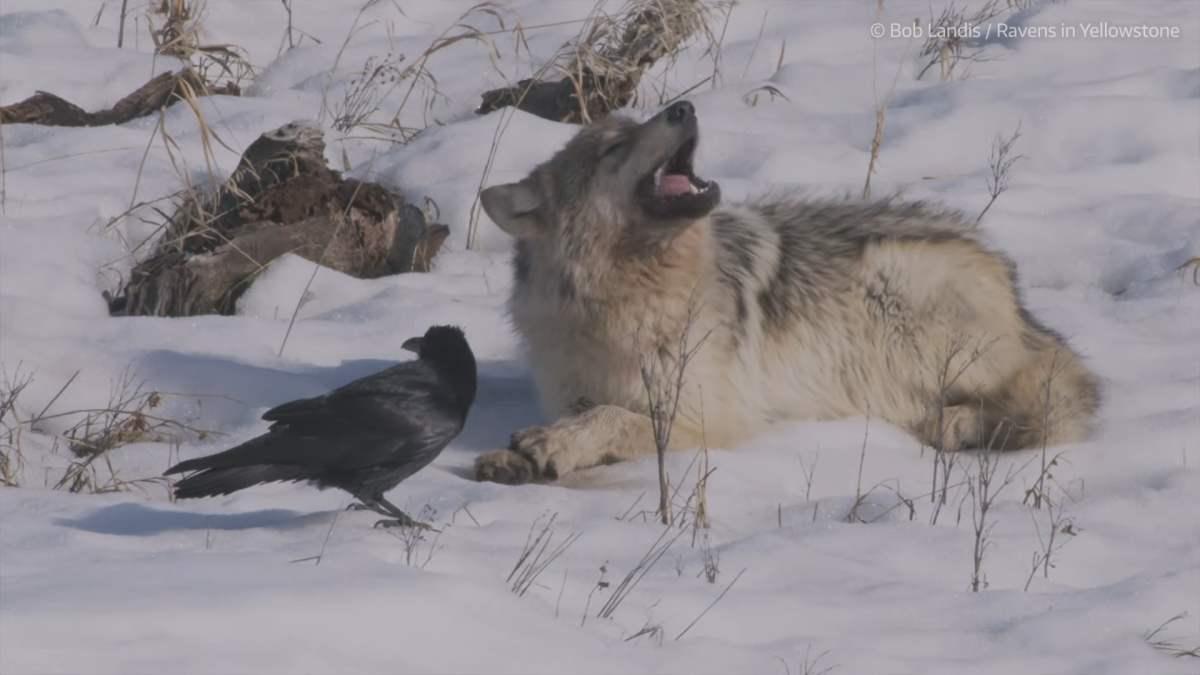
Yellowstone wolf eating a carcass gets disturbed by a raven who came to share the meal
Ravens use memory to keep track of the pathways to wolves’ kill sites so they are spared from the struggle of being in the right place at the right time. Ravens are known to rely on predators like wolves to reach the kill sites for food. Most scavengers do this indeed, but ravens don’t simply follow wolves. Instead, they use wolves as a “viable winter foraging strategy.” By repeatedly following wolf tracks, they create maps of the top kill sites and carcass hotspots in their intelligent brains, so when they need food, they simply have to fly to these sites, rather than taking up the hassle of hunting from ground to ground.
"This tight coevolutionary relationship between predator and scavenger has persisted in human thought for millennia,” senior author John Marzluff said. Food might be a good enough reason for following wolf tracks, but it is certainly not the only one. “Scavengers are not quite as glorious as predators and have traditionally been understudied by comparison. Getting a better understanding from the scavengers’ viewpoint might give us insight into sensory abilities, underappreciated environmental cues, and spatial and temporal memory," he added.
Marzluff, lead author Matthias-Claudio Loretto, and researchers from the Max Planck Institute of Animal Behavior fitted tiny GPS sensors to 69 ravens across Yellowstone and tracked them as well as 20 wolves for nearly two-and-a-half years, discovering that ravens did more than just follow the wolves for food.
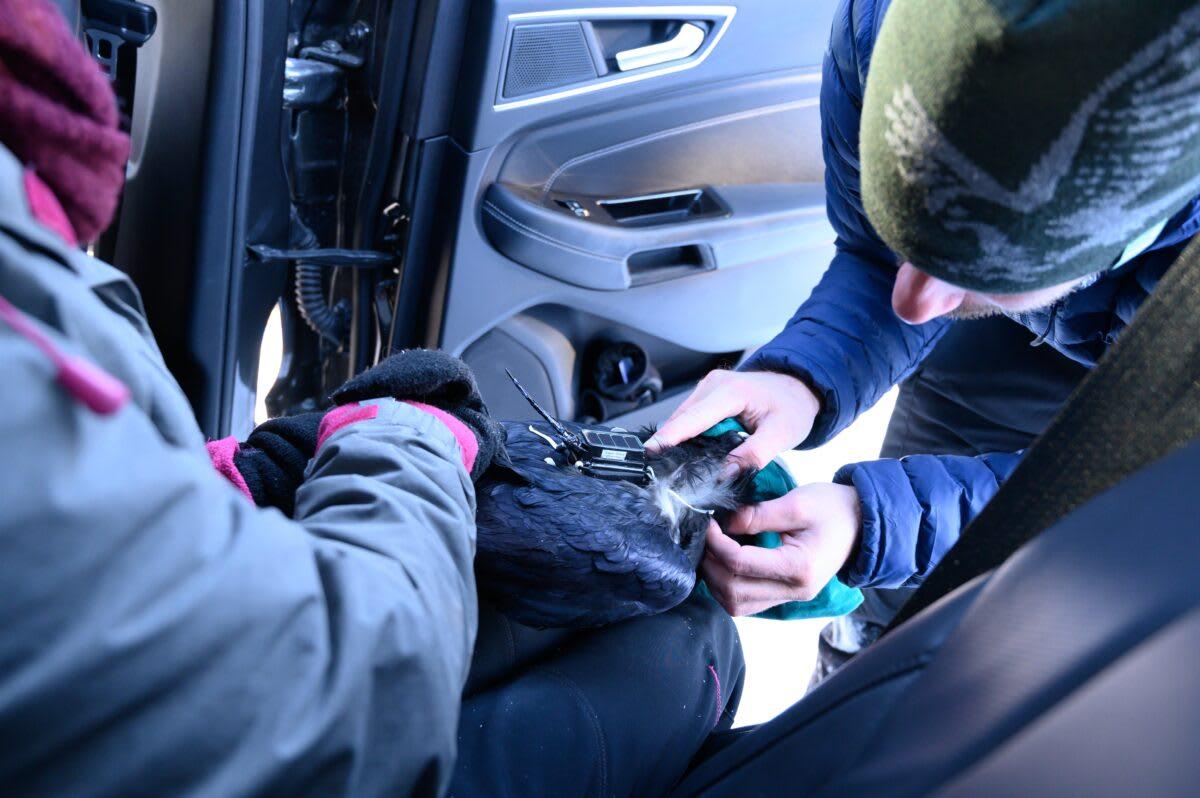
Matthias Loretto (R) fits a transmitter on a common raven. These tracking devices record the free-ranging bird’s location and acceleration, much like a cell phone does.
At nearly half of the observed wolf kill sites, within seven days, ravens were spotted. Some of them even flew more than 93 miles to reach a kill. Their flight patterns also suggested that they were making a beeline for the meat. Ravens were also likely to visit the most frequent wolf kill sites, according to the researchers’ “carcass abundance map." By clocking wolves’ kill patterns and plotting these sites in their brains, they design easy navigation for their food supplies.
“It was one of those moments when suddenly everything started to make sense,” Loretto told DISCOVER. At first, it was very puzzling, but they were surprised to realize how ravens use these kill patterns to their advantage, sometimes even flying around six hours at a stretch, justifying their “intelligent” status and problem-solving aptitude. It is a reminder, he said, that animals don’t just respond to their physical environment but also the behavior of other species, often decoding their patterns to make their own lifestyles easier and hunts predictable.