
Scientists Tested a Bonobo With a Child's Make-Believe Tea Party. Surprisingly, He Played Along
Published Feb. 6 2026, 5:53 a.m. ET

Kanzi, the bonobo.
Apparently, humans aren't the only ones with a knack for acting and imagination. A bonobo named Kanzi could have cleared the audition of an elite culinarian when he pretended to see food that wasn't even there. In a recent set of experiments, scientists wanted to test if animals could play pretend just as well as humans, and the results didn't disappoint. Kanzi was treated to a make-believe tea party where he was served invisible juice and grapes. According to the results published in the journal Science, the bonobo didn't question the absence of delicacies and simply played along. The researchers concluded that Kanzi was able to imagine a streak of invisible juice poured into the cups from a pitcher and a bunch of grapes being served in a jar.
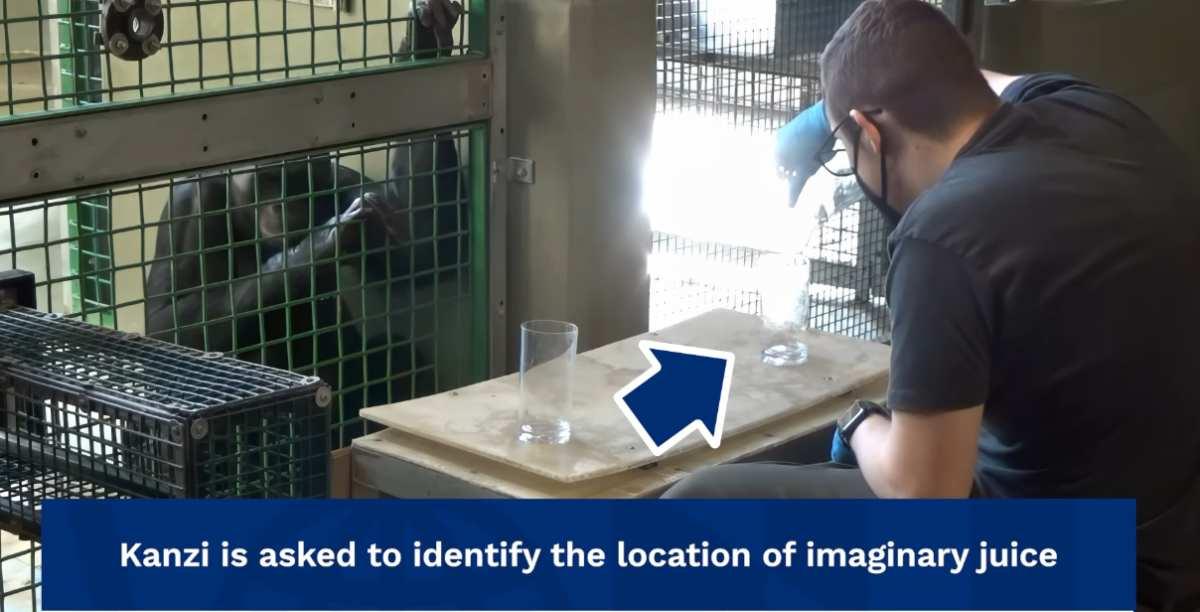
Kanzi, the bonobo, was being served invisible juice in a cognition test.
“He’s able to follow along and track the location of a pretend object, but at the same time, he appreciates that it’s not actually there,” said Chris Krupenye, an author of the study and an assistant professor of psychological and brain sciences at Johns Hopkins University, as reported by NBC News. This experiment is a testament to the mental capabilities of bonobos and their potential similarity to human cognition. “We think of our ability to imagine other worlds or other objects, or imagine futures, as one of these rich features of human mental life that are presumed to be unique to our species,” Krupenye said. Evidently, humans might share this unique gift of cognition, at least to some degree, with the ape.
The "pretend play" in human children begins in the early years of their lives. Kids having imaginary friends and invisible tea parties with stuffed toys isn't unusual, but an early cognitive behavior. Krupenye revealed that many experiments with child psychology are based on these make-believe scenarios. That's why the researchers thought it ideal to understand the cognitive potential of Kanzi.
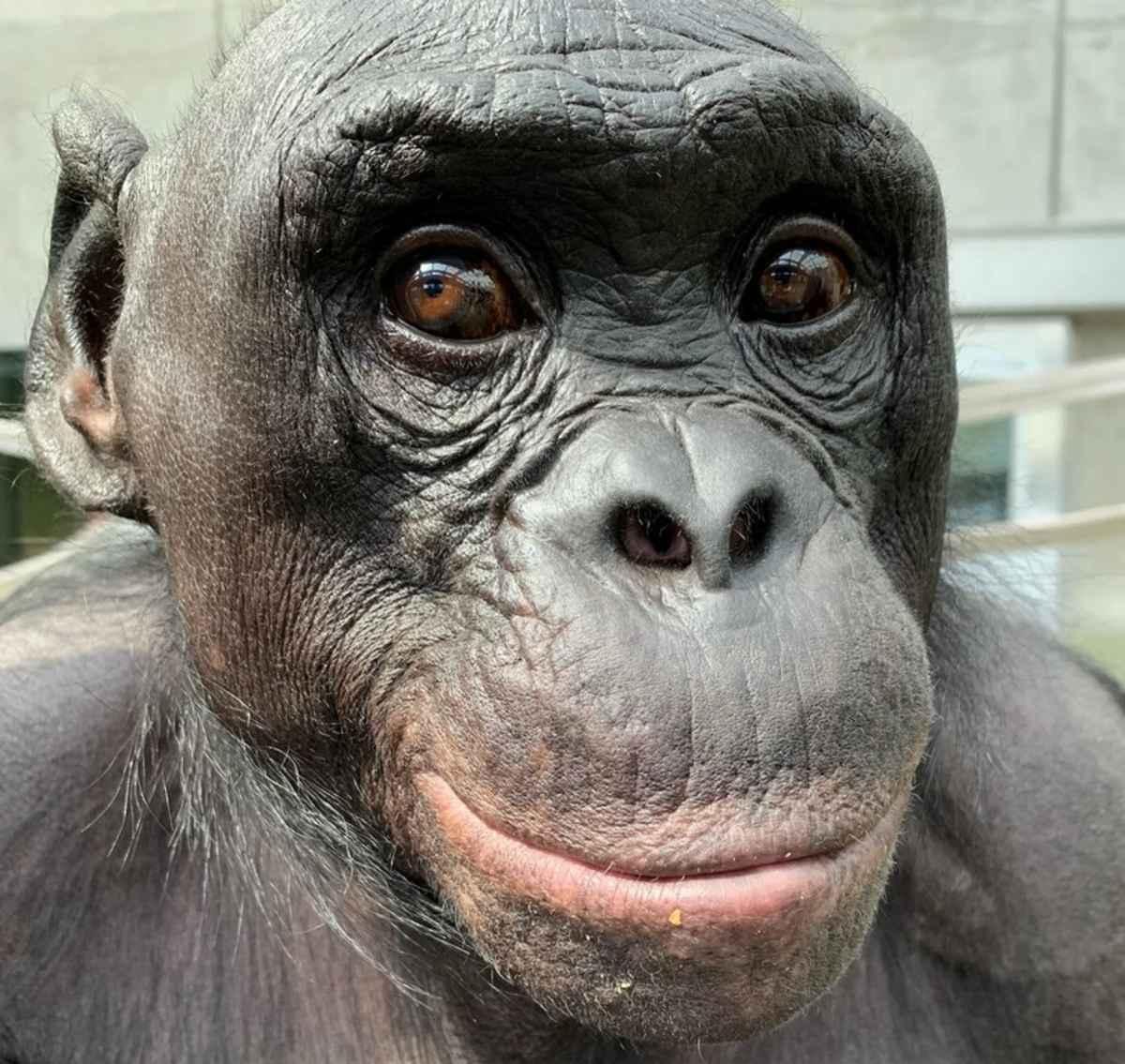
Kanzi, the bonobo.
In the first experiment, imaginary juice was poured from a transparent pitcher into two glasses. They kept pretending to pour from one container back to the pitcher to test Kanzi's ability to track the juice that wasn't visible. In the end, he correctly pointed out the vessel that had the invisible juice, showing that their cognition isn't entirely reliant on vision. He kept guessing correctly 34 times out of 50, which is 68% of the time and a sure shot "success rate."
Then, the researchers ran another test to check if Kanzi could distinguish real juice from the imaginary juice. When one cup of real juice and one cup of imaginary juice were poured, the ape was asked which one he wanted. Kanzi pointed at the cup filled with real juice most of the time. This control proved that he could tell the difference between what's real and what's imaginary.
For the second experiment, imaginary grapes were served out of a transparent container into two jars. Then, the researcher dumped a grape from one jar back into the container. When asked which jar still had the imaginary grape, the majority of the time, Kanzi correctly pointed it out.
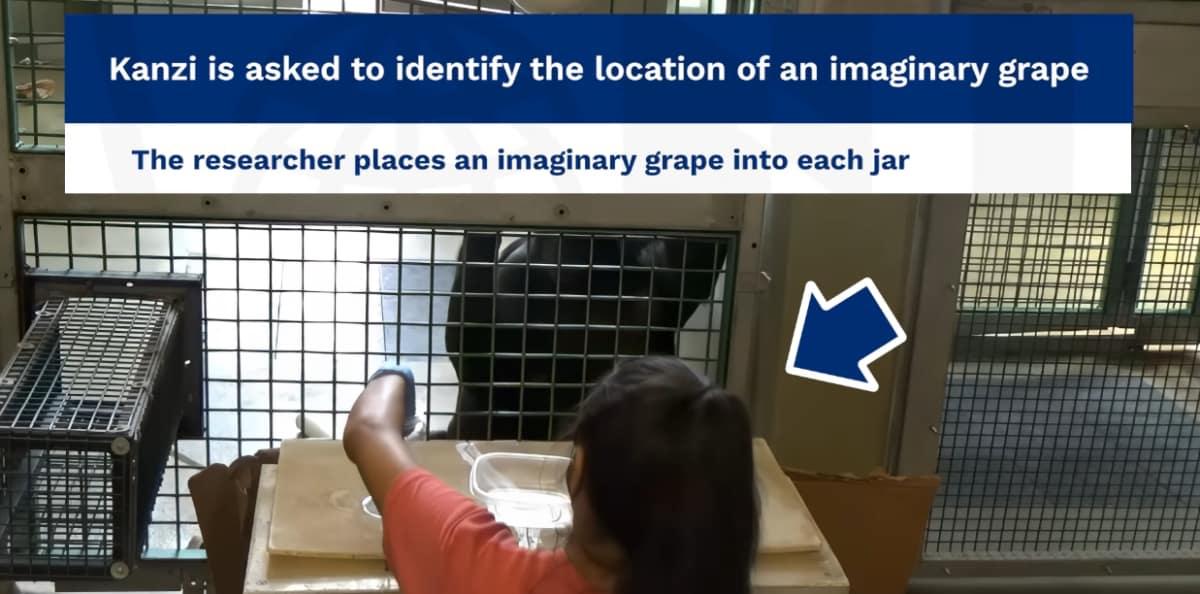
Kanzi, the bonobo, being served invisible grapes as part of an experiment.
"It's extremely striking and very exciting that the data seem to suggest that apes, in their minds, can conceive of things that are not there," study co-author Amalia Bastos said in a statement. "Kanzi is able to generate an idea of this pretend object and at the same time know it's not real," she added. The findings inspired the researchers to continue the study, potentially engaging with other animals. "We should be compelled by these findings to care for these creatures with rich and beautiful minds and ensure they continue to exist," Krupenye said.