
Rockies Are Losing a Tree Vital to Mountain Ecosystems. And This Invasive Creature Is to Blame
Updated Feb. 9 2026, 6:45 a.m. ET

Field technicians examine mature cones of a whitebark pine tree
In the high-elevation slopes of the northern Rocky Mountains and the Pacific Northwest, the whitebark pine (WBP) tree has been standing strong. For years, everything was perfect. Everything proceeded according to a nice routine. A Clark’s nutcracker, the elusive black-and-white bird, arrived and poked the purple-scarlet seed cones with its beak, bursting them open. The bird would then collect the seeds from inside the cones and stow away hundreds of them in a pouch beneath its tongue. It flew across the mountain meadows, burying clusters of these seeds, soon to tower into adult trees. Those that remained scattered on the ground were gobbled up by grizzly bears, who needed them to stock up on calories for the winter. In winters, the WBP traps the falling snow in its crown and stabilizes the snowpack, per the Cornell Lab of Ornithology.
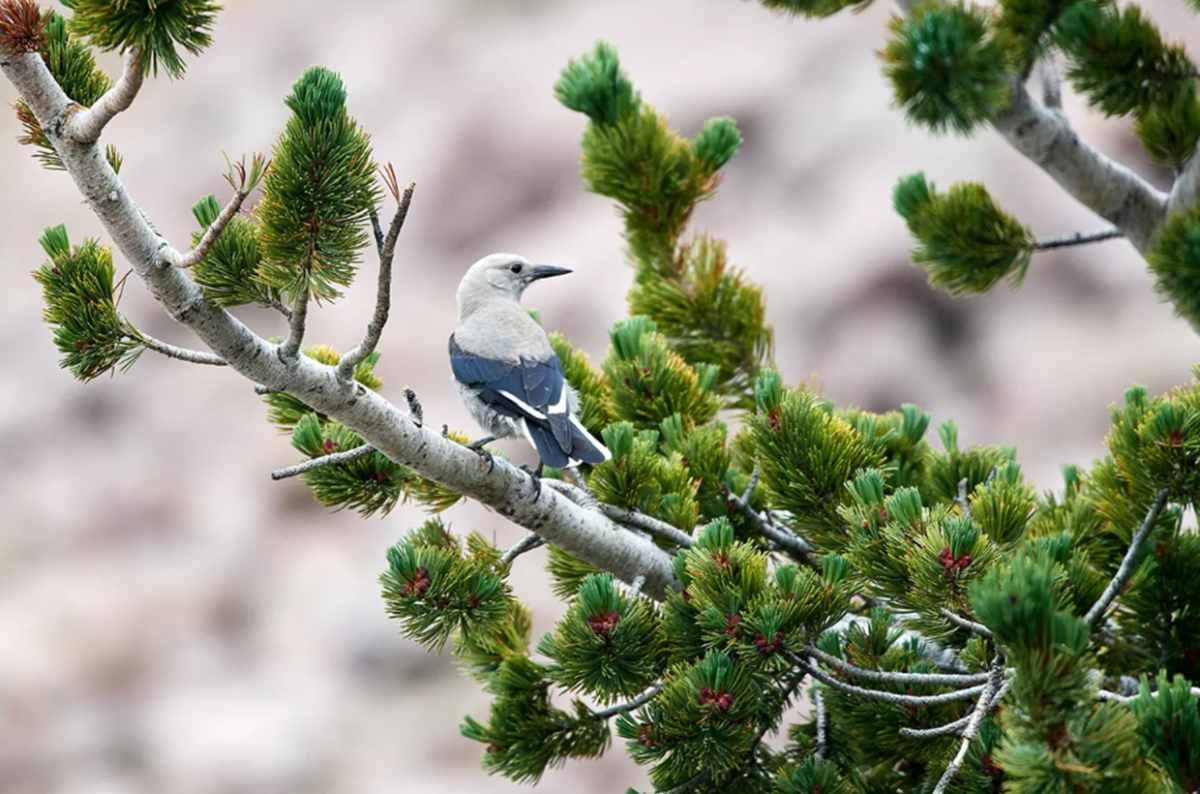
Clark's nutcracker on whitebark pine
However, today, this dreamy routine has dulled down to a grim realization. The mountain landscapes, earlier dotted with WBPs, are now fading into “ghost forests,” leaving both the climate scientists and species like nutcrackers and grizzlies depressed. In a study published in Environmental Research Letters, researchers projected a shocking 80% decline in the WBP population by the mid-21st century. For over a thousand years, WBPs have steadily clung to the lofty slopes, but now, exposed to a toxic cocktail of environmental stressors, these creeping pines are losing their grip. Under constant assault, their gnarly limbs are dying.
Not all blame goes to the humans, though. There’s also a little creature that’s suspected to be the greatest culprit. With a size no larger than a small pencil eraser, the mountain pine beetles wreak havoc on the WBPs. Despite having a teeny-tiny mouth, this beetle’s sting is enormously toxic. The female beetle notoriously lays her egg in the holes she punctured in the bark and then starts gnawing to make a cocoon for the eggs to hatch. The flow of water and nutrients gets disrupted, ultimately killing the tree. Add to it the white pine blister rust, a type of fungus that launches a direct attack on the tree’s needles. Over time, the bark develops cankers and blisters, ultimately disintegrating.
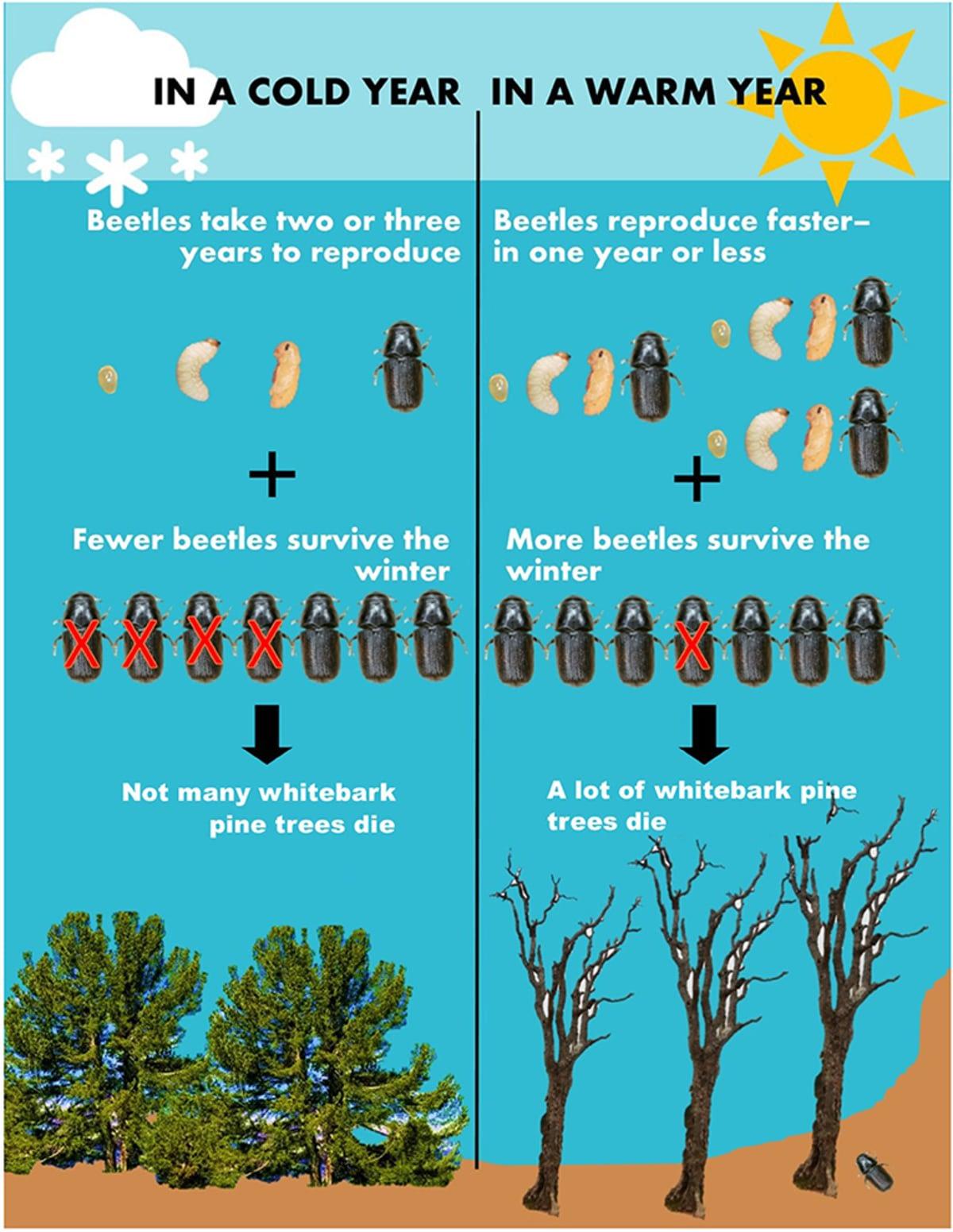
Illustration showing the process of mountain pine beetles infecting whitebark pine trees
“High elevation white pines currently face increasing mortality,” affirmed the Rocky Mountains Research Station. Researchers in this study mentioned that the WBP is now listed as a “threatened” tree species by the U.S. Fish and Wildlife Service (USFWS) under the Endangered Species Act (ESA).
Louisa Willcox, senior wildlife advocate for the Natural Resources Defense Council (NRDC), reinstated that the masses of grey and red trees littering the forests above her home in Montana are a “testament to the damage already being wreaked on the high-elevation ecosystems.” Nancy Bockino, research associate at the Northern Rockies Conservation Cooperative, raised the alarm, saying that “it’s like losing the roof of your house,” per ABC News.
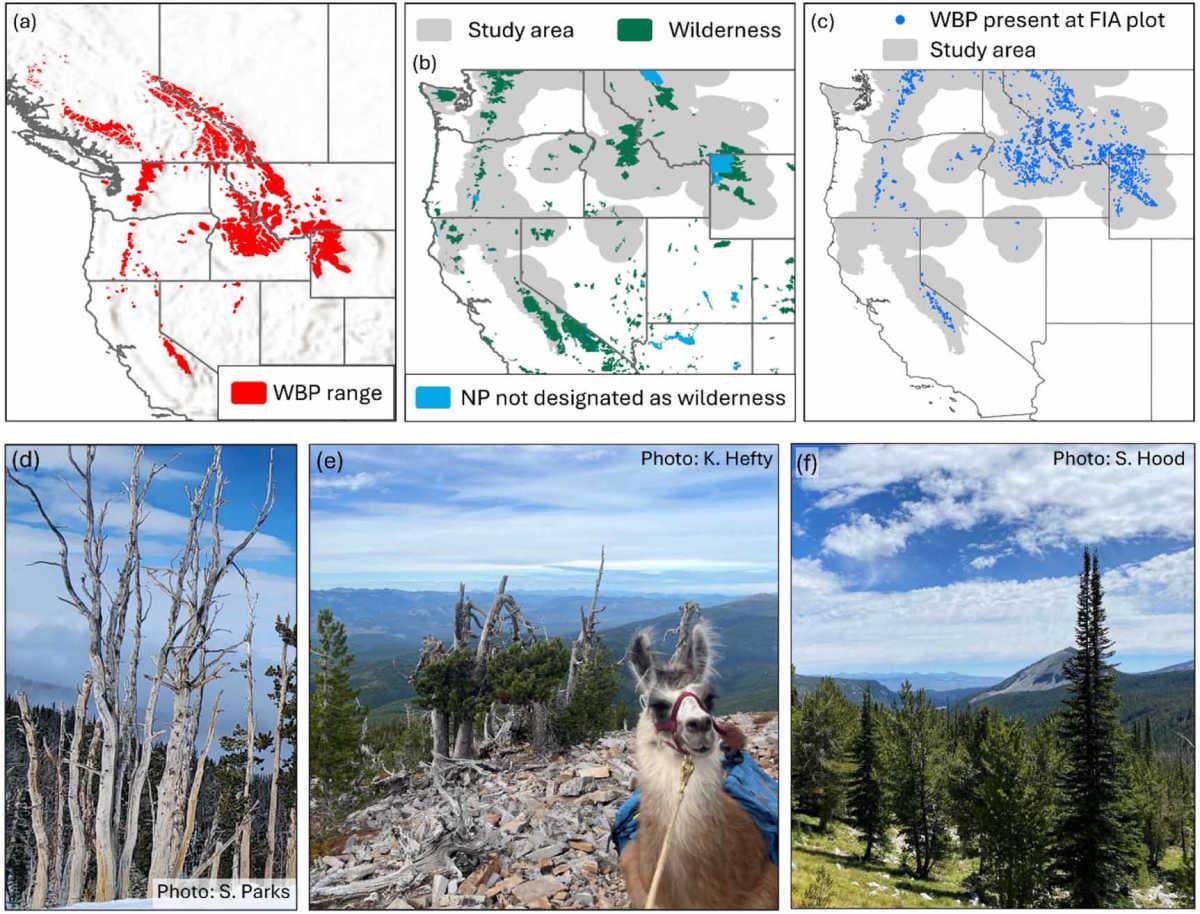
Maps showing the range of WBP in western North America (a); study area defined by the USFWS overlaid with protected areas (b) and the distribution of WBP at Forest Inventory and Analysis plots (c); several dead WBP trees northeast of Yellowstone National Park (d); llama posing on a rocky ridge with declining WBP trees in western Montana (e); a healthy WBP forest in southwestern Montana (f).
And then comes the biggest bogeyman behind WBP’s impending doom—climate change. In conversation with National Parks Traveller, lead researcher Diana Tomback shared that WBPs are ranked as one of the most vulnerable to climate change. In the study, she and her team highlighted that climate change is “affecting forested lands globally and challenging resource managers to identify strategies to mitigate or adapt to changing ecosystem processes.”
With the list of culprits in hand, scientists are now planning to develop restoration strategies that will reverse the alarming decline. It might take decades if not centuries. In a 2016 report in Restoration Ecology, researchers outlined the strategies of prescribed burns for fire management and climate control. Or maybe, if WBPs develop resistance or immunity to the deadly fungus, then the species may resurrect in the dwindling life graph. Right now, the scenarios look hypothetical, but if efforts remain persistent, they may as well turn into reality.