
Rare Six-Planet Parade Is About to Light Up the Night Sky: When, Where and How to See It
Published Feb. 2 2026, 4:26 a.m. ET

A planetary parade will march across the sky this month
The cosmic timekeeper has probably spent a great deal of time preparing the calendar of 2026, for it is marked with a variety of celestial events. From shooting stars to fiery displays of light and collaborative appearances, the stage is all set. February will host a ring of fire (solar eclipse) in Antarctica, whereas March will remain busy with spring meteor showers, a Blood Moon, and a pyramid-shaped glow called false dusk. The rare occultation of the “snow moon” with the royal star Regulus has just wrapped up. Meanwhile, on February 28, soon after sunset, the southwestern sky will turn into a necklace strung with six planets, all coming together in a rare alignment that astronomers also call a “planetary parade,” according to NASA.
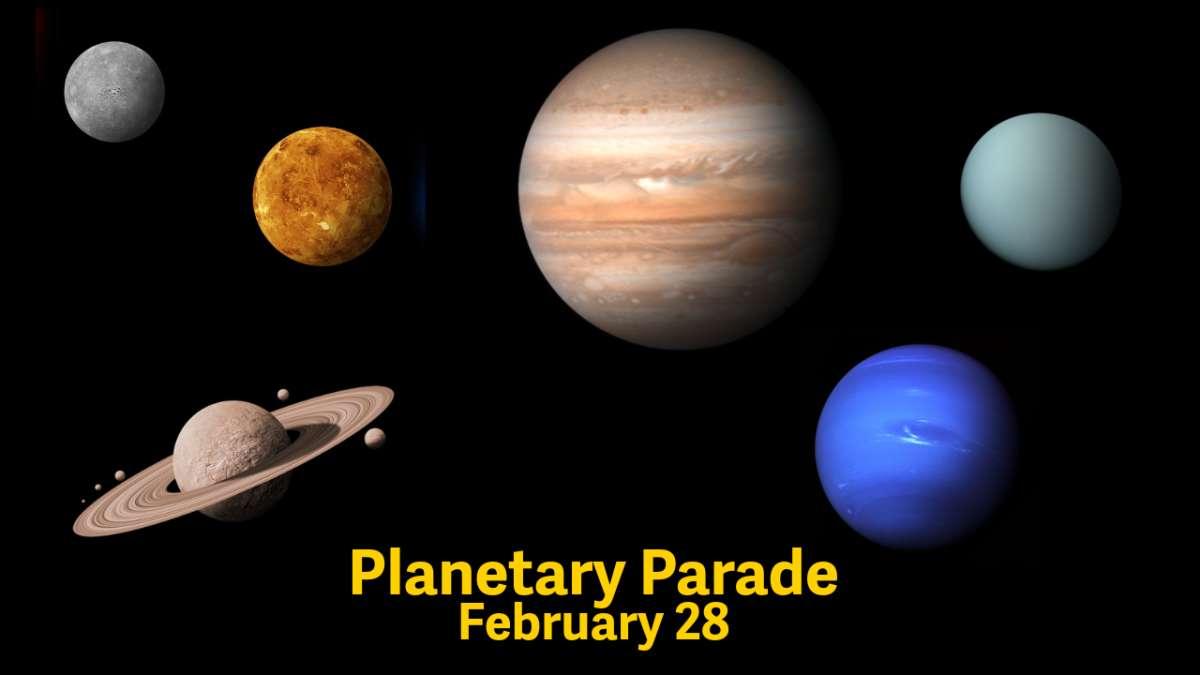
Mercury, Venus, Neptune, Saturn, Uranus, and Jupiter will appear in the sky shortly after sunset on February 28. This artist illustration features those six planets set against a black background.
Mercury will climb up in the western sky, close to the Sun, and stand in the constellation Pisces. The gaseous king of the solar system, Jupiter, will rise in the sky and gleam like a gigantic jewel near the bright stars Castor and Pollux in the constellation Gemini. Saturn will leap in the southwest, dropping down towards the horizon. Venus, followed by Jupiter, will be the brightest candidates in the dazzling choreography, whereas Uranus and Neptune will continue to glow as background performers. On February 28, Venus and Jupiter will remain close to each other, although their proximity will remain at low-elevation areas, above the horizon, which will make them difficult to spot from Earth.
Venus will appear in the constellation Aquarius, and Saturn’s soft golden glow will illuminate the constellation Pisces. The planetary alignment will prevail throughout the month of February, but will remain brightest at the end of the month. If you can spot Saturn from the ground, you can easily spot Neptune by scanning the surrounding area. On a negative note, the bright light of the Moon might interfere with the sighting as it approaches too close to Jupiter.
Two people watching the starry skies with a telescope mounted on the ground
While four of the six planets will remain visible to the naked eye, two will require optical aids to be visible. Spotting Mercury will be a bit tricky, but not impossible, though. The best time, according to NASA and StarWalk, is an hour after sunset. Venus, Jupiter, Saturn, and Mercury will be visible with the naked eye, whereas Uranus and Neptune will require some optical lenses, such as binoculars or a telescope, to come into clear view. The planetary parade will march across the southwestern skies at different times in different locations. In New York, for instance, you can see the parade on February 28, as well as in Mexico City, Tokyo, and Athens.
In other locations, like Beijing, Berlin, London, Mumbai, and Reykjavik, the parade will appear between March 1 and March 2. Starwalk recommends using their app to enjoy the planet parade as soon as the sky darkens. Choose a location on a clear western horizon, the app suggests. Once the parade performance wraps up, the six performing planets will drift away behind the curtains and continue to move in their respective orbits. Mercury and Venus will be the first ones to take retreat. They will be followed by Saturn and Neptune. Uranus will stay a little bit longer. Jupiter will be the last one to say goodbye.