
New Weather Satellite Shows Earth’s Chaotic Atmosphere in Stunning Detail
Published Jan. 30 2026, 7:35 a.m. ET

(L) Global surface and cloud-top temperatures by MTG-Sounder | (R) Illustration of Satellite (Representative Cover Image Source: (L) ESA; (R) Getty Images | Photo by Sergio Bonilla)
A new weather satellite is set to change forecasting. The satellite in question is the European Space Agency’s MTG-S, whose first images have recently been published. It will help in weather forecasting of countries across Europe and Northern Africa. Scientists claim that the satellite’s advanced technology will provide the best view to date of the chaotic dynamics, impacting the planet’s weather. These dynamics were captured by the Meteosat Third Generation-Sounder 1 satellite (MTG-S1) with the help of a remote sensing methodology known as infrared sounding. This methodology helped collect accurate data regarding elements such as trace gases, wind, humidity, and temperature.
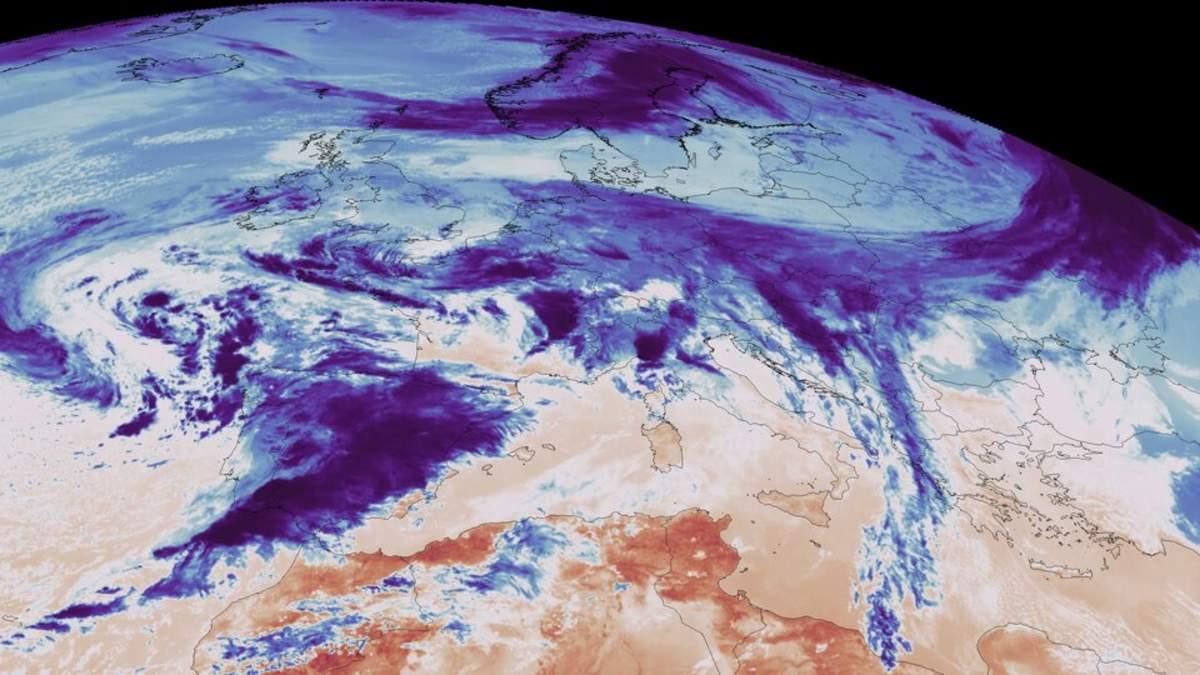
Temperatures over Europe and northern Africa by MTG-Sounder
The first images from the satellite were shared during the European Space Conference in Brussels. These images were taken on January 15, 2025, through the Infrared Sounder instrument. It showcases a full-disk view of Earth as seen from the geostationary orbit. This vantage point is around 22,300 miles above the planet’s surface. One of the images depicts both Earth’s surface temperatures and the temperature exhibited at the top of the clouds. High temperatures are reflected with a dark red color, while blue represents lower temperatures.
The warmest regions, such as the Cape Verde peninsula in the top-center of the image, the western coast of Namibia, and South Africa at the bottom-right, and the northeast coast of Brazil on the left, were demarcated in dark red. Blue color mostly dominated the swirl of clouds. For these temperature insights, a long-wave infrared channel was used. The satellite captured another temperature image, where a dark blue weather front envelops Spain and Portugal. This suggests that cold clouds had surrounded the area on January 15.
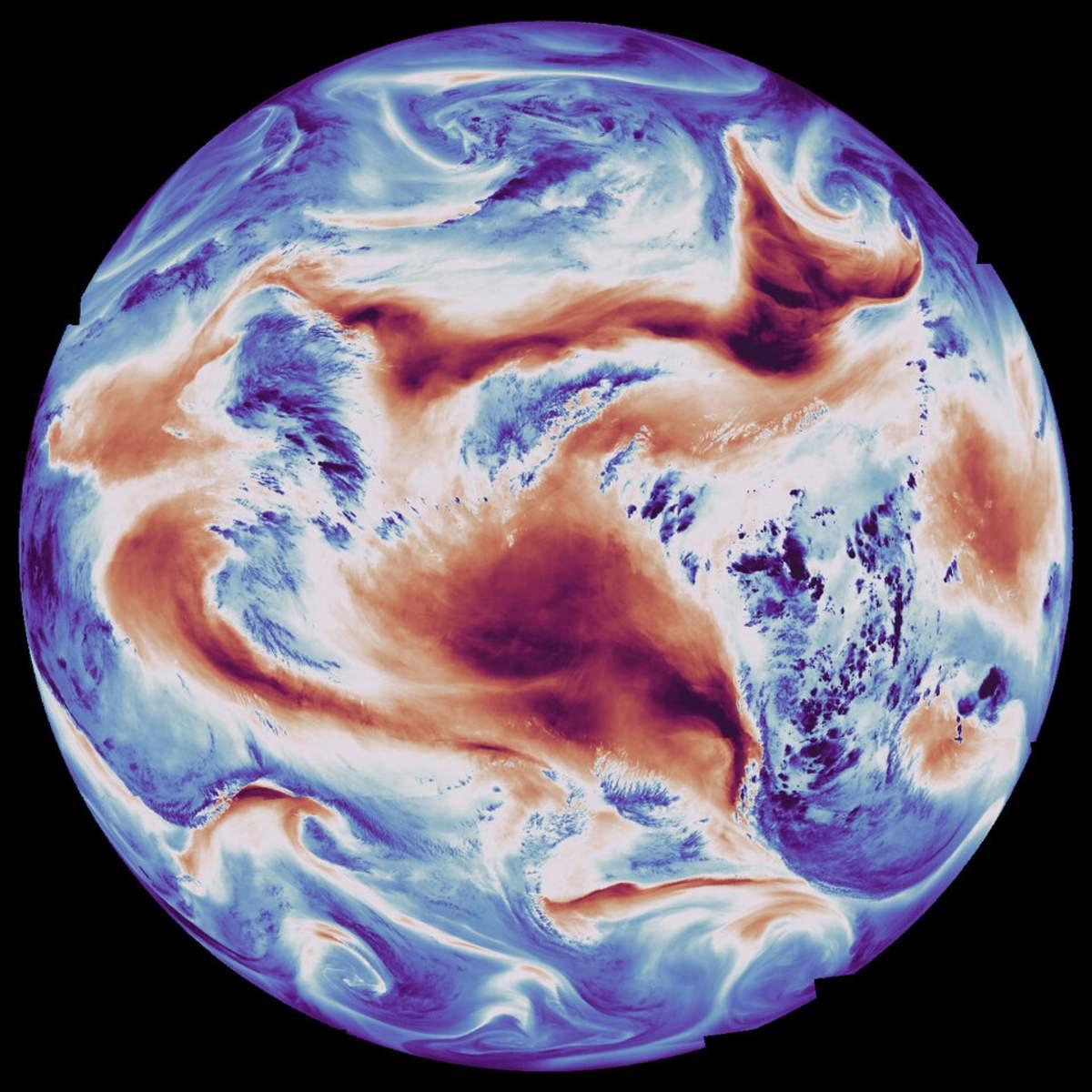
Global air humidity by MTG-Sounder
The satellite also captured a “humidity” image, representing moisture in the atmosphere. Blue was used to reflect the regions with higher humidity, while red corresponded to regions with lower humidity. The areas with the least humidity were demarcated in dark red, like the Middle East and the Sahara Desert at the top, as well as part of the South Atlantic Ocean in the center. Patches of high humidity were detected in several places in the eastern region of Africa, and are represented in dark blue.
ESA called the satellite “game-changing,” as it will determine air quality and weather forecasting across Europe and Northern Africa. It is in a geostationary state above the equator and can follow the same region on the planet’s surface, despite the rotation. MTG-S gathers information about Europe and parts of northern Africa every 15 minutes. From this information, the satellite provides temperature and humidity insights of the concerned areas every 30 minutes. These insights, along with data on lightning and cloud formation collected via the MTG-Imager (MTG-I) satellite, will allow meteorologists to create a better weather picture of the region, and that too with alarming frequency.
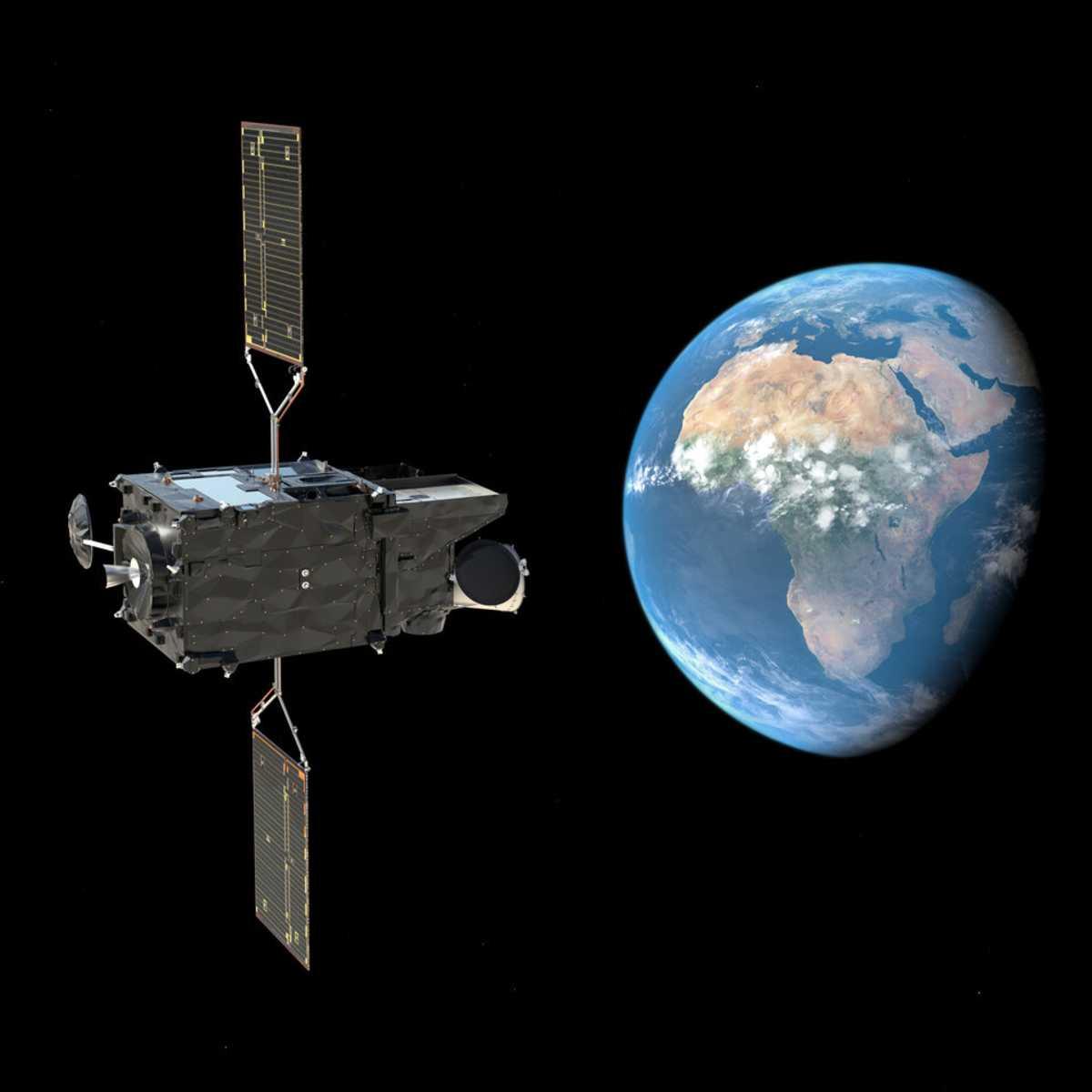
MTG-Sounder satellite over the equator
The satellite’s objective is to solve the scientific and societal challenges that other instruments face during weather forecasting. Considering the insights gathered from the first batch of images, it can be implied that it is well on its way to solving these issues. “Seeing the first Infrared Sounder images from the MTG-Sounder satellite really brings this mission and its potential to life. We expect data from this mission to change the way we forecast severe storms over Europe – and this is very exciting for communities and citizens, as well as for meteorologists and climatologists,” ESA’s Director of Earth Observation Programmes, Simonetta Cheli, shared. The next aim will be to use the Infrared Sounder instrument to create three-dimensional (3D) maps of the atmosphere.