
Death Valley National Park Witnesses Its Best Superbloom In a Decade. But The Peak Won’t Last Long
Published March 5 2026, 4:30 a.m. ET

The last superbloom in Death Valley took place in 2016.
For the first time since 2016, Death Valley National Park is experiencing a superbloom, with the beautiful flowers covering the entire landscape. The area is beginning to burst with yellow and purple blooms after a wet winter created the perfect conditions for a big wildflower season. “We are having the best bloom year since 2016 and many sprouts have not yet flowered. The showy yellow Desert Gold is one of the most prominent flowers, but there are a large variety of other species blooming as well,” the officials on the park website said.
Death Valley is now covered with several wildflower species, such as desert gold, brown-eyed primrose, sand verbena, fivespot, phacelia, Mojave Desertstar, and California suncups. However, the same bloom will not last forever, and it is recommended for people to visit as soon as possible. “Low-elevation flowers are blooming throughout the park and will likely persist until mid-late March, depending on the weather. Higher elevations will have blooms April-June,” the park officials said. “It’s the best I’ve ever seen. I definitely recommend getting here within the next week or so,” an LA photographer, who also witnessed the 2016 superbloom, visited the park recently, said, per the San Francisco Chronicle.
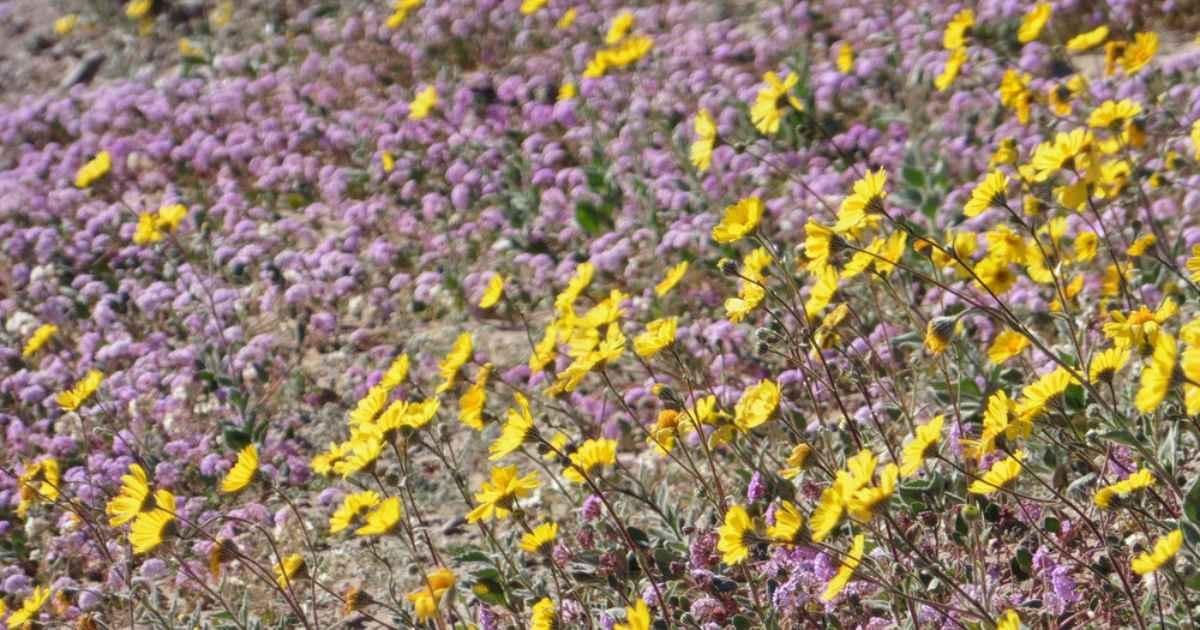
In the southern part of Death Valley, pink Sand Verbena (Abronia villosa) cover the ground below Desert Gold (Geraea canescens).
According to the information on the park’s website, desert gold is currently the most noticeable flower across the park. There are also many other low-elevation wildflowers blooming widely in the area. Even though they have not officially named it a “superbloom,” the officials have emphasized that it is the best bloom year since 2016. Moreover, many plants are still in the sprouting stage and yet to fully flower. The park also added, “although there aren’t as many flowers as in past ‘superbloom’ years, there are far more flowers than we have (in) most years.”
To have a strong wildflower season, a few factors must come together at the right time. Steady rainfall through fall, winter, and early spring helps awaken seeds buried in the desert soil; meanwhile, warm temperatures allow the plants to grow. The absence of strong dry winds also plays a huge part, as they can quickly damage fragile blooms. In Death Valley, a superbloom occurs when massive fields of wildflowers suddenly cover parts of the desert. These events are rare and typically happen only once every decade or so. Seeds can sit dormant in the soil for years, and when enough rain finally arrives, they quickly sprout. The flowers grow and bloom before producing a new generation of seeds.
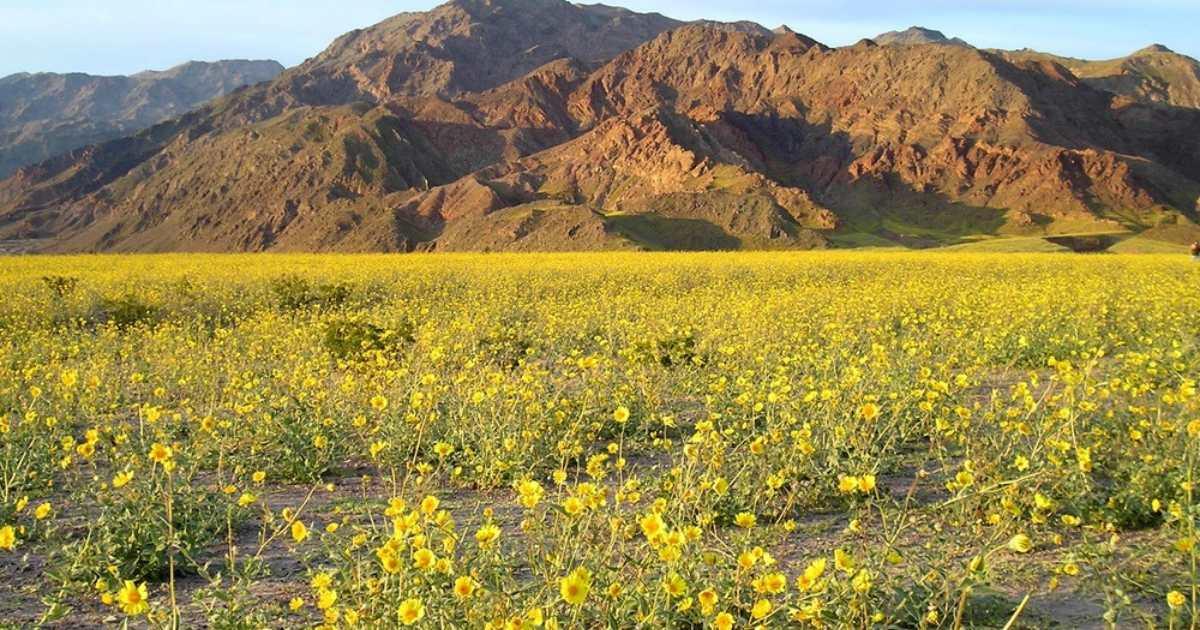
Abundant winter rains caused a spectacular superbloom at Death Valley in 2005.
Park ranger Jennette Jurado said that there is no strict definition for the term “superbloom.” The term is usually used when entire hillsides become densely covered with flowers. “We are seeing that on several alluvial fans around Furnace Creek to lower Badwater Basin, so ‘localized superblooms’ might best describe what we are currently seeing,” she added. The park’s website notes that Death Valley has witnessed major superblooms before, and the most notable ones were in 2016, 2005, and 1998.
However, not only in Death Valley National Park, wildflowers are blooming across many other places, such as Anza-Borrego Desert State Park along Henderson Canyon Road and Red Rock Canyon State Park. Typically, the wildflower season begins in mid-February and lasts through May. So, if you want to experience this spectacular view, plan a road trip soon within these months.