
Arctic Snow Once Seemed to Be Expanding. Scientists Now Say the Data Was Misleading
Published Feb. 9 2026, 9:29 a.m. ET

Satellite image of winter snow cover in the Northern Hemisphere
Just because satellites capturing snow cover images have improved doesn't mean the Arctic lands are flourishing. For years, the widening snow cover led researchers to believe that it was a sign of improvement. In reality, the satellites have just gotten better at capturing snow covers that are shrinking and would often go unnoticed. University of Toronto researchers, in a recent study, have found that the snowscape of the Northern Hemisphere is in a vulnerable state. For decades, the United Nations’ Intergovernmental Panel on Climate Change (IPCC) reports have used the U.S. National Oceanic and Atmospheric Administration's (NOAA) observations of autumn snow covers since the 1960s. Scientists for quite some time have been questioning NOAA's data, suggesting inconsistent observations. Now, the recent development has prompted researchers to rethink the decades of data and validated the concerns that arose earlier.
Aleksandra Elias Chereque, a PhD student in the department of physics at the University of Toronto’s Faculty of Arts & Science, along with her colleagues, went back to the data to point to differences that don't make sense. They questioned NOAA's report about an increase in snow cover of about 579,000 square miles per decade. The increase in snow cover sounds promising, but sadly, it might stray away from facts. When Chereque and her team conducted their analysis, they found contrary results and detected a snow-cover decrease of 193,000 square miles every decade. If that were the case, then how come NOAA detected an increase 1.5 times the size of the province of Ontario? Apparently, the agency's data collection method is to blame.
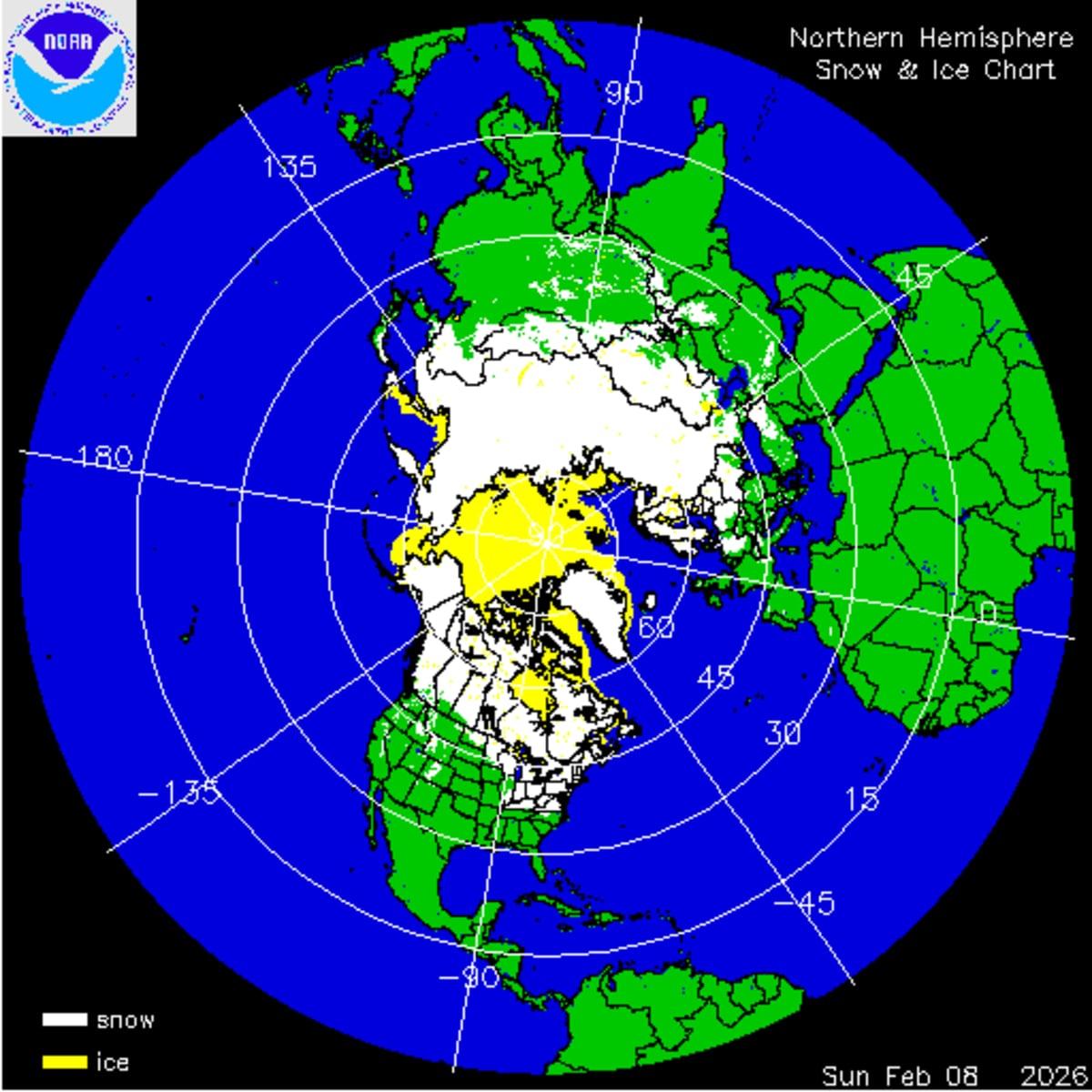
Northern Hemisphere Snow and Ice Chart as of February 8, 2026.
The researchers believe that it was a false upward trend in snow cover because the data collection system became increasingly sensitive to thin and patchy snow. That way, even the tiniest and shrinking patch of snow gets accounted for, making the results of the observation unreliable. "It’s as if the satellite’s ‘eyeglasses’ got better and better over that period,” says Chereque. “It looks like there’s more snow now than there used to be—but that’s only because the satellite kept getting better ‘prescriptions for its glasses.’ It looked like there was more snow, but that’s not what was happening," she explained. The recent study published in Science Advances provides proof of the claim that snow cover in the region has, in fact, decreased.
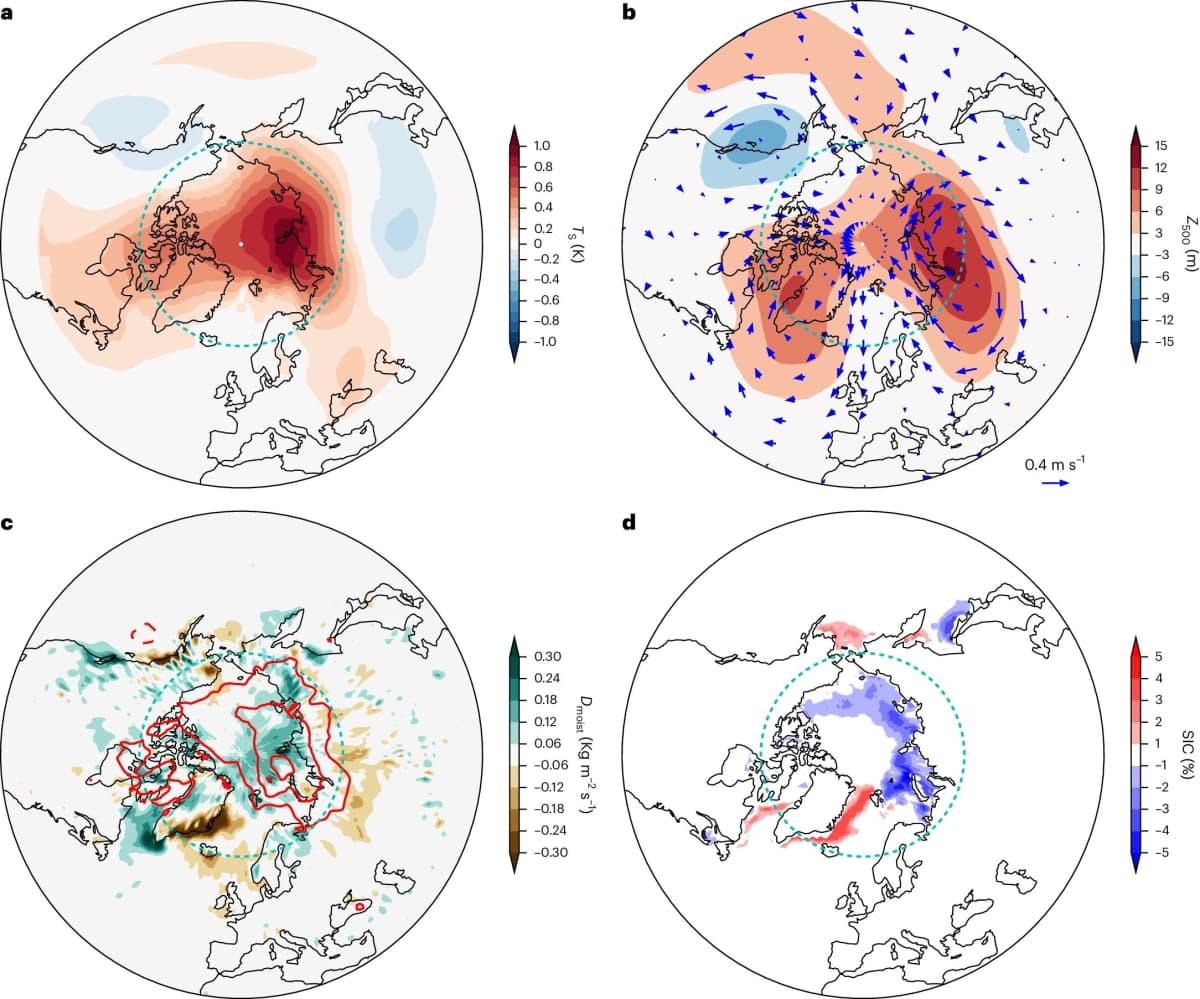
Modeling of Arctic warming amplification based upon factors of natural variability, such as surface temperature (a), geopotential height (b), moisture flux and longwave radiation (c) and sea ice concentration (d).
Snow covers are extremely important to the environment; hence, the accurate and recently derived data is essential to know and mitigate future challenges. "Snow cover is important because it’s a positive climate feedback mechanism,” Chereque said. "This is referred to as the snow-albedo effect—albedo meaning reflectivity. Snow loss leads to a decrease in albedo, which leads to higher energy absorption, which, in turn, leads to enhanced snow loss," she added. The phenomenon, also known as "Arctic amplification," is the reason why heating in the region is not uniform. Now that the study, co-authored by atmospheric physicist Paul Kushner, has evidence supporting the snow cover decline, experts can take action on that.
"We’ve gained a better understanding of this important mechanism of Arctic amplification," Chereque pointed out. “Showing how and why the snow cover trend was wrong helps us learn how to use this data set properly when we're estimating past conditions and future trends. And that helps in understanding whether climate models are accurate," she added.