
A Washington Airport Just Became the First in the U.S. to Earn a Major Environmental Certification
Published March 9 2026, 10:05 a.m. ET

Aerial view of King County International Airport looking south down Runway 14R toward Mount Rainier
A Washington airport has been honored for its environmental efforts. The King County International Airport (KBFI), also known as Boeing Field, has become the first airport in the country to get the International Air Transport Association (IATA) Environmental Assessment (IEnvA) certification. IEnvA is essentially a subscription-based program aimed at environmental management. This international certification helps airports to move towards environmental sustainability by adopting certain globally recognized standards and industry best practices.
IATA shared in their statement to KBFI that this certification honors their commitment to improving their environmental performance. “By meeting the rigorous standards set forth by the International Air Transport Association, you have demonstrated a clear resolve to minimize environmental impact and foster a greener future for our planet,” IATA said to the airport. The airport authorities were elated with the recognition and reinforced their commitment to the environment. “At King County, we’re committed to reducing our environmental impact, especially for the people who live and work near the airport,” said King County Executive Girmay Zahilay. “Earning this recognition reflects the dedication of King County employees who are doing the day-to-day work to protect nearby communities and build a cleaner future for the next generation. We’ve made real progress, and we’re going to stay focused on doing the work to reduce our carbon footprint.”

King County International Airport-Boeing Field, Seattle, Washington, aerial from the northwest.
John Parrott, director of the airport, shared that it was an "honor" to receive the certification. He further claimed that, along with preparing themselves and responding to climate change, the airport remains committed to backing King County’s Strategic Climate Action Plan. Due to their work in the recent past, the airport is on track to fulfill its set goal of carbon neutrality by 2030 for Scope 1 and Scope 2 emissions. The Scope 1 emissions are related to direct emissions controlled by KCIA, while Scope 2 is linked to emissions from cooling, heating, and electricity in buildings.
As per the Airports Council International (ACI), KBFI has achieved Level 3 in the Airport Carbon Accreditation Program (ACAP). This accreditation has come their way because the airport has successfully managed to involve users and tenants to reduce the establishment's greenhouse gas emissions. Over the years, KCIA has adopted several practices to leave a positive impact on the environment. It became the first airport in the nation to purchase and use a battery-electric runway sweeper as well as deploy a hybrid-electric aircraft rescue and firefighting (ARFF) vehicle. Authorities have now replaced all airport operations vehicles with battery-electric vehicles (BEVs). In October 2025, the airport hosted the demonstration of BETA Technologies’ ALIA CTOL, an all-electric aircraft. Later, the aircraft began flying using the newly refurbished Runway 14L/32R.
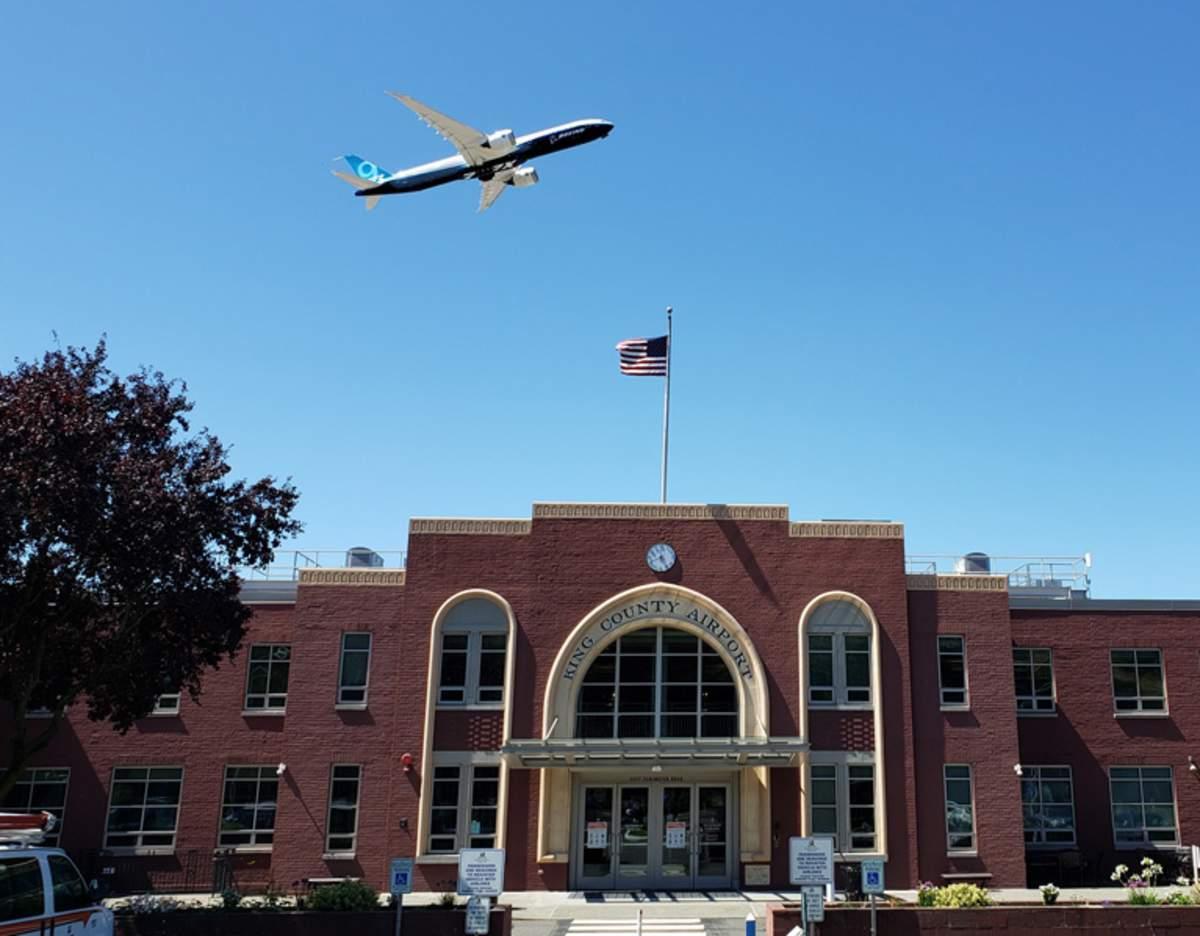
King County International Airport (KCIA), commonly known as Boeing Field (BFI).
All these efforts are expected to help the airport reduce its carbon emissions. During the demonstration of CTOL (conventional takeoff and landing aircraft), several officials from the Washington State Department of Transportation (WSDOT) and other state agencies were present, according to Flying Magazine. “We’re taking action to reduce our airport’s carbon impact, and part of how we do that is by embracing new technologies like electric aircraft,” Boeing Field director John Parrott shared back then. “We’re proud to host Beta Technologies and its Alia aircraft as a demonstration of a new era in aviation.”
Airport spokesperson Cameron Satterfield is happy with the progress, claiming that achieving environmental sustainability is a long road on which the airport has been for a long time, according to Flying Magazine. “The airport embraced the initiative early, recognizing that reducing emissions and improving environmental performance was simply the right thing to do for the surrounding community,” he said. Satterfield is hopeful that certifications like IEnvA will help them get grants and funding associated with sustainability initiatives, as well as attract environment-conscious partners.