
Strange ‘Bioluminescent’ Jellyfish That Can’t Survive Sunlight Was Just Caught on Tape in Norway
Published Feb. 10 2026, 7:45 a.m. ET

Elusive crimson-colored red helmet jellyfish with long fringing tentacles recorded by OceanX researchers in Norway
It looks like a big blob of red jam, red helmet jellyfish, with dozens of flesh-colored, noodle-like tentacles fringing out of it. The species has witnessed everything from the rise and fall of dinosaurs, the crashing and colliding of tectonic plates, the ordering of continents, the evolution of oceans, the tragic mass extinctions, and the catastrophic climate events. However, strangely enough, most scientists have not even caught a glimpse of this creature. Call it a choiceless aversion to light; red helmet jellyfish spend their lifetime swimming in dark depths. Scientists have named it “Periphylla periphylla.” Recently, OceanX scientists got lucky as they observed these tantalizing creatures thousands of feet below the surface, per the BBC.

OceanX researchers aboard OceanXplorer on a week-long mission in Norway
They were on a week-long mission in Norway, aboard OceanXplorer. They charged up the gear and launched the drones for the mission. The objective was to install a new tool in the remotely operated vehicle (ROV), a special syringe full of sea monkeys, supposed to feed sea stars to entice them to glow. The team did not mention whether they glowed or not, but the videos they captured with low-light cameras certainly revealed details that left them more than just stupefied.
From the bioluminescence of lantern sharks to kelp forests, seaweed meadows, big tunas, and mackerel schools, the dive captured so many details. But none left them in as disbelief and awe as the sighting of this crimson-colored jellyfish, its shoelace-like tentacles tasseling around in the dark green waters. More than their eyesight, they rely on their foot-long tentacles for everything from trapping prey to navigating the waters. Noise pollution is never a problem, as they do not react to sound.
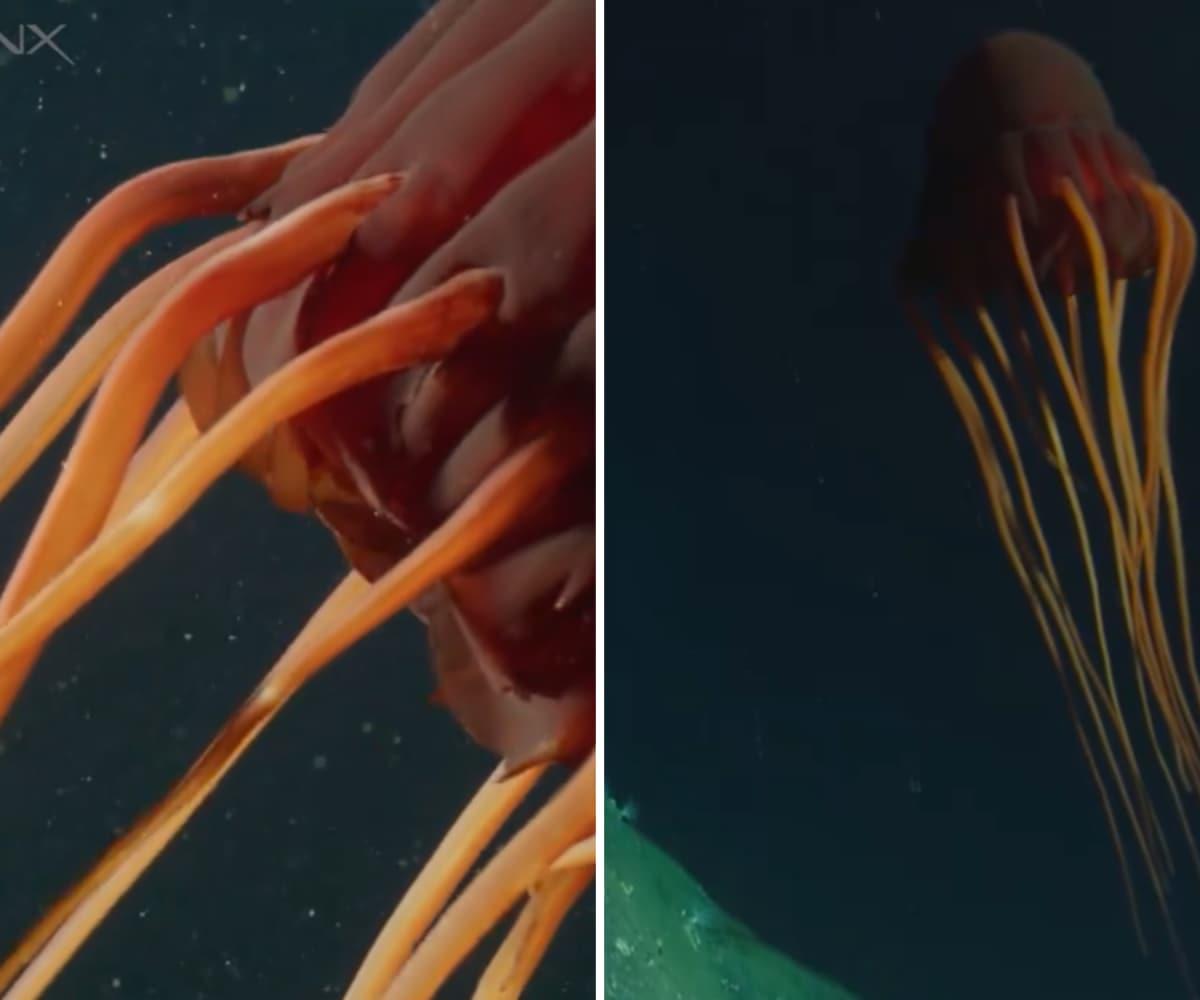
Red helmet jellyfish with long, fringy tentacles recorded by OceanX researchers
Not relying on eyesight is one thing, but they resist light at all costs. According to the Institute of Marine Research, the jelly's physiology is designed for darkness, not light. A photo-sensitive red pigment causes these jellies to avoid “sunlight like the plague.” Rather than poking their head above the surface water to bask in the Sun like most fish, they prefer the frigid, shadowy depths. The ultraviolet radiation in sunlight can damage their tissues. So, they only come to the surface at night to feed, and before sunrise, they duck down once again, plunging as deep as 3,280 feet, per BioGraphic.
In other areas, however, they are more resilient than other fish. They can tolerate much lower concentrations of oxygen than most fish, enabling them to survive peacefully in “dead zones” commonly observed in blooms in Norway’s fjords. Today, BioGraphic says, these fish have become abundant in these fjords, particularly the Trondheimsfjord, where one trawling trip can catch up to 8 tons of them in just five minutes.
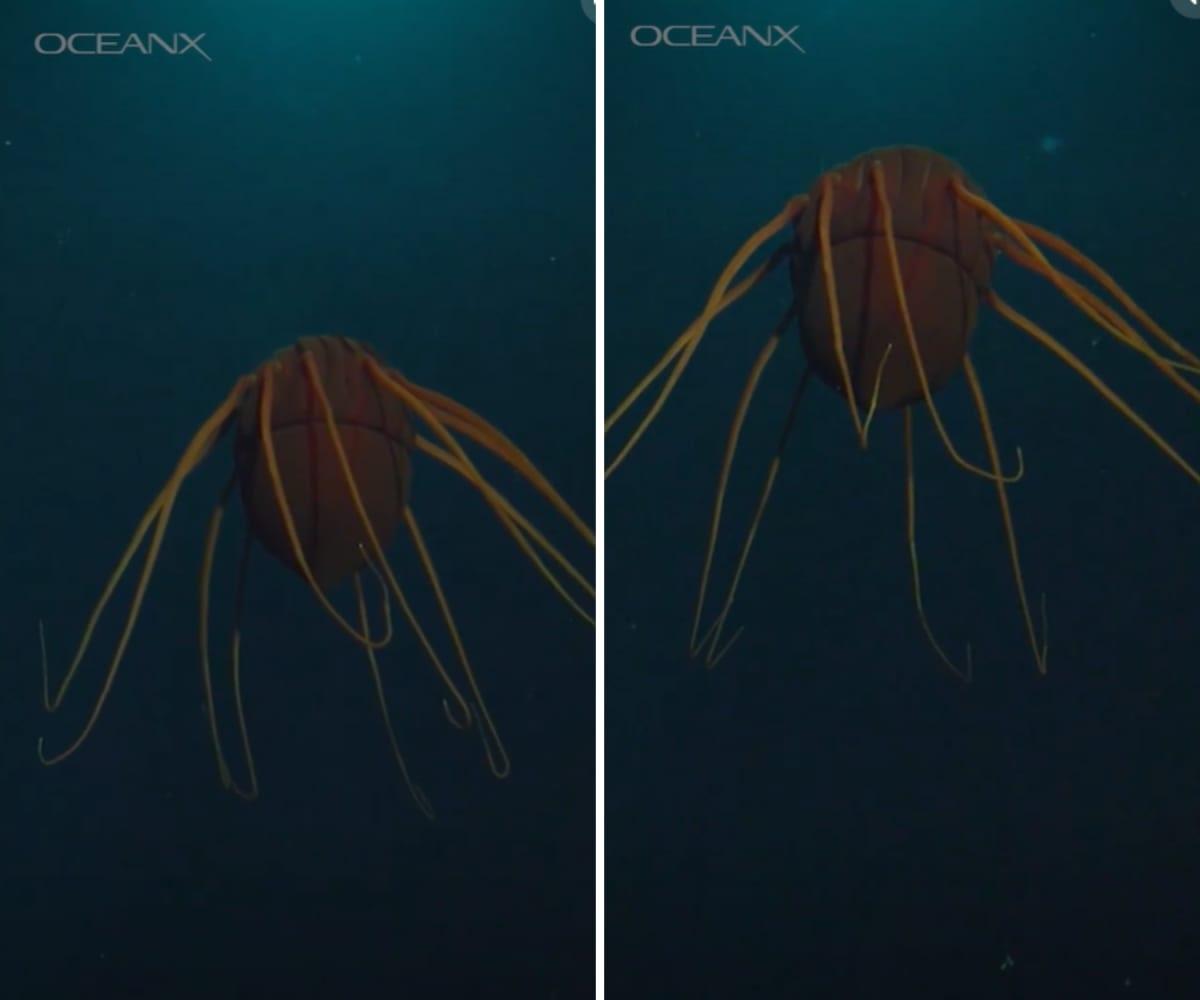
Red helmet jellyfish with its long, fringing tentacles recorded by OceanX researchers in Norway
"During observations, it was found across multiple depths throughout Masfjorden and Sognefjorden,” scientists shared. One of the reasons is likely their ultra-quick reproduction process. The jellies follow a “holopelagic” life cycle where the medusae do not go through the polyp stage. This means that the fertilized eggs released by the reproducing jelly directly develop into medusae.
If there are predators like big fish or sea turtles prowling around, the elusive jelly emits a blue glow and spreads it to cast a glowing net as a defense strategy. Sometimes, this also camouflages the prey in their transparent bellies. For OceanX researchers like Anne Gro Vea Salvanes, seeing this mysterious creature up close was “once-in-a-lifetime experience.” Perhaps because, as humans, we are programmed to feel "goosebumpy" when witnessing something that appears when everything goes dark, and there is no light.