
53 Pilot Whales Died on a Beach in 2023. Now, Scientists Think One Pregnant Whale Triggered It
Published March 9 2026, 7:09 a.m. ET

This handout photo issued by British Divers Marine Life Rescue (BDMLR) shows pilot whales in North Tolsta, on the Isle of Lewis, Scotland, July 16, 2023.
The 2023 spine-chilling scene of more than 50 pilot whales being stranded on shore still haunts environmentalists. Now, further investigation into the matter has brought new heartbreaking details to light. The findings of the investigation conducted by the Scottish government's Marine Directorate were published on Thursday, March 5. The result showed that the tragedy didn't happen because the pod of 54 pilot whales had poor health. The group of whales swam to the shore in unison due to panic caused by a pregnant female pilot whale's difficulty in giving birth. "A mature female" had been experiencing a prolonged and "difficult birth," presumably caused by poor positioning of a calf within the womb.
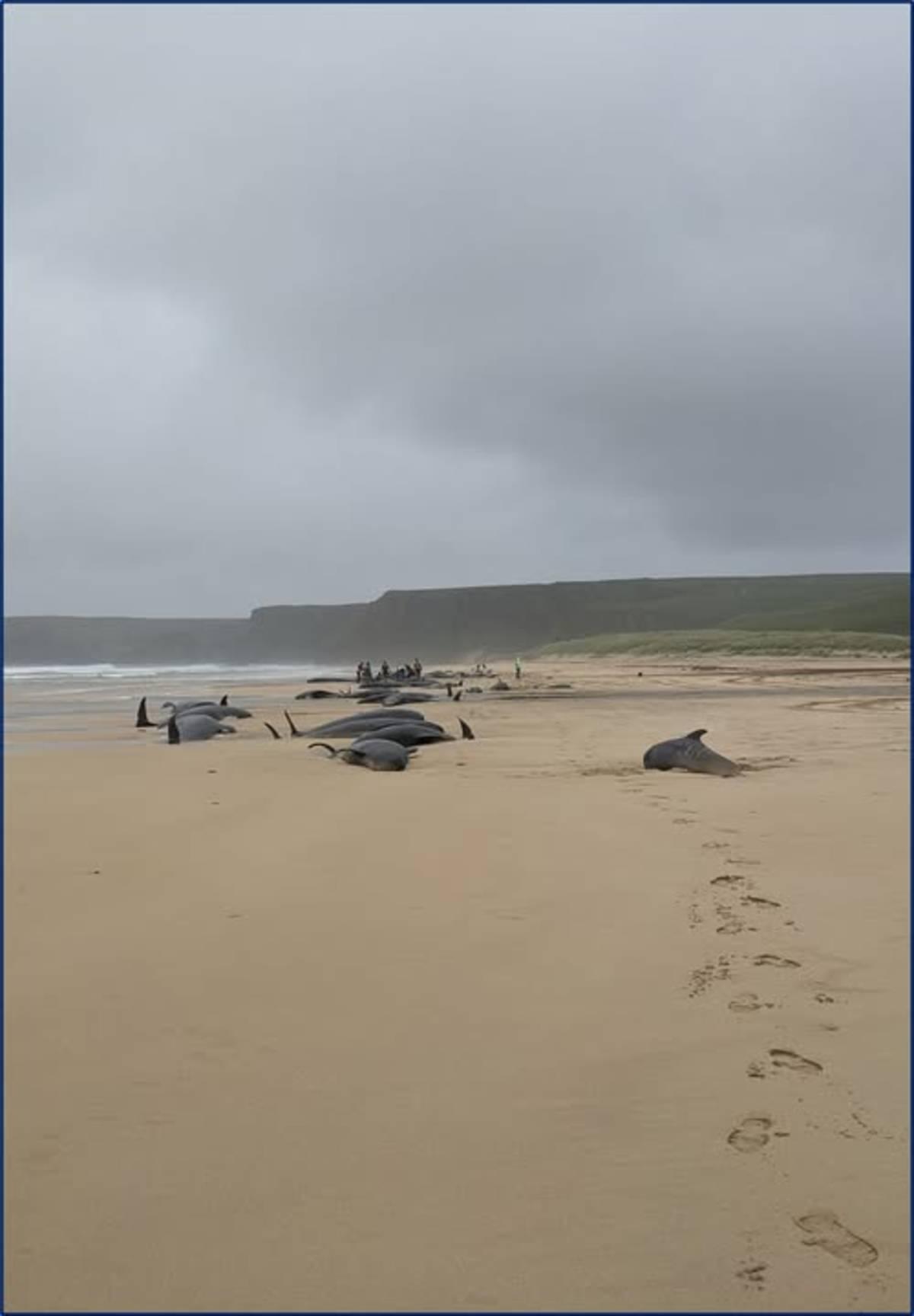
Mass-stranding of long-finned pilot whales in Scotland in 2023.
Out of distress, the female swam too close to the shore, causing a social trigger within the group. Setting an example of solidarity, the rest of the whales followed close behind. But little did they know that the "strong" bond of the pod would be the cause behind their mass die-off. Once stuck, the winds and sands on the shore made it impossible for the group to return to deep waters, ultimately sending them to an early grave. According to the report, only one of the 54 whales was taken offshore while the rest either drowned or were euthanized to stop their suffering. Dr. Andrew Brownlow, lead scientist of the Scottish Marine Animal Stranding Scheme (Smass), highlighted how the codependency among creatures can shape massive die-offs.
This incident "is a reminder that mass strandings are rarely the result of a single cause. Rather, they emerge at the intersection of individual physiology, group social behaviour and external marine environmental conditions," he told The Guardian. “Understanding how these factors interact is essential if we are to improve our capacity to anticipate, interpret and, where possible, mitigate the impacts of a changing ocean," he added. Brownlow explained that the behavior exhibited by the rest of the pod was out of sensitivity and willingness to protect one of their own from predators. They sensed the distress of the maturing female pilot whale and decided to protect her from impending dangers.
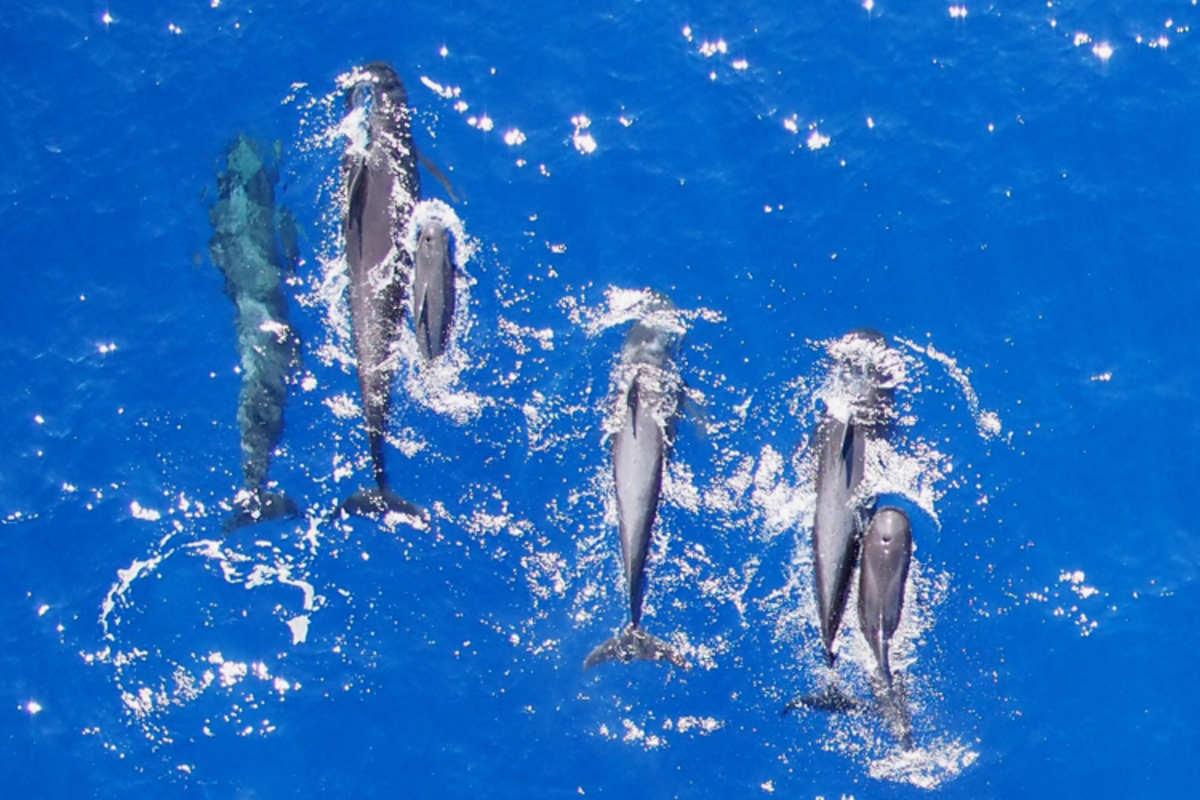
A group of pilot whales in deep waters.
“If a member of the pod was in distress, this species’ well-documented social cohesion would have led others to aggregate closely in a protective response,” he revealed. “In this instance, that behavior appears to have drawn the group into the shallow, sandy bathymetry [the water depths] of Tràgh Mhòr," he added. The expert revealed that the shores of Tràgh Mhòr, a famous Scottish beach, have a slopy seabed and suspended fine sediments. For the whales that accidentally plopped onto this slippery seabed, it acted like an "acoustic trap." In the aftermath, the whales were unable to send echolocation signals, which diminished their ability to navigate their way back to the deep waters.
The incident occurred on July 16, 2023, and sent shockwaves across the world. The pilot whales, a breed of dolphins known for having unity within their pods, were found motionless and even lifeless in the shallow waters off Tolsta Bay on the Isle of Lewis in Scotland. Unfortunately, almost a year later, a similar incident occurred on the Orkney island of Sanday. Over 77 pilot whales were found stranded on the shore. Upon studying the mass strandings of whales and dolphins in Scottish waters, the organization has observed a 300% increase in frequency in the past 30 years.