
Photographer Stumbles Upon a Hidden 'Whale Graveyard' Beneath Greenland's Ice
Published March 2 2026, 3:23 a.m. ET

'Whale Bones,' the award-winning photograph captured by Alex Dawson in eastern Greenland
“Focus on the photography. Everything will be fine,” photographer Alex Dawson told himself as he dived into the shallow, blue waters of Eastern Greenland, off the coast of Tasiilaq, about 66 miles south of the Arctic Circle. Tasiilaq, a town on Ammassalik Island in Greenland, relies on whales for livelihood. Alongside Dawson was a crew of five other scuba divers, each towing their own gear. It was -20°C (-4°F). When Dawson jumped into the waters, fear crept in. It took him at least a few moments to adjust his vision to the inky darkness. When he finally saw some light, he couldn’t stop but drop his jaw in sheer wonderment. Bizarre white shapes were splattered on the shallow bed, making the place look like a site of sinister ritual. Sinister or not, the shapes were remains of minke whales.
Inside the whale graveyard, the bones of several minke whales were lying around 16 feet deep. Dawson said that whale hunters drag their catch ashore at a place called "flenseplassen," or “skinning grounds." Families get together to cut away the skin, blubber, and meat and strip the carcass down to the bare bones. The only thing that remains is the skeletons, which are carried away underwater by the tides.
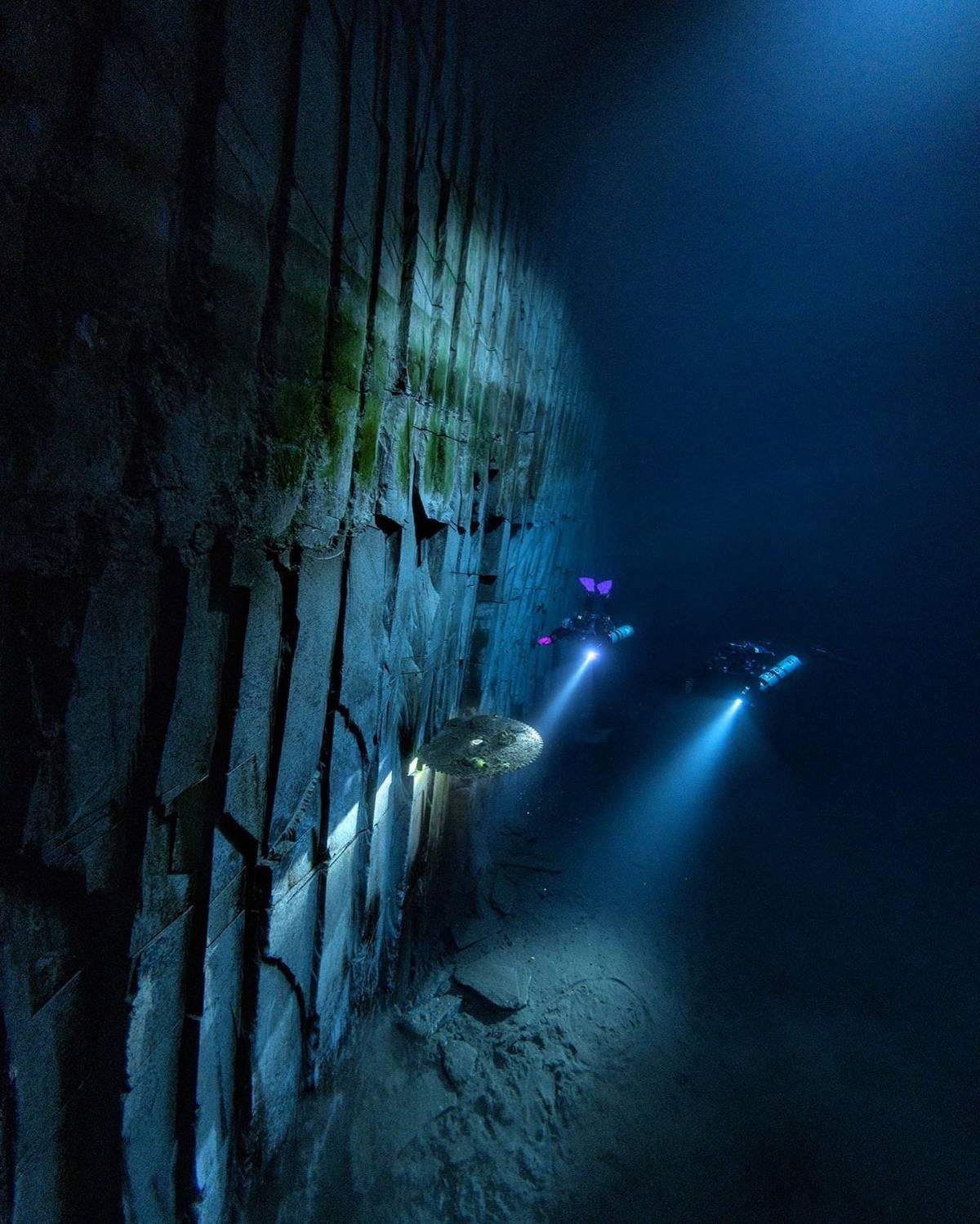
Scuba divers flashing torchlights in eastern Greenland
The only entry point to the site was through a small human-sized hole in the ice. "Once we got there it took hours to make the hole," Dawson said, adding, "We tried to clear out as much of the slush from the hole as possible." After all was done and he rammed his body through the hole, he felt jittery, wondering, "Who's down here?" as he shared with Newsweek. When he finally reached below, he started looking around. He said, “I was like, ‘This is so crazy. There are so many bones everywhere.’” There were carcasses of at least 20 minke whales. Together with freediver Anna Von Boetticher, Dawson captured the spine-chilling scene on his camera. Some of his photographs were honored by photography awards, including the surreal “Whale Bones,” which bagged the Underwater Photographer of the Year prize in 2024.
The photo shows a seabed peppered with bone pieces, their patterned skeletons attached to elongated jawbones. Above the shard of skeleton appears Anna in a diving suit. She seems to be flashing a torch’s light on the skeleton to inspect it. Commenting about the photographs, Dawson shared with Newsweek that his goal is to create an “I wish I was there” feeling.
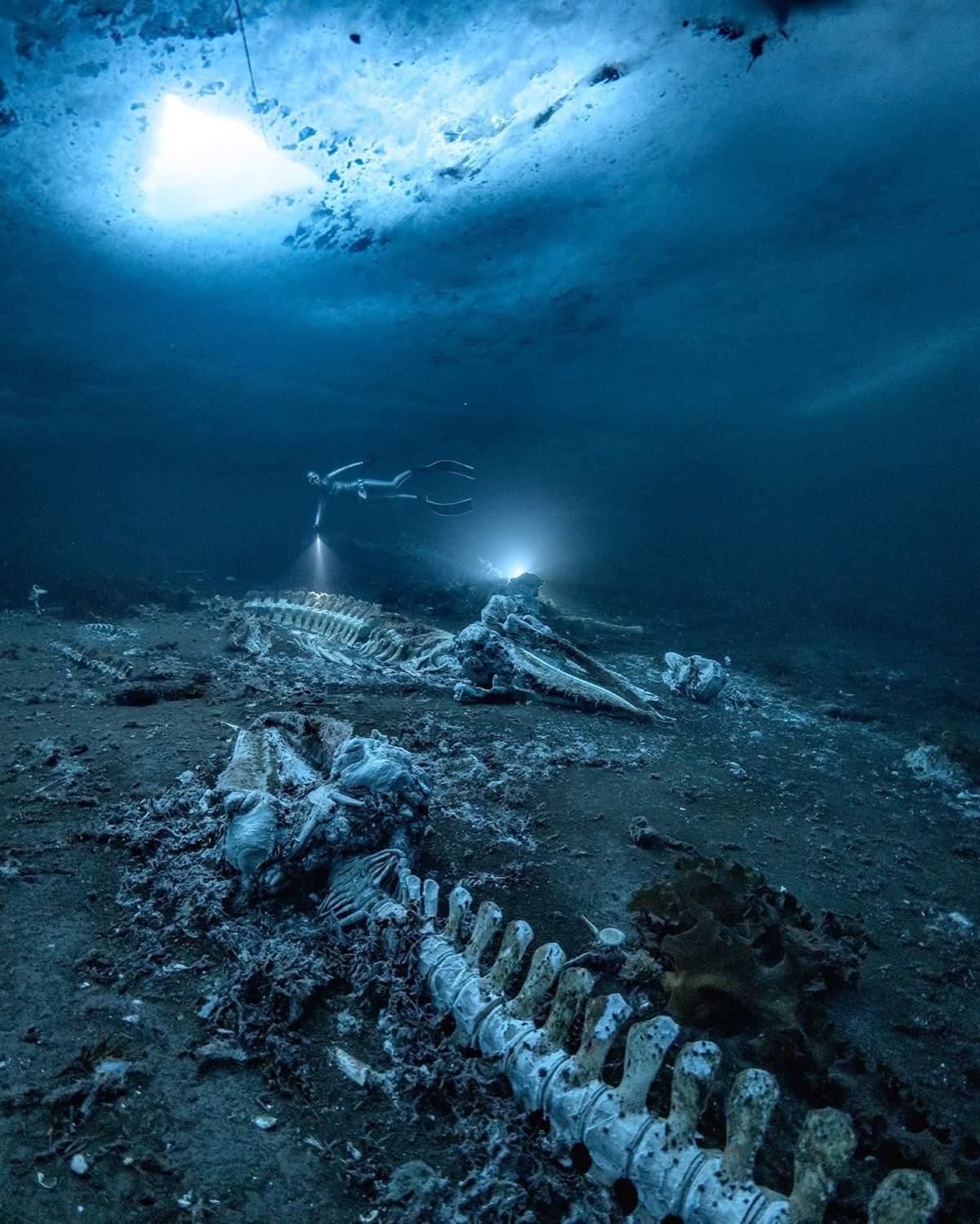
Photographer Alex Dawson stumbled upon a 'whale graveyard' while diving inside the blue waters of eastern Greenland with five other scuba divers.
Curator of benthic invertebrates at Scripps Institution of Oceanography in San Diego, California, Greg Rouse explained that the death of a whale offers a bounty of life to the rest of the ocean. The carcasses offer copious supplies of nutrients for the little-big residents. Filled with gas, the body inflates like a balloon and rises to the surface waters, catching the attention of seabirds and sharks. Others, like lobsters, sleeper sharks, and crabs, strip the blubber and muscles from the bone. Detecting the new snacks, invertebrates arrive. As oils leak out into the seabed, a "massive bacterial mat forms around the whale," Rouse said. The remaining bones release gases, like sulfur, which are then consumed by chemosynthetic organisms.
With such a thrilling troupe of dramas playing inside the water, Dawson’s photographs are also evidence of how unexplored waters can hide so much mystery. "It's just the black abyss below you. You feel like all these creatures are lying there [in the deep] looking up at you," he said.