
15 States Could See Northern Lights This Weekend — Check Best Viewing Times and Locations
Published Jan. 16 2026, 6:58 a.m. ET

A couple sits in foldable camping chairs, watching the Northern Lights
The Northern Lights will be visible across 15 states this weekend due to a solar storm. According to the report by the National Oceanic and Atmospheric Administration’s (NOAA) Space Weather Prediction Center, auroras can be seen in parts of the northern United States. The Earth will be experiencing an incoming surge of solar energy on January 16, 2026, (late Friday night) and on January 17 (early hours of Saturday). When charged particles of the Sun interact with Earth’s atmospheric gases, such as oxygen and nitrogen, along with the planet’s magnetic field, a visual display of light is visible in the night sky.
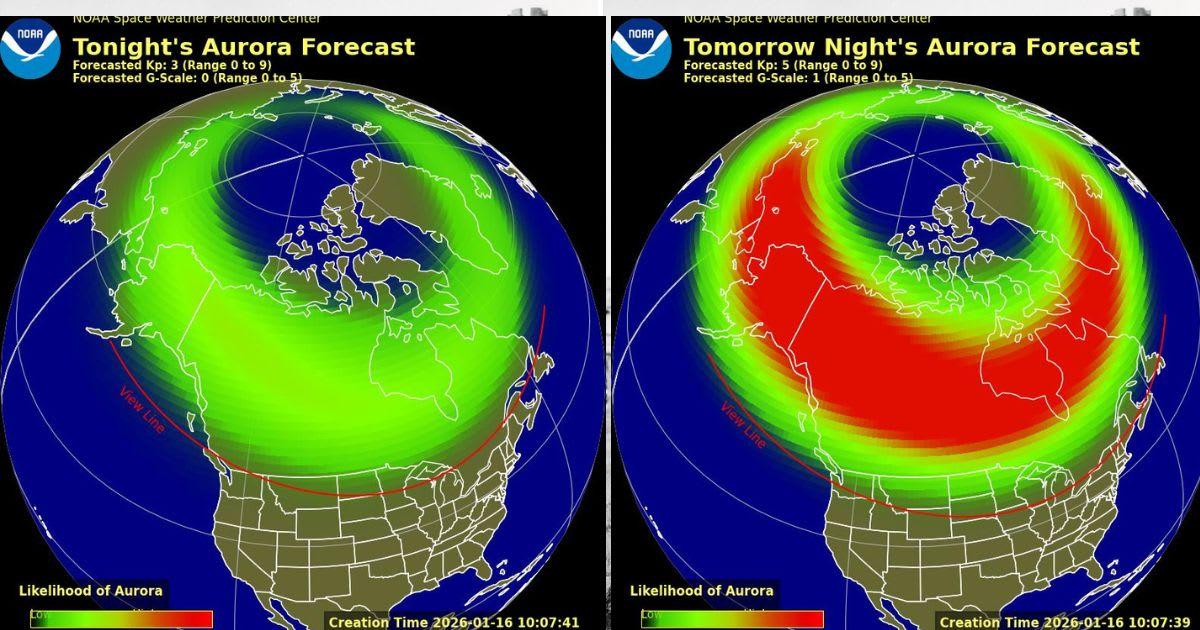
Aurora Viewline for tonight and tomorrow night
NOAA released a forecast revealing that a minor geomagnetic storm (G1) will occur as a result of the recent solar flare, and the intensity might also increase with faster solar winds. Although it is a prediction, the perfect time to look at the aurora borealis will be between 6 p.m. and 6 a.m. Central Time. This timing translates to Friday evening and early Saturday morning, presumably before sunrise. However, it must be noted that space weather is highly unpredictable, so the timing can shift, and patience is essential in this case.
The Northern Lights are predicted to appear across 15 states, and the strongest possibility of visibility is in Alaska, Washington, Idaho, Montana, North and South Dakota, Minnesota, Wisconsin, Michigan, and Maine. If the geomagnetic activity remains at a G1 level, then the lights may be seen across northern Montana, North Dakota, Minnesota, and northern Michigan. In case the solar winds rise up to G2 level, there's a chance that the Northern Lights can be seen from Wisconsin, Washington, and Idaho, and even northern Iowa and northern Illinois. A sheen might also appear in Wyoming, New York, Vermont, and New Hampshire.
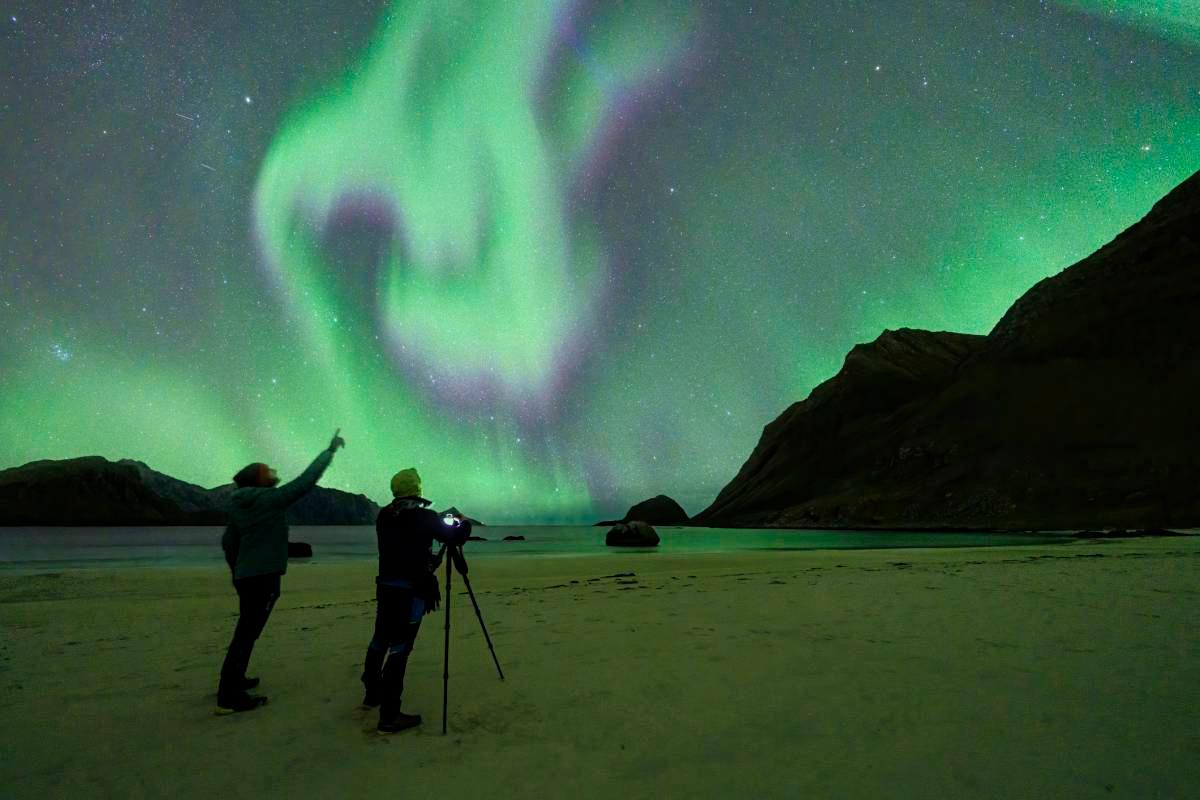
Two people looking at Northern Lights.
To see the Northern Lights in their full glory, it is important to look at the darkest sky without any city lights to disrupt the view. It cannot be seen during the day as the sunlight washes out the faint glow. For the best view, look at the subtle pale light and a slow shimmer near the horizon, as it might not look neon-bright instantly to the naked eye. It is also suggested to stay away from bright screens for a while so that the eyes are able to adjust. Moreover, it is also advised to check the forecast from time to time to stay updated on weather conditions and timing changes.
Experiencing the Northern Lights is extremely special and capturing them on lens is one of the ways to cherish them forever. However, the good news is that one does not require a professional camera record the moment. The night mode feature is easily available on updated versions of most mobile phones, and it can be used to capture the scene. A DSLR camera can also come in handy to photograph auroras. Usually, the sight is mostly limited to northern latitudes; seeing them in the south is a rare occurrence. With solar activity increasing, we can expect more aurora-viewing opportunities moving ahead.