
Why are Scientists in New York Spreading Crushed Rocks Across Fields?
Published March 3 2026, 8:35 a.m. ET

Spreading Silicate on Field
The greenhouse effect has been concerning scientists worldwide for decades now. Many have proposed methods to mitigate the issue, but none to date have been able to put a lid on the matter. A unique solution called enhanced rock weathering has been proposed, which may remove up to 5 billion tons of CO₂ yearly this century from the atmosphere. A study published in the journal Communications Sustainability investigates this assertion. In this method, crushed silicate rocks like basalt are spread out on the field. This technique supposedly accelerates the natural process of rock weathering, which typically takes tens of thousands to millions of years to facilitate.
The objective of rock weathering is to move CO₂ from the atmosphere to the ocean, according to New Scientist. This movement has previously helped cool down the planet during several hothouse periods. Experts propose using the method on a large scale and adding silicate rocks to the picture. “The main benefit is through sort of solving atmospheric CO₂ through chemical reactions,” shared Chuan Liao at Cornell University in New York. “And there are also some side benefits, such as adding… magnesium, calcium potentially, to supplement soil nutrients.”
Experts essentially suggest crushing silicate rocks, adding them to crop soil, and allowing the rock dust to react naturally with carbon dioxide, according to the Cornell Chronicle. These processes will attach carbon to stable minerals at a quick pace, which can survive for millennia. Along with sequestering carbon and removing it from the atmosphere, the method will also enhance crop yields by adding calcium, magnesium, and iron to soils. Farmers also benefit, as they don't have to invest in synthetic fertilizers to incorporate these nutrients.
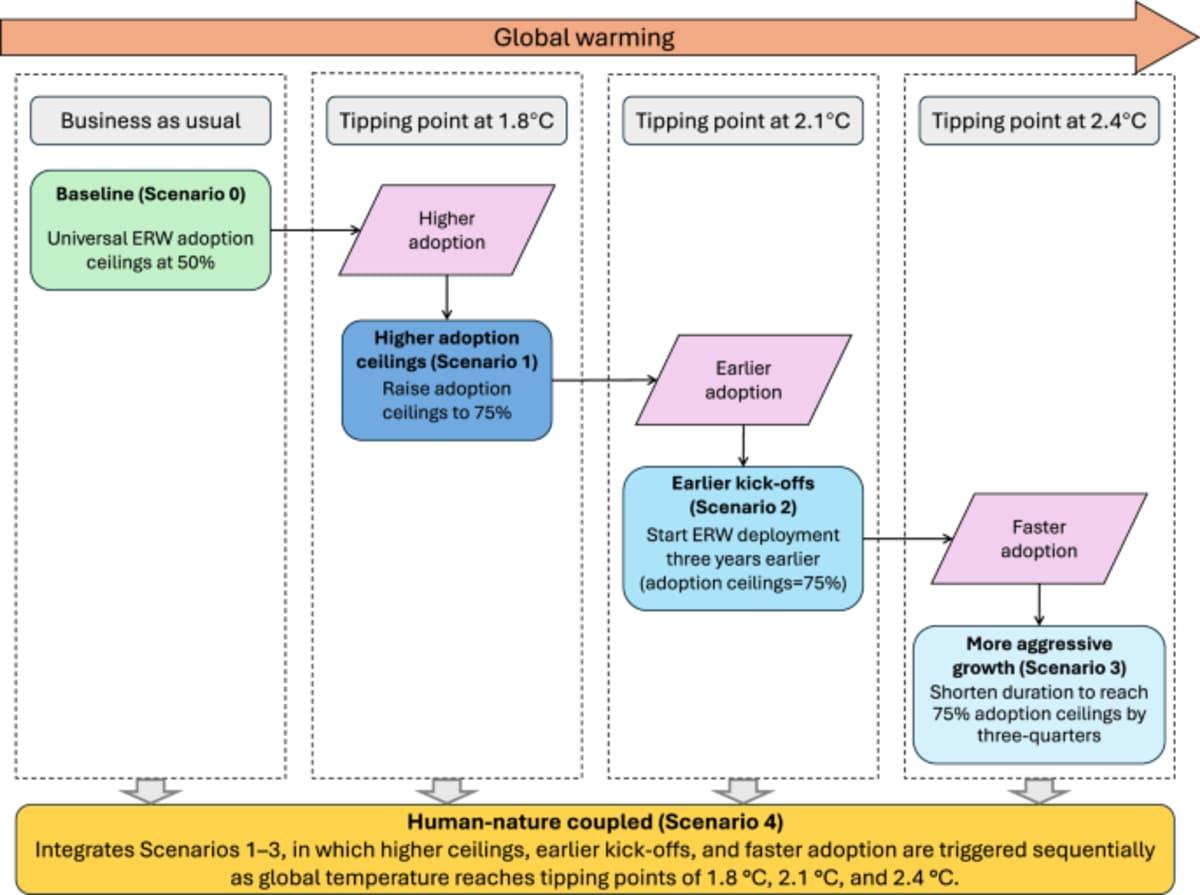
Conceptual framework of ERW adoption scenarios under global warming
The aforementioned study presents various models that predict how this global adoption of enhanced rock weathering can be facilitated. These models utilized historical insights available about the adoption of other agricultural technologies, such as the application of irrigation across different regions. The models revealed that such methods are adopted in a staggered trajectory; some come on board early, while some are late to the party.
Results are different based on the approach undertaken by officials. If the method is administered using an aggressive approach, then 0.76 gigatons of carbon will be removed annually by 2050 and 1.1 gigatons by 2100. If the approach is moderate, then 0.35 gigatons will be removed annually by 2050 and 0.7 gigatons by 2100. One of the models was formulated with the scenario of global warming reaching a tipping point. “Faster global warming is likely to increase pressure on policymakers and farmers to adopt this technology in a more aggressive way,” Liao said. “Enhanced rock weathering provides one solution in a whole portfolio of carbon mitigation strategies that will need to be adopted to achieve our goals.”
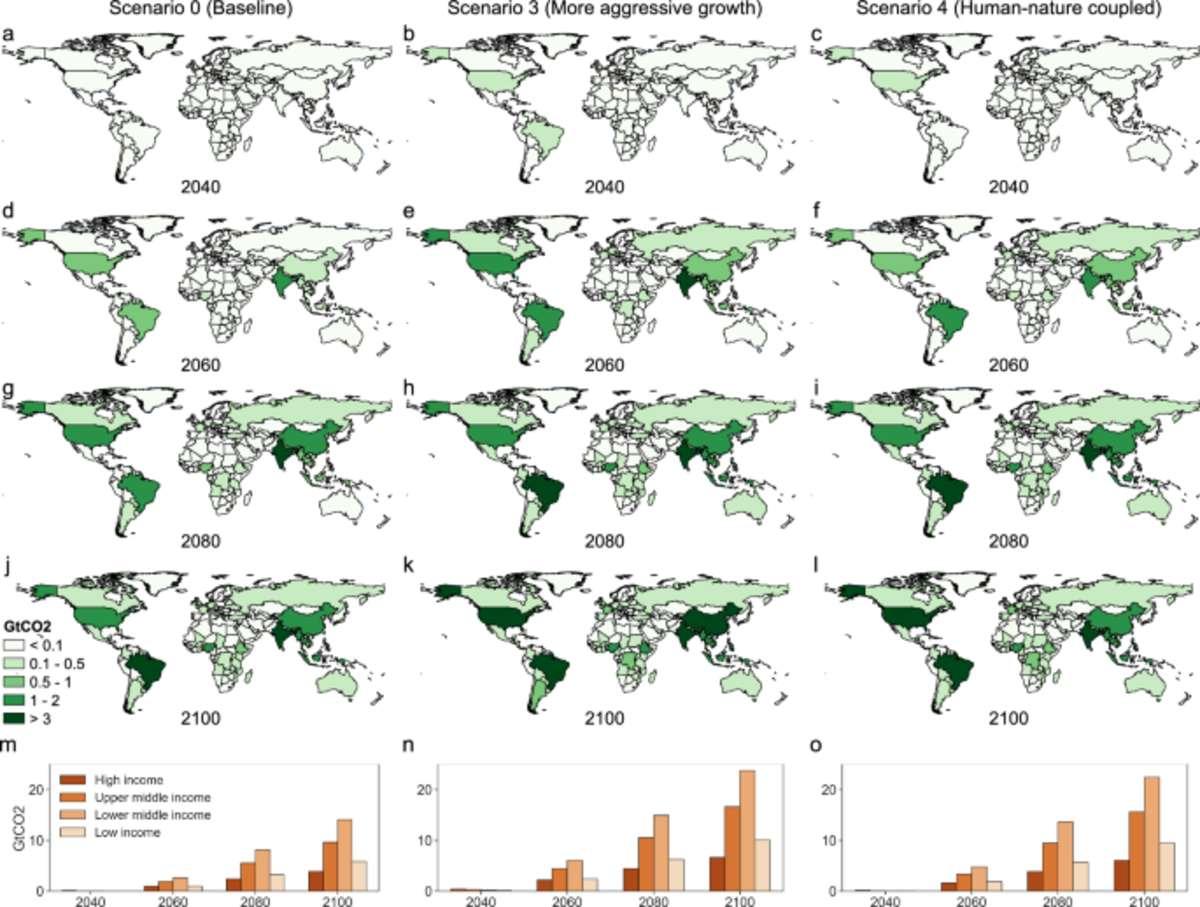
Country-level cumulative CDR from ERW across scenarios and time horizons
These outcomes are only possible if the proposed models are applied. The resultant trajectories are based on the involvement of the Global South in the project, which has more suitable conditions to facilitate rock weathering. “If this were to be scaled, the Global South would eventually contribute more, and tech transfer and global carbon markets could accelerate adoption in these regions while also making adoption more equitable,” explained Liao. “Previous research assumed a uniform adoption across regions. Our major contribution in this study is to model these trajectories in a more realistic way.” The expansion to the south is also necessary, as it promotes equitable distribution. “It means carbon credits could be directed to those countries, to small-farm owners, which could help raise their income and support crop yields,” Liao said.
The proposed trajectories take into consideration factors like adoption, regional lags, and social tipping points to improve their efficiency. Enhanced rock weathering has become an appealing option to various parties. Companies like Microsoft have invested millions to increase the scale of this process. “We need to sharpen scientific predictions of enhanced rock weathering, because it has amazing potential to drive carbon profits directly into farmers’ pocketbooks,” shared Benjamin Z. Houlton, the Ronald P. Lynch Dean of CALS and a co-author, who has conducted extensive field studies and farmer outreach around the practice.
Marcus Schiedung at the Thünen Institute of Climate-Smart Agriculture in Germany, though, is not impressed by the method, according to New Scientist. He believes that the methodology depends on many uncertain factors, such as rain. “I’m a sceptic,” he said. “We need to be sure that the CO₂ is taken up. Otherwise, we get into the risk that we measure something removing carbon, but somewhere else it’s released again, which is, in this geochemical complex system, likely to happen.”