
The Sun Just Unleashed a Powerful X-Class Flare — And Even Southern US States Might See Auroras
Published Dec. 2 2025, 6:55 a.m. ET

Two people looking at the Northern Lights.
At 90 million miles away, a gigantic star, 109 times larger than the Earth, is spinning around, leading the entire solar system and all of its planets along with it. But the Sun has its own timetable, a timetable that includes an 11-year cycle of awakening. After every 11 years, the pockets of electrically-charged hot gas blazing inside the Sun suddenly get released, as a result of which it wakes up. And as it does, it starts ejecting enormous bursts of energy that zip through the space and slam into Earth’s protective boundary, the magnetic field. Nowadays, as the Sun reaches the peak of its solar cycle number 25, it is up to some mischief again. At 9:49 pm on November 30, Earth’s light-giving star initiated a series of intense X-class flares that are expected to trigger rainbow auroras, far beyond the skies of the south, according to a report by NASA.
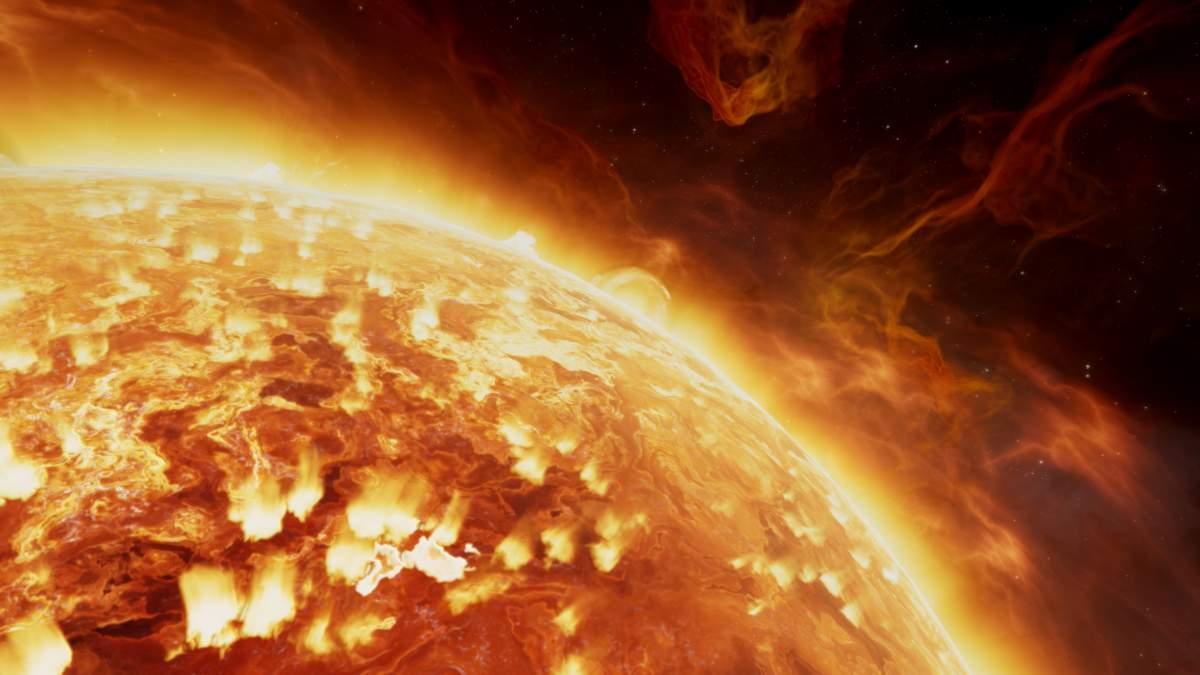
Sun's surface blazing with extremely hot material and plasma
With its state-of-the-art Solar Dynamics Observatory, NASA keeps a constant and uninterrupted watch over the Sun, recording the tiniest of details. Lately, the high-precision cameras of the observatory have captured some images of this dramatic event. The images reveal Sun unleashing a powerful X-class solar flare, which is coinciding with the biggest sunspot observed in the last decade. Nicknamed “AR 4294-96,” this sunspot comes in the wake of a series of weaker M-class solar flares, but it actually originated from a smaller sunspot named AR 4295.

Man admiring the Northern Lights aurora near the ocean.
Solar flares, solar eruptions, geomagnetic storms, and coronal mass ejections (CMEs) are some of the ways the Sun expresses its restlessness as it nears its 11-year solar cycle's end and its magnetic poles start twisting and tangling to shift their north-south positions. Most times, the energy it releases is so fervent that it ends up deforming Earth’s magnetic boundary, often disrupting the radio communications, electric power grids, GPS navigation signals, and even the functioning of spaceships and satellites. In this case, the solar flare caused a blackout in Australia and parts of Southeast Asia, Forbes reports.
On a happy note, these energetic solar particles can provoke surreal and dazzling exhibits of colorful light in the sky as they collide with the gassy particles hanging in the atmosphere. When the two crash, the atmosphere becomes excited and turns into a stage show of sparkle and rainbows. While the flares observed in recent months have already draped the Southern California skies with radiant light performances, the latest flare is set to inspire the display of Northern Lights well beyond the northern states, as far south as Illinois, Oregon, Alabama, and Northern California, per Newsweek.
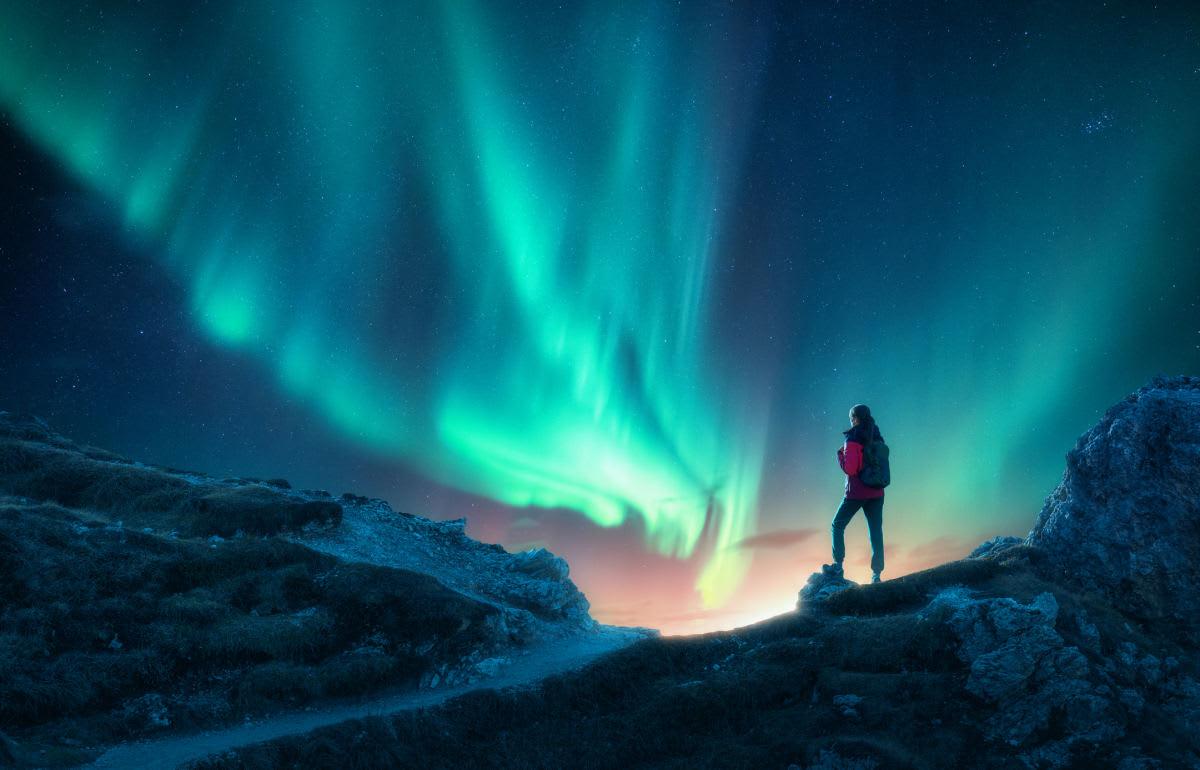
Woman standing on a rugged cliff looking at a dazzling display of glassy blue-green auroral lights in the sky
In the coming weeks, extreme flurries of ultraviolet light and acutely hot material will explode into Earth’s atmosphere. This flare is classified as an X1.9 flare. Solar flares are typically classified according to their intensity and energy output, on the scale A, B, C, M, X. An X-class flare, for instance, is 10 times stronger than an M-class flare and 100 times stronger than a C-class flare. A flare in itself doesn’t trigger auroras, but it can increase the likelihood of CMEs, which can become powerful catalysts for auroras.
The latest flare comes as a result of the sunspot AR 4294-96 releasing its trapped energy. Sunspots, NASA explains, are areas of intense and complex magnetic fields that produce solar eruptions. Counting sunspots is one way scientists calculate how magnetically active the Sun currently is, and what phase it is navigating in its 11-year solar cycle. This year, it seems the Sun has planned to entertain the residents with dazzling light performances before it calms down and retires to sleep again for the next 11 years.