
Scientists Finally Track Elusive 'Ghost of the Desert.' Data From GPS Collars Reveal Their Secret Lives
Published March 2 2026, 9:11 a.m. ET

Scientists in Saudi Arabia fitted GPS trackers in the collars of wild sand cats
Nicknamed “ghosts of the desert,” these elusive beauties flit through the night like phantoms, strictly avoiding light. Only when the sky is dark do they crawl out of their hiding and tread the vast, lonely stretches of desert sands, walking for miles and miles. Like ghosts, they leave no tracks, thanks to their fur-coated footpads. Repelled by the light, they will crouch low and avoid illumination. With ears so alert, they can detect even the faintest groan of a reptile or rodent crawling beneath the sand. Under the cover of a dark sky, it will dig them out of their burrows, kill, and bury them as food stock for later, per the Smithsonian’s National Zoo & Conservation Biology Institute.
Oftentimes, they proceed with a venomous snake or a rat clinging to their mouth, a snack for midnight cravings, probably. They can survive without drinking water for weeks. All the water they need, they squeeze it out of their prey. In a recent investigation, scientists fitted GPS trackers to the collars of six of these ghosts, a.k.a. sand cats, at Prince Mohammed bin Salman Royal Reserve in Saudi Arabia. The goal was to catch a sneak peek into the mysterious lives of these secretive predators.
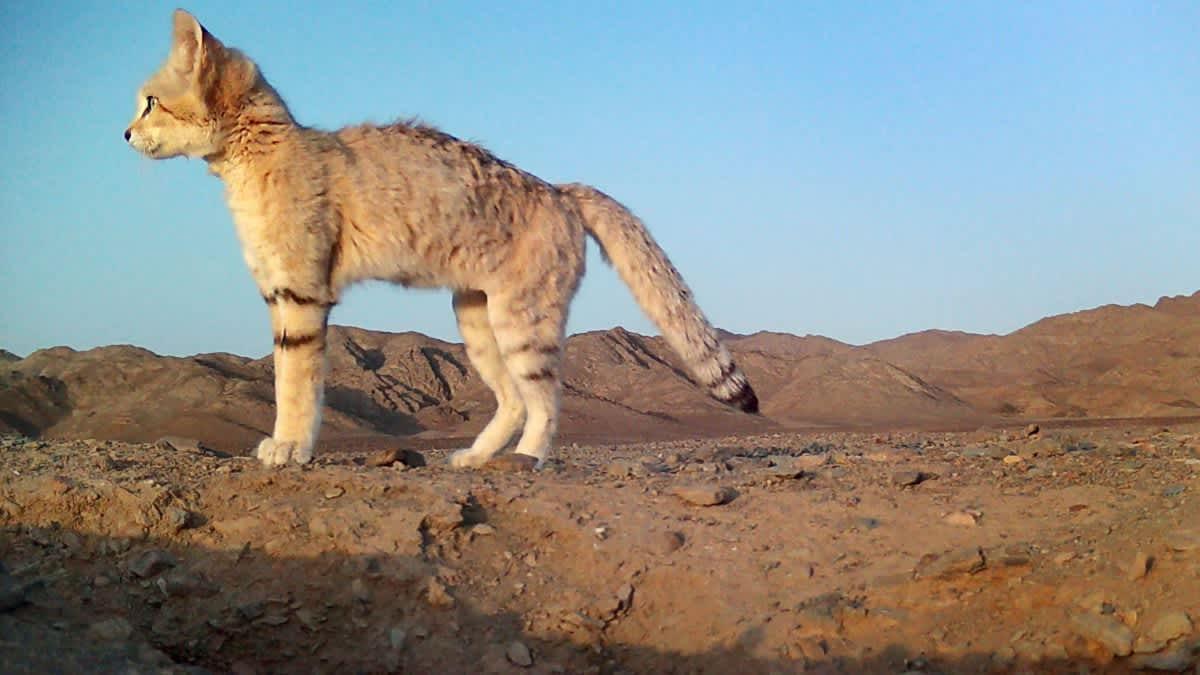
A secretive, light-avoiding sand cat gazes at a den while standing in a desert field
Sand cats are one of the rare and oddball creatures that dwell in extreme desert environments throughout the year. Scientists have spotted them surviving in some of the hottest and driest regions of the planet, including the harsh sand deserts of Kazakhstan, Turkmenistan, Uzbekistan, the Arabian Peninsula, Iran, and north-eastern Afghanistan. In conversation with the BBC, reserve CEO Andrew Zaloumis said the nocturnal ghosts can walk up to 3 to 5 miles in one night. "Males appear to hold large, sometimes overlapping territories, while females use multiple dens across wide areas," he said.
In the latest study, Zaloumis and his team partnered with the Royal Zoological Society of Scotland's (RZSS) WildGenes laboratory to analyze the sand cat’s genome, which revealed that there are two subspecies, rather than four as previously thought. On X, @MadeinSaudi highlighted this as a “global achievement,” from successfully fitting GPS collars on six sand cats to producing the “most comprehensive genetic and scientific database for this species worldwide” and “recording 3000 location points that revealed the secrets of its nocturnal life.”
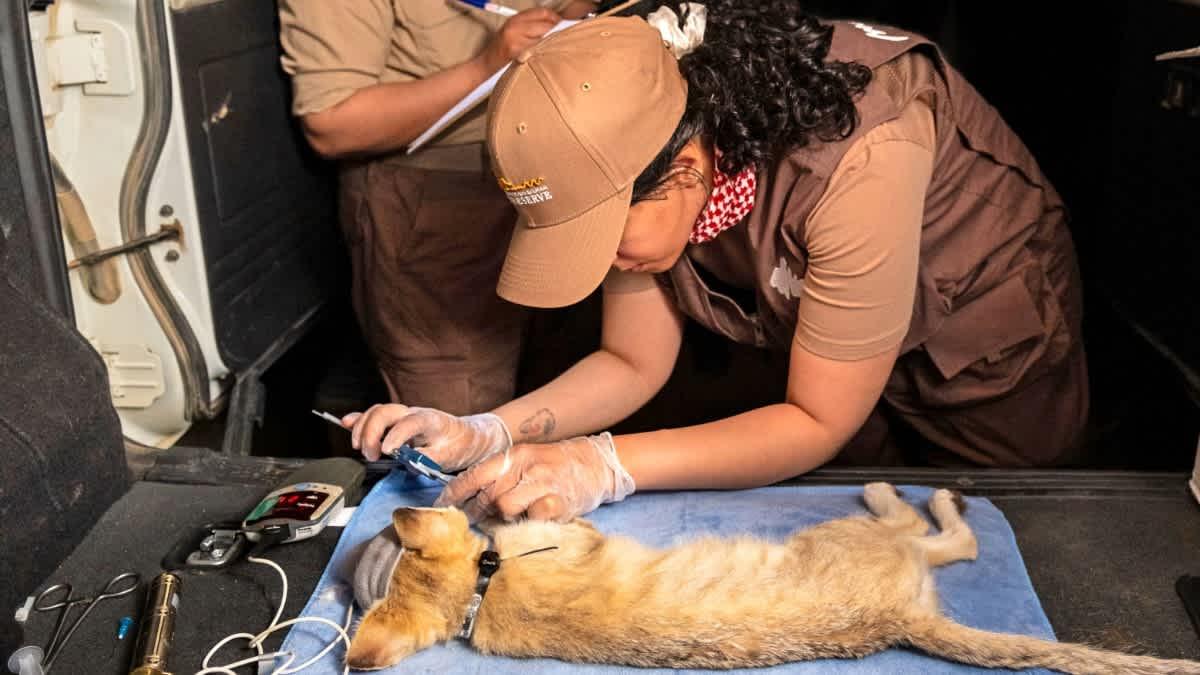
Scientists fitting GPS trackers in the collar of a sand cat in Saudi Arabia to gain more insights into its nocturnal lifestyle
Why go to such great lengths to know the secrets of these animals? The reason couldn’t be just plain curiosity but something much greater. Scientists shared that the insights and information collected can prove immensely helpful in understanding the species’ population structure and evolutionary relationships.
“For a wide-ranging desert carnivore, this highlights the importance of connectivity. Large landscapes alone do not guarantee long-term resilience if populations remain isolated,” Zaloumis remarked. Besides, there are threats like habitat degradation, overgrazing, unrestrained infrastructure expansion, disturbances in dunes, trapping, and poisoning that humans do for predator control, not to forget the diseases, as Arab News notes. Add to it the blazing shadows of climate change, which might interfere with the extremities of the environment the elusive cats truly need to survive and evolve. While their future hangs in uncertainty, the information collected during this study is like a signpost that will guide scientists on how best to safeguard these creatures.