
Scientists Discover 4,000-Year-Old Mummified Cheetahs in Saudi Arabia's Caves
Published Jan. 19 2026, 7:28 a.m. ET

Mummified remains of a cheetah discovered inside a cave by Saudi Arabian researchers
In 1977, a hunter from Jibjat, Dhofar in Oman killed a female cheetah, the fastest land animal on Earth. From that point onward, the population of cheetahs across the Arabian Peninsula started dwindling like the clappers. Before this period, cheetahs were revered as golden huntresses, often gifted to kings and trained in royal armies. Over the years, the relentless and vicious assault of humans devoured them, and the big cats vanished.
Then, in 2022, a team of researchers descended into a 50-foot-deep sinkhole of Lauga, a network of lava caves in the Arar area of northern Saudi Arabia. Their goal was to find bats, bugs, and clues of prehistoric biodiversity, But while they inspected the cave, their eyes fell upon something even more remarkable, something they hadn’t expected: Mummies of cheetahs gazing at them with cloudy eyes. Their shriveled, dried-out limbs splayed on the musty floor, and fangs jabbing out from leathery lips. They documented the findings in a report published in Communications Earth and Environment.
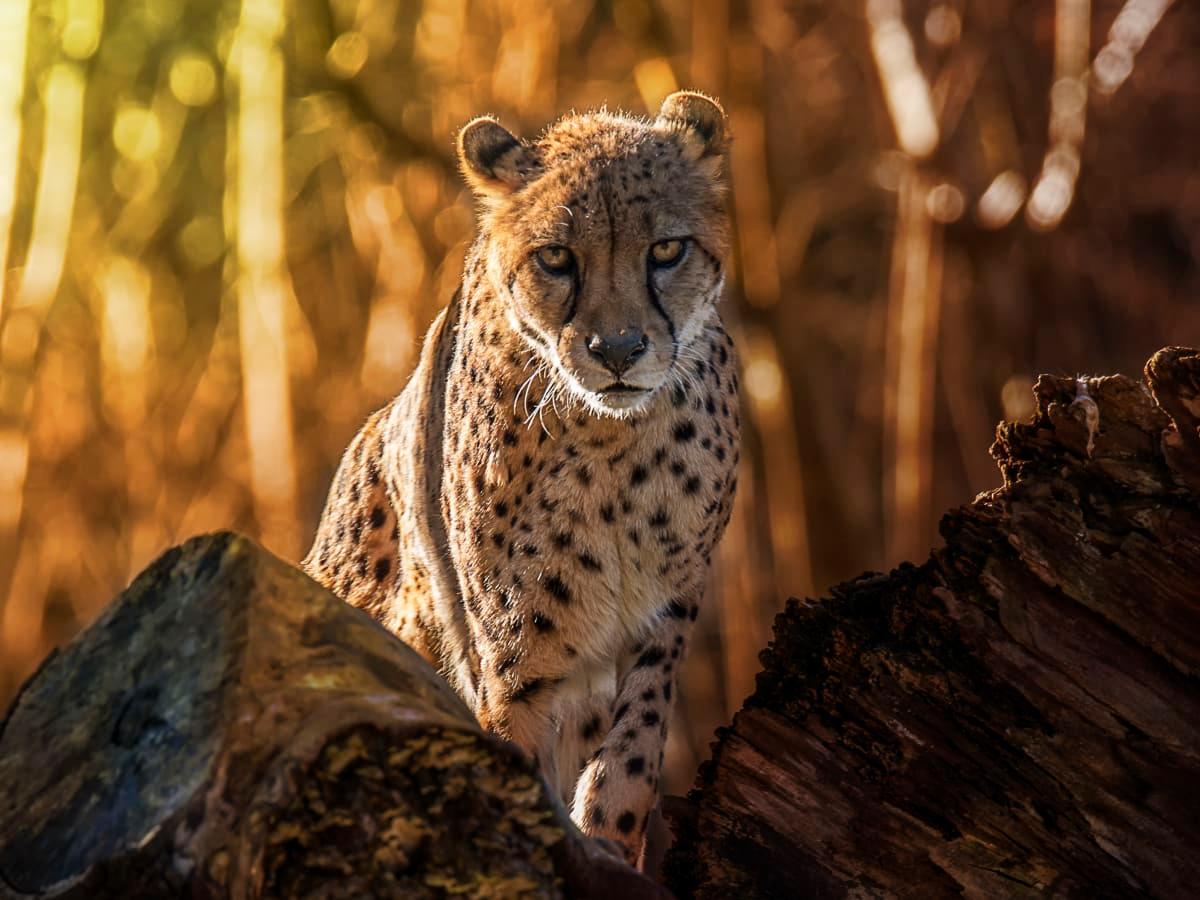
Majestic cheetah with fierce sapphire eyes perched on a muddy outcrop gazing at the camera with golden sunset in the background
Almost everyone has heard of the Egyptian mummies and how well-preserved they were. But as CBS News suggests, the cheetahs here experienced natural mummification. Something inside the cave prevented the decay of these dead bodies, probably the hot, dry environment as one finds in places like glacier ice, desert sands, and bog sludges. Still, researchers believe that this is a “serendipitous discovery” that unlocked several glowing windows into understanding the predator-prey dynamics and the evolutionary history of these big cats, which are now extinct in this area.
In the last few decades, there has been a steep decline in the cheetah population, especially across 91% of their historical range, including Saudi Arabia. Today, a mere 50 to 70 individuals are left in Iran. IUCN Red List estimates only 6,500 cheetahs remaining in the wild. While combing the caves, researchers found seven of their mummies along with pieces of 54 other cheetahs. To investigate the remains, the team utilized two methods – radiocarbon dating and genomic sequencing.
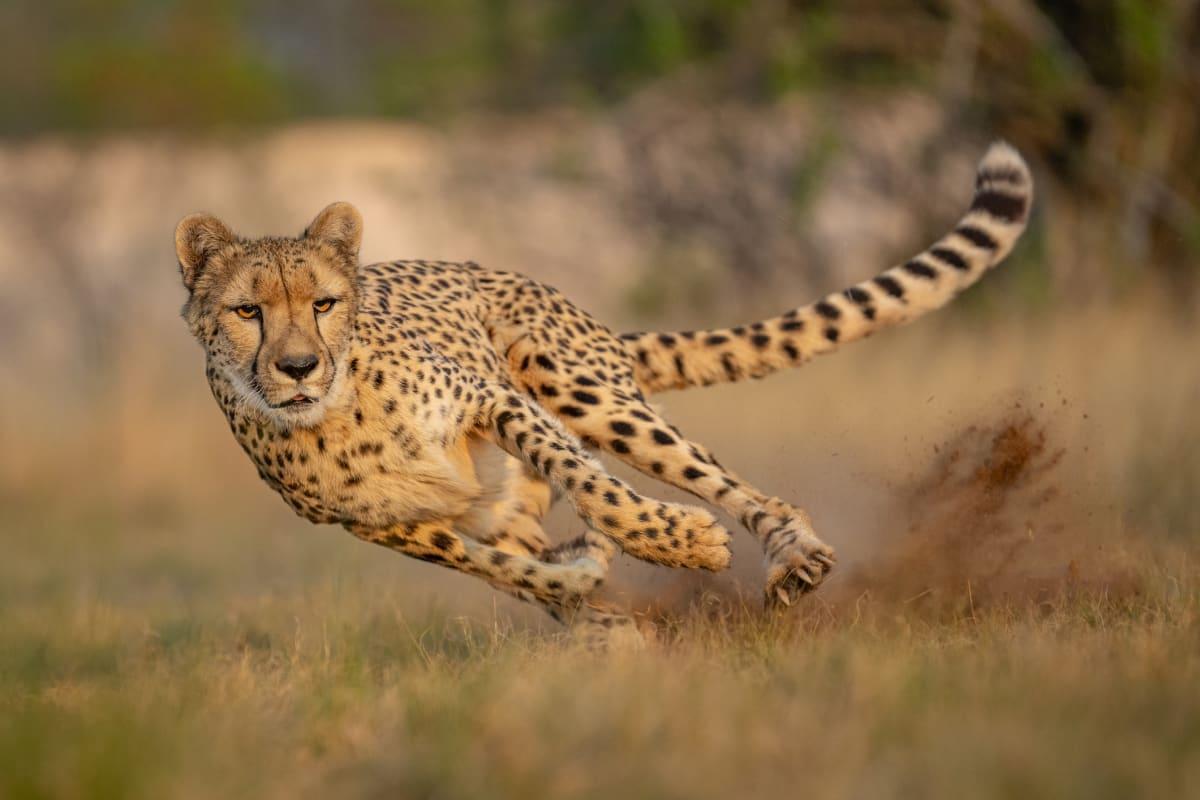
Majestic cheetah with fierce sapphire eyes taking a left turn in a grassland, shooting dust, with golden sunset in the background, a moment frozen in time
Radiocarbon dating revealed that the oldest remains dated back to 4,223 years while the youngest dated to 127 years. Of the 20 skulls uncovered, 14 belonged to subadults, six belonged to adult cheetahs, and nine others to cubs likely younger than 18 months. In conversation with IFLScience, lead author Ahmed Al Boug reflected that the age gap of mummies divulges a lot of insights about the density of cheetahs during this time and their “span of occupancy,” that they remained persistent in this region for millennia. This suggests how human interference became a menacing threat to these crested predators.
Further investigation through DNA extraction and genome sequencing revealed another interesting story about their historical diversity. "The mummified cheetahs have two lineages," Kumarasamy Thangaraj, a forensic geneticist at the CSIR Centre for Cellular and Molecular Biology in Hyderabad, told Live Science. Researchers had expected to find Asiatic cheetahs, a subspecies that is known to reside in this region during this period.

Research scientist conducting genomic sequencing to extract DNA information from a sample
But the DNA data of mummies indicated that while the youngest mummy was an Asiatic cheetah, the older ones were more genetically aligned with the Northwest African cheetah. “It was a big surprise,” Boug told Scientific American. Another dilemma arose. Why and how did they get inside the caves and die there? Two hypotheses were whisked out. One, the cheetahs were using caves as denning sites. Another possibility is that the cheetahs were caught in sinkholes; they couldn’t climb back up and were trapped in the caves.
And maybe, a gazelle walked into the cave, or a hyena or a bird, and they feasted on the carcasses of these big cats after they died. If yes, researchers are excited to unravel more ancient secrets from the volcanic cavern.