
Scientists are Studying the Behavior of Mayonnaise in Space— Here’s Why it Matters
Published Dec. 8 2025, 4:47 a.m. ET

(L) Astronauts eating aboard ISS; (R) Man slathers mayonnaise on bread (Representative Cover Image Source: Getty Images | (L) Historical; (R) Grace Cary)
The mascara sitting on your dressing table won't be safe to use after a few months from now. As for that block of cheese or those apples sitting in your refrigerator, it won’t even take months. If they sit there for more than two weeks, they’d turn grotesque. Everything soft has an interdependent relationship with its environment. A little disturbance in the environment can alter the chemistry, biology, appearance, and even the life span of a soft matter object. On Earth, there are a plethora of resources to investigate this relationship. But scientists were interested in developing a facility that could allow them to assess the changing behaviors of soft matter objects in relation to the microgravity environment of outer space. In the NPJ Microgravity journal, they documented the behavior of mayonnaise examined by Colloidal solids (COLIS), a new experimental facility.
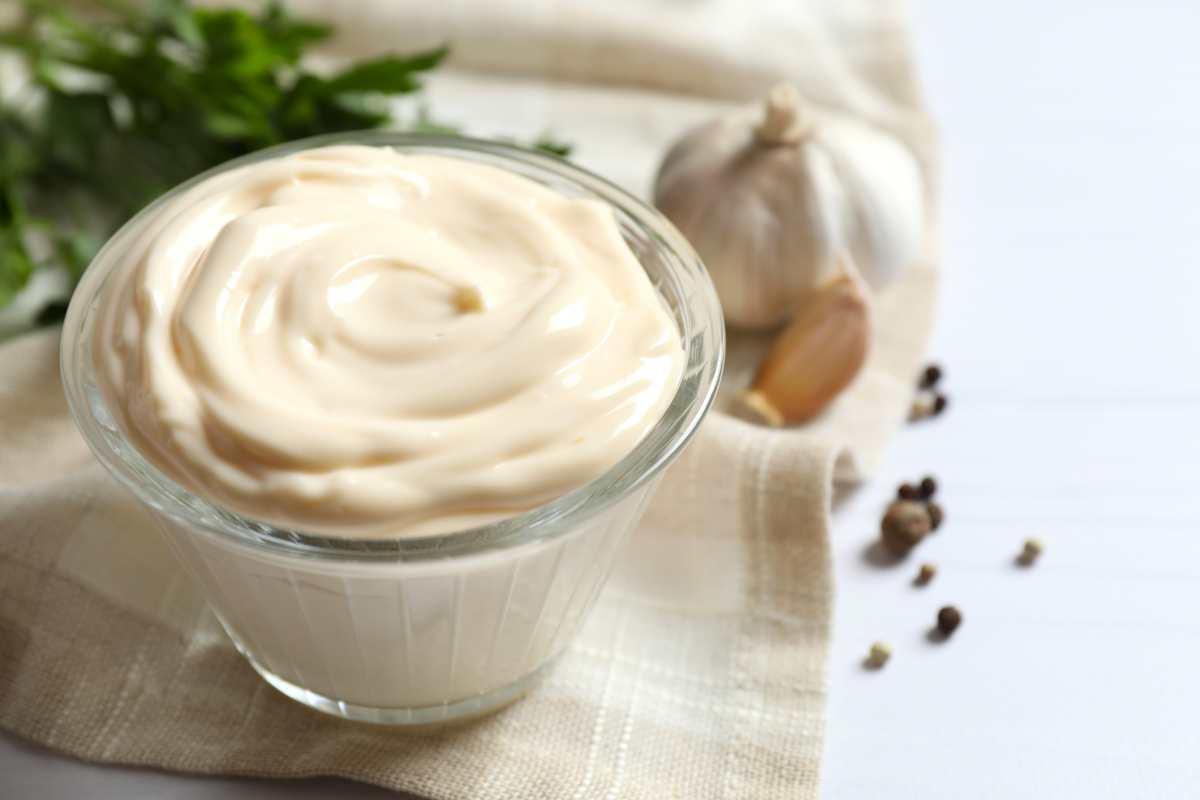
A bowl of mayonnaise sitting on a cloth
COLIS is a state-of-the-art light scattering setup on the International Space Station (ISS). Accommodated inside the Microgravity Science Glovebox (MSG) host facility, the facility enables astronauts aboard ISS to conduct experiments on proteins, gels, and glasses. It was used to test soft matter objects, including food, based on how they respond to microgravity and change.
National Geographic explains how a database of over 250 foods is prepared for the astronauts and is freeze-dried for space travel. Once these foods reach the ISS, and as the fundamental bounding force of gravity is stolen from them, they start behaving erratically. Over the years, astronauts on space missions have shared photos of crumbs swirling in space, liquids hanging in the air. During NASA's Gemini Program, freeze-dried foods included for the astronauts had a shelf life of two weeks.

An astronaut in a spacesuit.
In a video by NASA Johnson, astronaut Shane Kimbrough aboard ISS was scooping out jelly from a box, and a tortilla slathered with peanut butter floated around. Canadian Space Agency astronaut David Saint-Jacque demonstrated opening a box of honey. When he unscrewed the box and stretched the lid, a dollop of honey stretched into a twisty band that scurried mid-air, forming undulating shapes between the mouth of the box and its lid. The shelf life of honey doesn't change in the microgravity environment, but most of the other things, from breakfast burritos to burgers and biscuits, from creams to medicines, every item has its own shelf life and its own response to microgravity. Mayonnaise, too.
Born from the partnership between researchers from Politecnico di Milano and the Université de Montpellier, COLIS investigates the “speckle patterns” in soft matter items. It was developed by Redwire in Belgium for the European Space Agency (ESA). Roberto Piazza, a professor of Condensed Matter Physics, said in a press release that studying these materials in microgravity allows scientists to “isolate the effect of gravity, a silent but decisive force in how they change over time.” He added, “It’s amazing to see how much gravity, so familiar in our daily lives, acts behind the scenes to shape the materials we use every day."