
Germany’s Deadly Volcano Has Been Dormant For 13,000 Years. Scientists Have Now Detected Unrest
Published March 13 2026, 6:12 a.m. ET

Laacher See, also known as Lake Laach or Laach Lake, seen from the east, located in Germany.
Nestled in Western Germany's Eifel region, where the Rhine River rushes from the north to meet the southern waters of the Moselle River, is a bowl-shaped depression surrounded by wooded hills and vineyard-covered slopes. Within this valley at the center sits Laacher See, a large volcanic crater lake. The last eruption of the former Laacher volcano occurred about 13,000 years ago and is considered to be one of the most devastating events in European history.
On the surface, the volcanic basin is quiet, mysterious, and seemingly dead. But deep beneath the surface, it is agitating in pure unrest. About 5 to 7.5 miles deep into the dark innards of the volcanic basin, partially molten rock exists, and stress and pressure are slowly building up, indicating that a seemingly dormant caldera could open its mouth and awaken, as scientists documented in a recent study published in Geophysical Journal International.
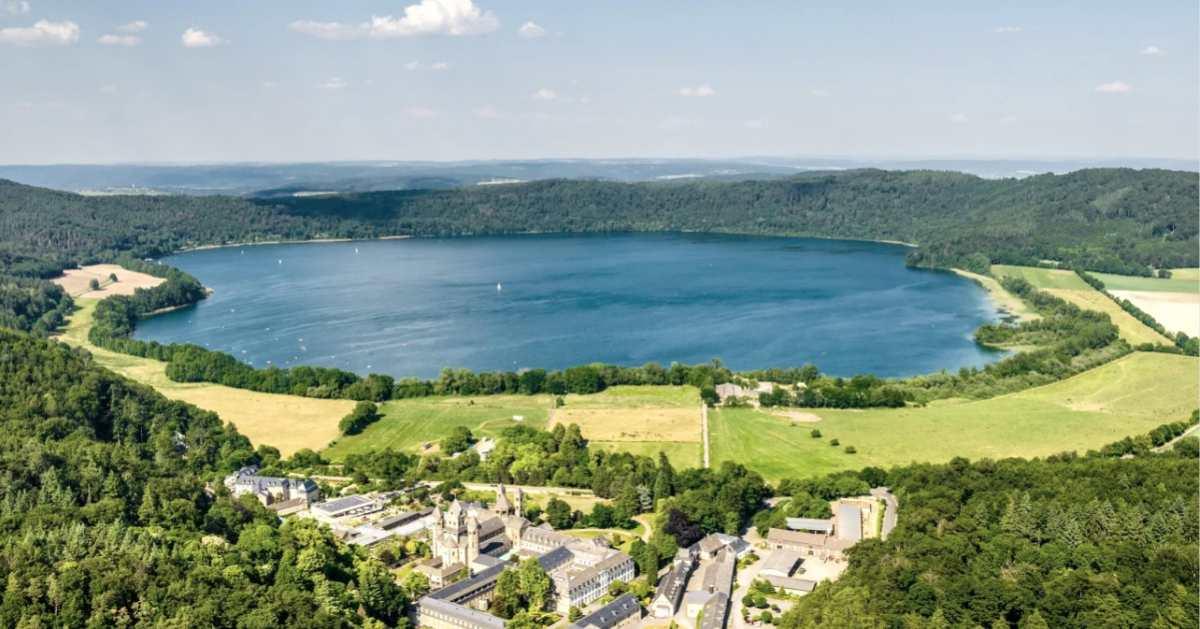
A scenic view of Lake Laach, a large volcanic crater lake in the Eifel region of Germany.
Part of the East Eifel Volcanic Field (EEVF), Laacher See’s dormant appearance has deceived scientists for decades, making them believe that it is a “sleeping giant,” unlikely to awaken in the near future. However, recent studies documenting the gas fluxes and fluid migrations suggested that the volcano might be stirring up into an awakening. The magma chambers crammed at the bottom could be sending the molten material rising to the surface, and the fluid channels might be activating. The movement of fluids through the crust could be triggering tremors, many of which have been detected by the team. They suspect that beneath the quiet surface lurks a system that is becoming intensely active due to the buildup of underground stress and pressure provoked by moving fluids.
Scientists utilized a suite of modern tools and contemporary methods to investigate the volcanic basin and churn out a wealth of details about its current status. Large-N seismic experiments were deployed, with thousands of tiny nodal seismometers examining the seismicity and analyzing the wavefields dancing across the volcanic field. Additionally, an interactive waveform visualization tool, snuffler, proved helpful. Gas studies and tomography images unraveled a vast magmatic reservoir hiding inside the volcanic field, slanting towards the basin. It was known from previous studies that a cylindrical rock sat beneath the surface, hiding amongst the hot mineral springs, but the latest study has added a new piece to the jigsaw puzzle. The study not only suggests the existence of this unusual rock but also a dimension of movement added to the rock.
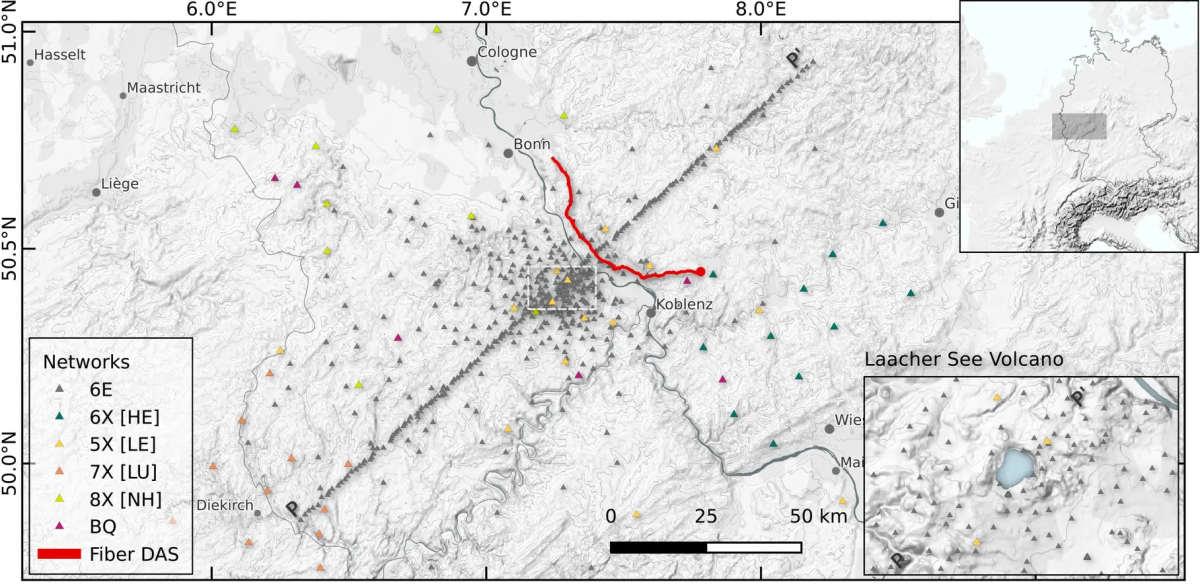
Location of the approximately 500 seismic stations that were installed in the Eifel region between September 2022 and August 2023 as part of the “Large-N Experiment” in order to obtain the highest possible resolution image of the magmatic subsurface. (Image Source: Marius Isken, GFZ (CC BY 4.0 Dahm et al. (2025); Seismica, Vol. 4 No. 2; doi.org/10.26443/seismica.v4i2.1492))
The study was led by Torsten Dahm of the GFZ Helmholtz Centre for Geosciences. "From the beginning of 2023, the rate of seismicity in our catalogue increased significantly," the researchers wrote, something that couldn’t be attributed solely to the external factors like weather conditions. The newly discovered reservoir turned up as the missing piece of the puzzle, the same anomaly that triggered the eruption 13,000 years ago. The researchers found more than 1,000 microquakes were localized in one year, most of them along a narrow, vertical zone between Ochtendung and Lake Laach. “The strength of the reflections indicates that fluids have accumulated in these layers. Whether these are magma or magmatic fluids has not yet been clarified and will be investigated using improved evaluation methods,” Dahm described in the press release.
The study, however, is limited by a lack of tomographic images of the upper crust and insufficient availability of data. As a result, it remains challenging to map the exact magmatic processes and carbon dioxide concentration in relation to the crustal stress. Perhaps a more advanced suite of instruments and deeper examination is required to solve the mystery and to fill the gaps in the riddling story of this sleeping giant.