
Geminid Meteor Shower Peaks Soon — and You Could See Hundreds of Shooting Stars in the Sky
Published Dec. 11 2025, 8:50 a.m. ET

Silhouette of a person standing under a sky filled with shooting stars
When comets come close to the Sun, the intense heat reduces them to gas, rock, and dust. When Earth orbits the Sun, it runs into this train of debris, sparking excitement and provoking rocks to race towards the Earth. At atmospheric entry, the rocks, called meteors, flare up and start emitting brilliant flashes of light that can resemble anything from sharp needle-like streaks to agitated fireballs, collectively dubbed “shooting stars.” Earth experiences dozens of meteor showers each year, including the Geminid Meteor Shower in December. This year’s Geminid Meteor Shower is already active and is anticipated to reach its peak between the late night of December 13 and the early morning of December 14, according to the American Meteor Society (AMS).
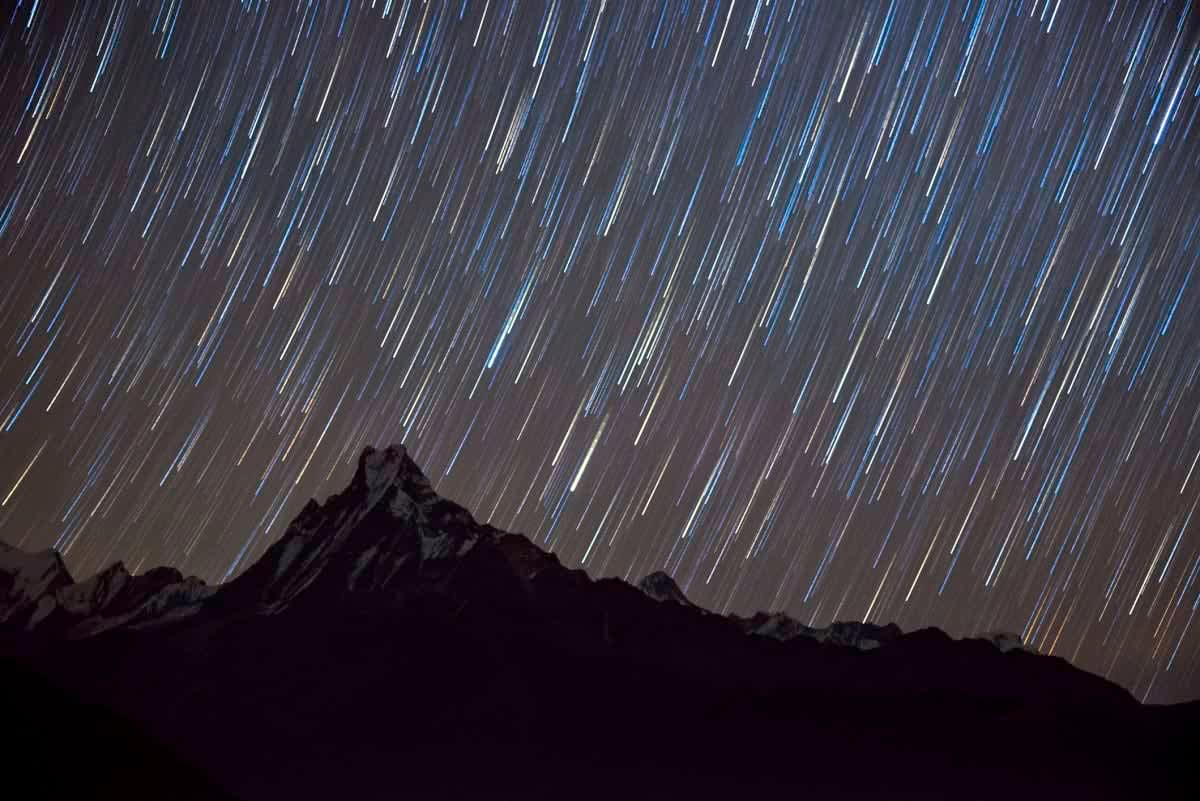
Brilliant spectacle formed by stars shooting sparkly streaks of light in the dark skies
The Geminids meteor shower is named after the Gemini constellation, which is the radiant point from where meteors emerge when they shoot towards the Earth. In conversation with The Guardian, Professor Jonti Horner, an astrophysicist at the University of Southern Queensland, shared that Geminids are the best annual meteor shower by far, with people able to see potentially dozens of meteors an hour. This year, the spectacular shooting star event became active on December 4 and is likely to dazzle the skies till December 17, per the AMS. The shower often brings along 50 to 100 meteors per hour, and could go up to 120 per hour during its peak period, according to NJ.com. On the other hand, NASA says the count is 40 to 50 meteors per hour. Expect glowing fireballs or streaks of light in green, purple, or amber hues.
Experts think it is going to be one of the most beautiful shooting star displays of this year. And scientists say, this is unlike any meteor shower observed before. While most meteor showers originate from comet tails, Geminids actually originate from the cluster of debris left over from asteroid 3200 Phaethon. According to Horner, the asteroid is named after the hero of Greek mythology, who was the son of the Sun god Helios.
Silhouette of a woman spreading her arms wide while standing under dark skies dazzling with the glitter of zillions of shooting stars
Another interesting thing about this year’s Geminid is that the waning crescent moon won’t wash out the starry light show, as it won't rise until the predawn hours when the shower is at its peak, per Space. Cloud cover could pose another obstruction to those viewing the shower. Experts, therefore, recommended choosing a location that is away from street lights, like a rural or suburban area. Visibility will be highly diminished in areas where there is heavy light pollution.
Additionally, there are two pointers experts have shared that can help you choose the best location for viewing the shooting stars spectacle. One tip is to locate the magnitude-1.58 star Castor using a smartphone astronomy app and find a patch of sky around 40 degrees above it. This is where the meteor trails will be at their longest, according to Space. Another tip is to look for Jupiter, which is quite close to the constellation Gemini. You may find it in the upper-right side of Jupiter. Like everyone else, Horner is excited to witness the annual celestial spectacle. “I would always rather stay up late than get up early, so for me I will stay up until I get too tired,” he said.