
Experts Put Listening Devices in the Ocean and Heard Mysterious Calls from Whales Rarely Seen Alive
Published Feb. 5 2026, 4:35 a.m. ET

One of the very few underwater photos ever taken of the elusive Baird's Beaked Whale.
In 2010, America documented the deadliest oil spill in history, about 41 miles off the coast of Louisiana in the Gulf of Mexico. An offshore rig exploded, and over the next 87 days, millions of barrels of oil leaked. This leaking oil seeped into the adjoining waters. Fish started dying. Corals were flattened to pulp. Those who survived developed injuries and diseases as the toxic fumes and chemicals in the oils choked their breath. The tragic blast wiped away a thumping 83% of the beaked whale population from the sea, enrolling their name in the list of top vulnerable species.
For years, scientists have been flocking to the same coast to understand these whales; however, being an elusive species, the mammals spend most of their lifetime in the dark depths, arriving at the surface in seldom moments, if at all. In a new study published in PLOS, scientists deployed an acoustic technology that enabled them to study their behaviors without disturbing them, without even seeing them, but just by listening to the sounds they make in their underwater dwelling.
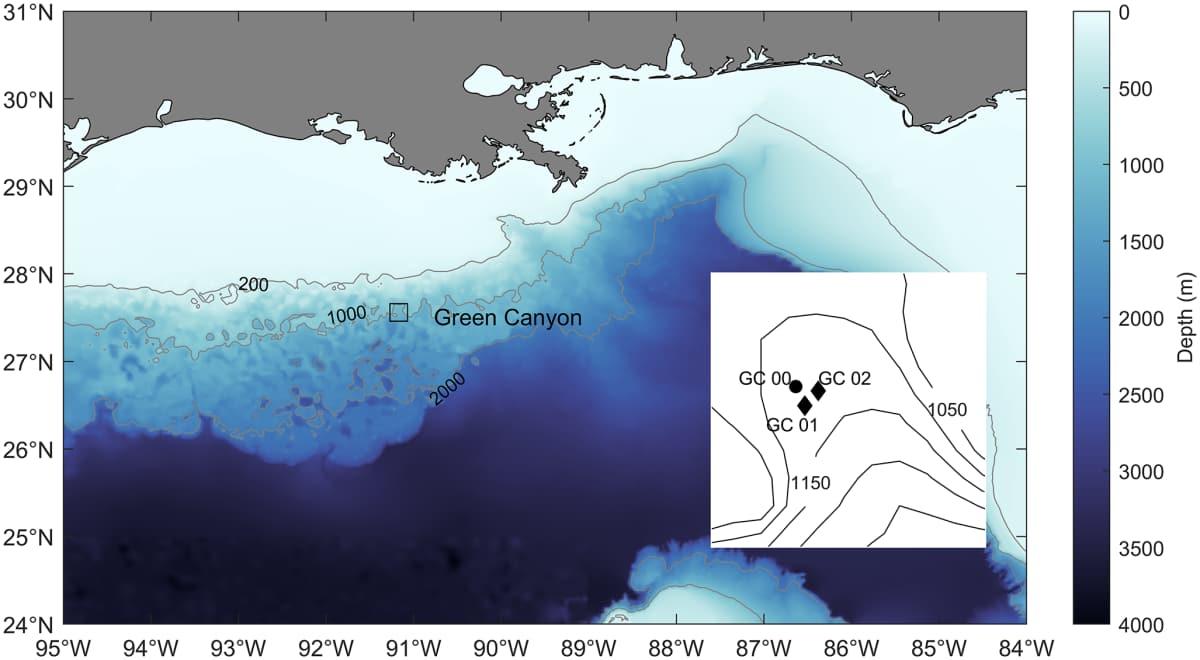
Gulf study site near Green Canyon (GC) where the tracking HARP array was deployed for acoustic tracking of beaked whales and recorded for 6 months.
Due to their reclusive nature, beaked whales remain one of the least understood whale species in the world. Methods like traditional visual surveys, distance-sampling techniques, and animal-borne tags have proved insufficient and unfeasible in tracking their movements, especially in offshore locations. In this study, the team used passive acoustics or 3D acoustic technology to track the diving and foraging behaviors of beaked whales residing off the coast of Louisiana, at a depth of approximately 3,600 feet. By laying out a network of bottom-mounted hydrophones, they tracked the different types of sounds whales make while they roam around interacting, hunting prey, and eating.
The acoustic monitoring technology deployed underwater listening systems that recorded whales’ species-specific echolocation clicks, distance from the seafloor, and time differences of arrival (TDOA) of signals across multiple acoustic receivers to estimate source locations. Two High-Frequency Acoustic Recording Packages (HARPs) equipped with multiple time-synchronized sensors were strapped to the seafloor, where they recorded the clicks and buzzes of beaked whales during 50 deep dives. Then came a little bit of math work.
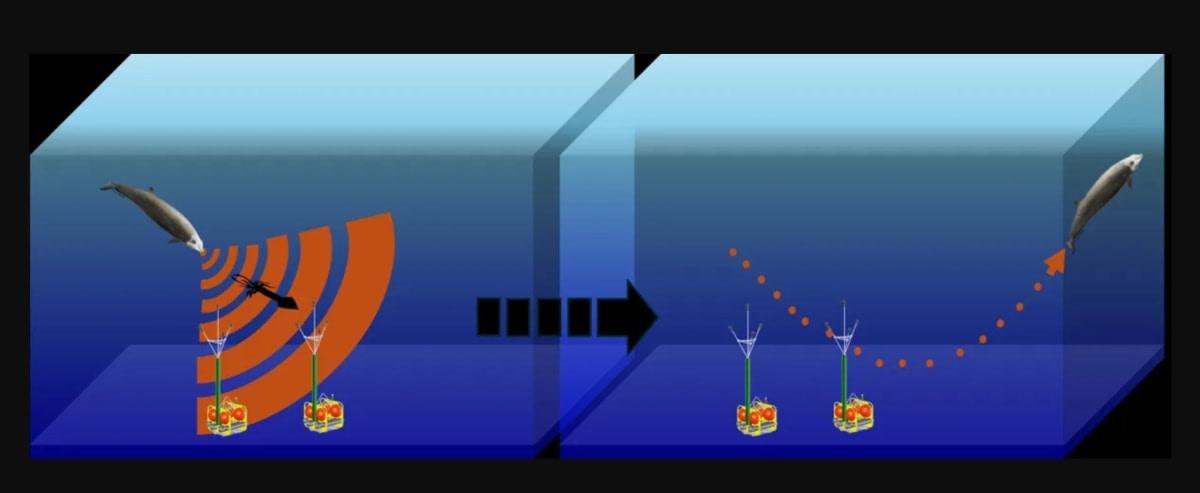
Echolocation clicks from a goose-beaked whale reach hydrophones at different times, revealing its 3D position and dive behavior while foraging.
The team measured tiny differences in the arrival times each click took to reach the individual sensors. From these time differences, they were able to estimate the direction of the sound sources. In the next step, the scientists combined data from both HARPs and constructed a three-dimensional picture of the underwater deep-diving movements of three species, including goose-beaked, Gervais, and Blainville’s beaked whales.
Goose-beaked whales spent longer times in foraging trips, about 20 minutes, as compared with Blainville’s, which spent nearly 14 minutes, and Gervais, which spent just under 13 minutes. Data also suggested that the three whale species foraged at different depths. Goose-beaked whales seemed to go all the way down to the seafloor to have their meals. Lead author and bioacoustics scientist at the University of Miami, Héloïse Frouin-Mouy, said, "This interpretation is consistent with stomach content analyses showing that goose-beaked whales prey on larger cephalopods, which are typically found at greater depths than the prey of other beaked whale species."
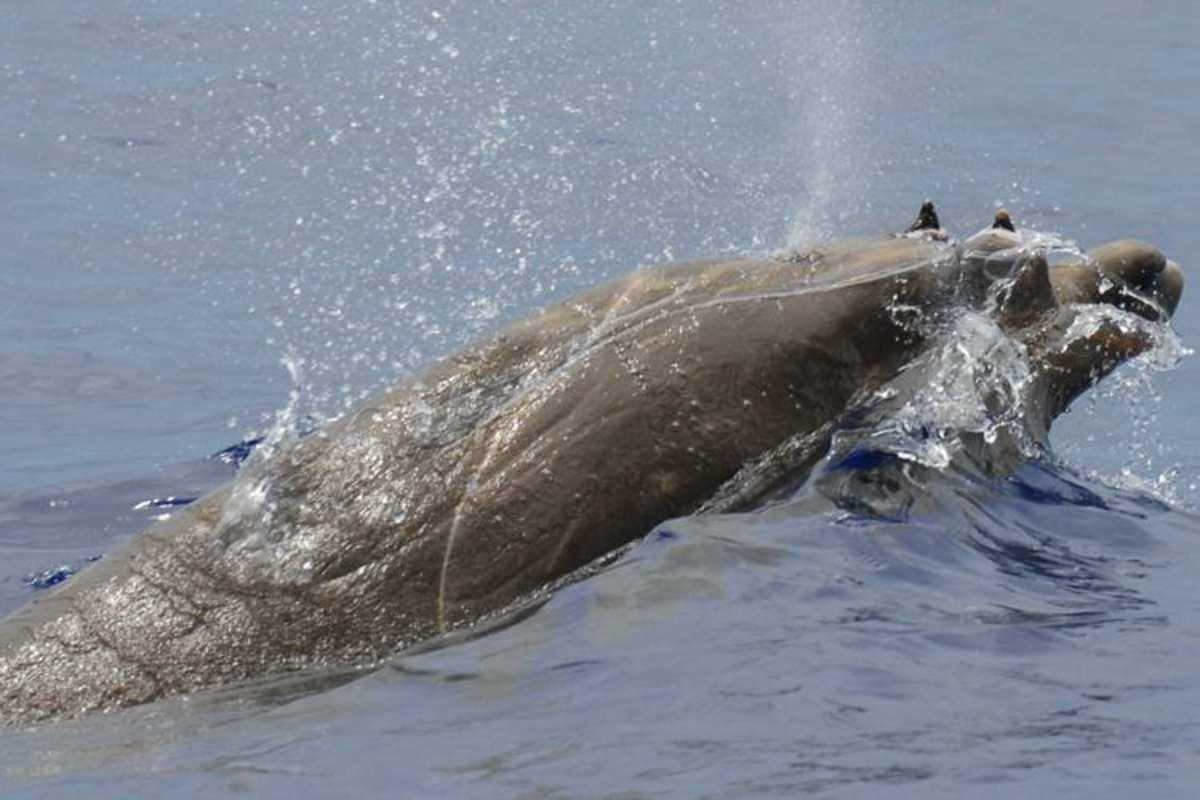
Head of a solitary adult male Blainville’s beaked whale showing the high bottom jaw line and the erupted teeth.
According to a press release, the study provides the “first detailed description of the deep-diving behavior of a Gervais’ beaked whale (Mesoplodon europaeus) anywhere in the world," which is not only fascinating but also noteworthy. For years, this species has been nearing the brink of decline, and scientists have felt an urgent need for reliable data on their behaviors. The work will also enable scientists to investigate the degree of suffering that whales are going through due to human stressors, such as chemical pollution, underwater noise, overfishing, mining, and general habitat degradation.